
Pulp Fiction, 1914 · page 19 of 258
The Argosy, August 1914 — page 19: what you’re looking at
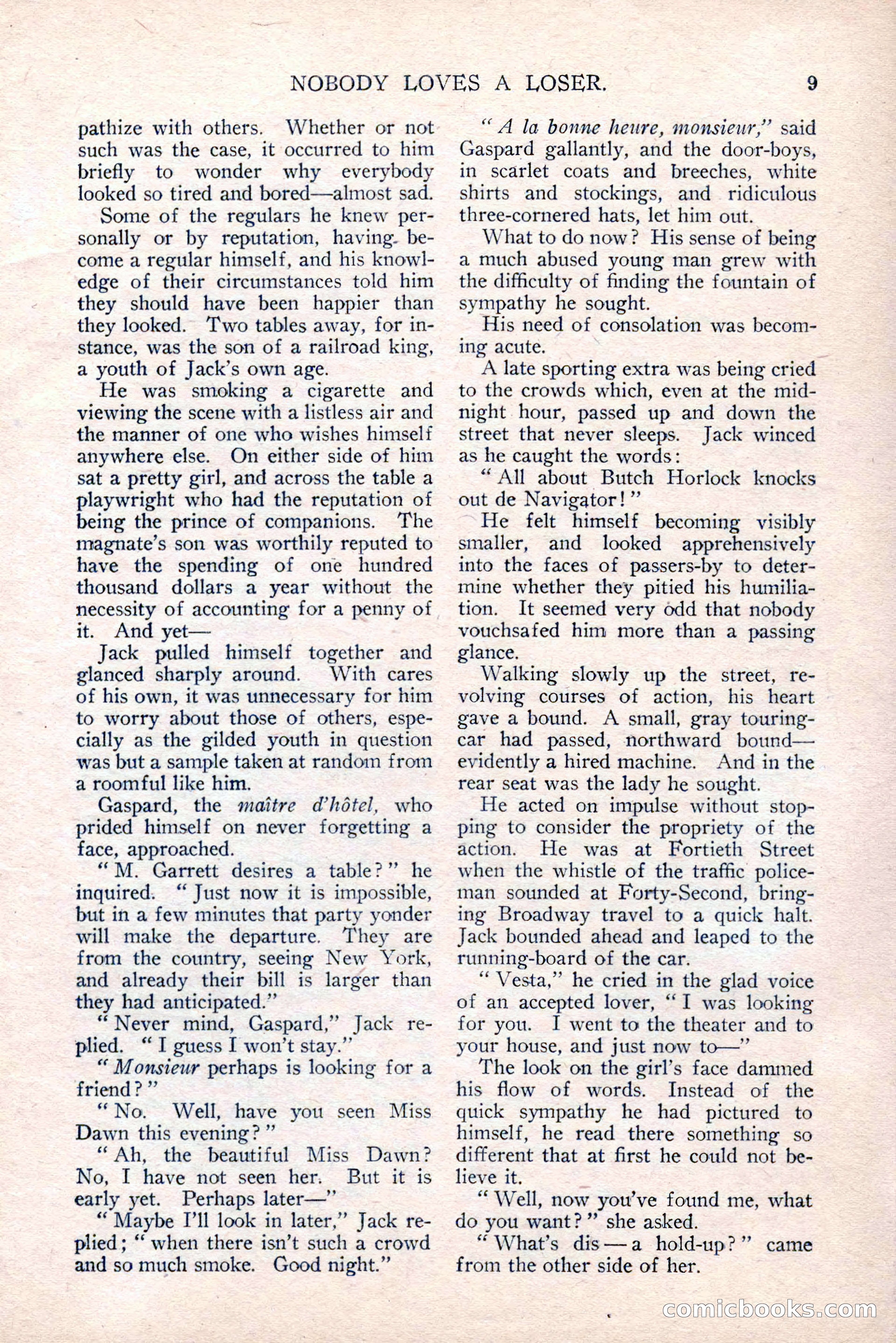
A restored page from Pulp Fiction, 1914. Page through the whole issue in the reader above.
📄 Transcribed text from this page (OCR, searchable)
Machine-transcribed from the original scan — historical spelling and the odd misread are preserved.
NOBODY LOVES A LOSER. 9 pathize with others. Whether or not such was the case, it occurred to him briefly to wonder why everybody looked so tired and bored—almost sad. Some of the regulars he knew per- sonally or by reputation, having. be- come a regular himself, and his knowl- edge of their circumstances told him they should have been happier than they looked. Two tables away, for in- stance, was the son of a railroad king, a youth of Jack’s own age. He was smoking a cigarette and viewing the scene with a listless air and the manner of one who wishes himself anywhere else. On either side of him sat a pretty girl, and across the table a playwright who had the reputation of being the prince of companions. The magnate’s son was worthily reputed to have the spending of one hundred thousand dollars a year without the necessity of accounting for a penny of it. And yet— Jack pulled himself together and glanced sharply around. With cares of his own, it was unnecessary for him to worry about those of others, espe- cially as the gilded youth in question was but a sample taken at random from a roomful like him. Gaspard, the maitre dhétel, who prided himself on never forgetting a face, approached. “M. Garrett desires a table?” he inquired. “ Just now it is impossible, but in a few minutes that party yonder will make the departure. They are from the country, seeing New York, and already their bill is larger than they had anticipated.” “Never mind, Gaspard,” Jack re- plied. “I guess I won't stay.”’ “ Monsieur perhaps is looking for a friend?” “No. Well, have you seen Miss Dawn this evening? ” ‘Ah, the beautiful Miss Dawn? No, I have not seen her. But it is early yet. Perhaps later—” “ Maybe I’ll look in later,” Jack re- plied; “‘ when there isn’t such a crowd and so much smoke. Good night.” “A la bonne heure, monsieur,” said Gaspard gallantly, and the door-boys, in scarlet coats and breeches, white shirts and stockings, and_ ridiculous three-cornered hats, let him out. What to do now? His sense of being a much abused young man grew with the difficulty of finding the fountain of sympathy he sought. His need of consolation was becom- ing acute. A late sporting extra was being cried to the crowds which, even at the mid- night hour, passed up and down the street that never sleeps. Jack winced as he caught the words: “All about Butch Horlock knocks out de Navigator!” He felt himself becoming visibly smaller, and looked apprehensively into the faces of passers-by to deter- mine whether they pitied his humilia- tion. It seemed very odd that nobody vouchsafed him more than a passing glance. Walking slowly up the street, re- volving courses of action, his heart gave a bound. A small, gray touring- car had passed, northward bound— evidently a hired machine. And in the rear seat was the lady he sought. He acted on impulse without stop- ping to consider the propriety of the action. He was at Fortieth Street when the whistle of the traffic police- man sounded at Forty-Second, bring- ing Broadway travel to a quick halt. Jack bounded ahead and leaped to the running-board of the car. Vesta,” he cried in the glad voice of an accepted lover, “I was looking for you. I went to the theater and to your house, and just now to—” The look on the girl’s face dammed his flow of words. Instead of the quick sympathy he had pictured to himself, he read there something so different that at first he could not be- lieve it. “Well, now you’ve found me, what do you want?” she asked. “What's dis—a hold-up?” came from the other side of her. COMMICGLOOOKS (S@)