
Pulp Fiction, 1914 · page 127 of 258
The Argosy, August 1914 — page 127: what you’re looking at
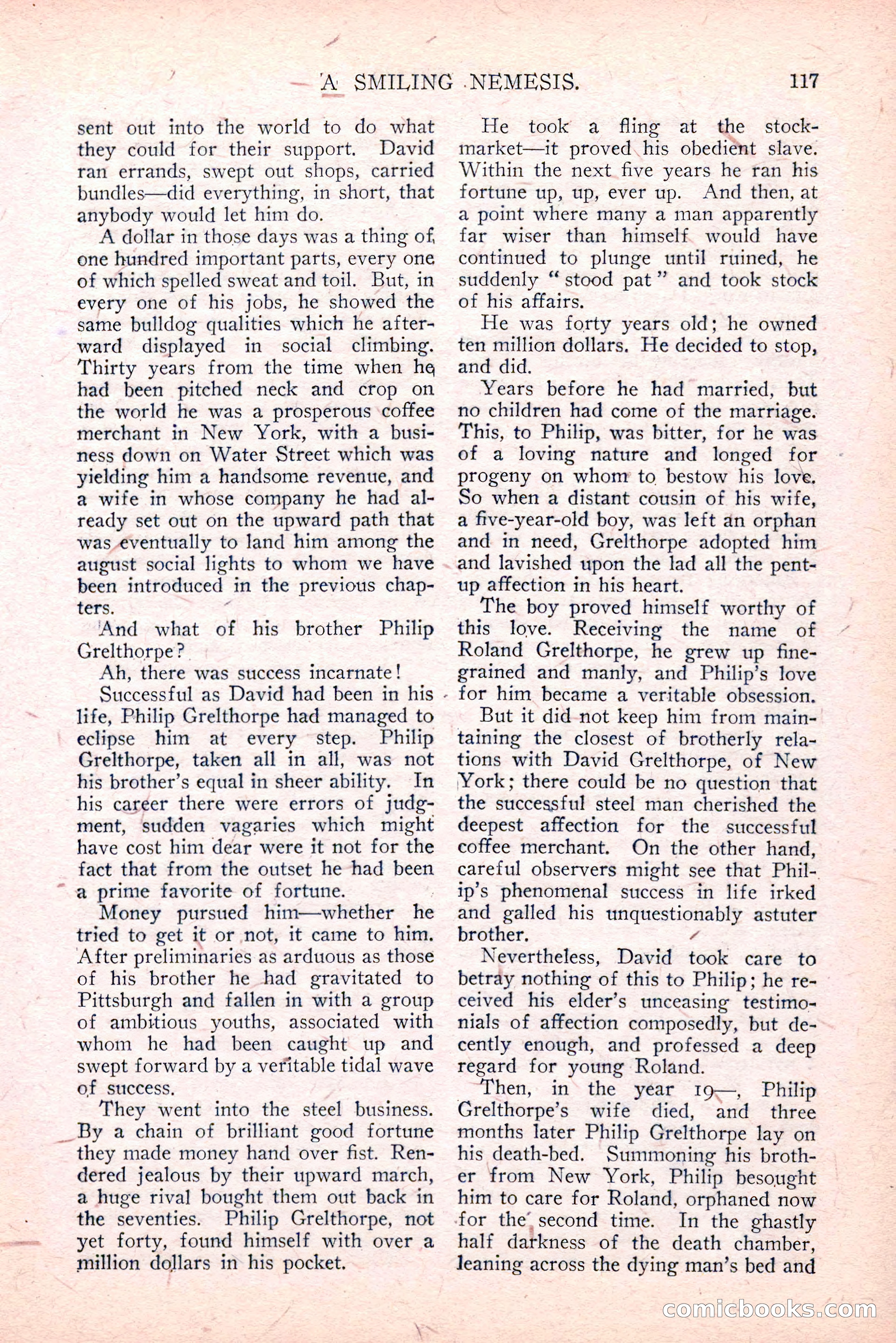
A restored page from Pulp Fiction, 1914. Page through the whole issue in the reader above.
📄 Transcribed text from this page (OCR, searchable)
Machine-transcribed from the original scan — historical spelling and the odd misread are preserved.
‘A SMILING .NEMESIS. sent out into the world to do what they could for their support. David ran errands, swept out shops, carried bundles—did everything, in short, that anybody would let him do. A dollar in those days was a thing of, one hundred important parts, every one of which spelled sweat and toil. But, in every one of his jobs, he showed the same bulldog qualities which he after- ward displayed in social climbing. Thirty years from the time when he had been pitched neck and crop on the world he was a prosperous coffee merchant in New York, with a busi- ness down on Water Street which was yielding him a handsome revenue, and a wife in whose company he had al- ready set out on the upward path that was €ventually to land him among the august social lights to whom we have been introduced in the previous chap- ters. And what of his brother Philip Grelthorpe? Ah, there was success incarnate! Successful as David had been in his - life, Philip Grelthorpe had managed to eclipse him at every step. Philip Grelthorpe, taken all in all, was not his brother’s equal in sheer ability. In his career there were errors of judg- ment, sudden vagaries which might have cost him dear were it not for the fact that from the outset he had been “a prime favorite of fortune. Money pursued him—whether he tried to get it or not, it came to him. After preliminaries as arduous as those of his brother he had gravitated to Pittsburgh and fallen in with a group of ambitious youths, associated with whom he had been caught up and swept forward by a veritable tidal wave of success. They went into the steel business. __By a chain of brilliant good fortune they made money hand over fist. Ren- dered jealous by their upward march, a huge rival bought them out back in the seventies. Philip Grelthorpe, not yet forty, found himself with over a million dollars in his pocket. for the second time. 117 He took a fling at the stock- market—it proved his obediént slave. Within the next five years he ran his fortune up, up, ever up. And then, at a point where many a man apparently far wiser than himself would have continued to plunge until ruined, he suddenly “stood pat” and took stock of his affairs. He was forty years old; he owned ten million dollars. He decided to stop, and did. Years before he had married, but no children had come of the marriage. This, to Philip, was bitter, for he was of a loving nature and longed for progeny on whom to bestow his love. So when a distant cousin of his wife, a five-year-old boy, was left an orphan and in need, Grelthorpe adopted him and lavished upon the lad all the pent- up affection in his heart. The boy proved himself worthy of this love. Receiving the name of Roland Grelthorpe, he grew up fine- grained and manly, and Philip’s love for him became a veritable obsession. But it did-not keep him from main- taining the closest of brotherly rela- tions with David Grelthorpe, of New York; there could be no question that the successful steel man cherished the deepest affection for the successful coffee merchant. On the other hand, careful observers might see that Phil- ip’s phenomenal success in life irked and galled his unquestionably astuter brother. ¢ Nevertheless, David took care to betray nothing of this to Philip; he re- ceived his elder’s unceasing testimo- nials of affection composedly, but de- cently enough, and professed a deep regard for young Roland. Then, in’ the yéar 19, Philip Grelthorpe’s wife died, and _ three months later Philip Grelthorpe lay on his death-bed. Summoning his broth- er from New York, Philip besought him to care for Roland, orphaned now In the ghastly half darkness of the death chamber, leaning across the dying man’s bed and COMMICLOOokKs (C@)