
Pulp Fiction, 1914 · page 125 of 258
The Argosy, August 1914 — page 125: what you’re looking at
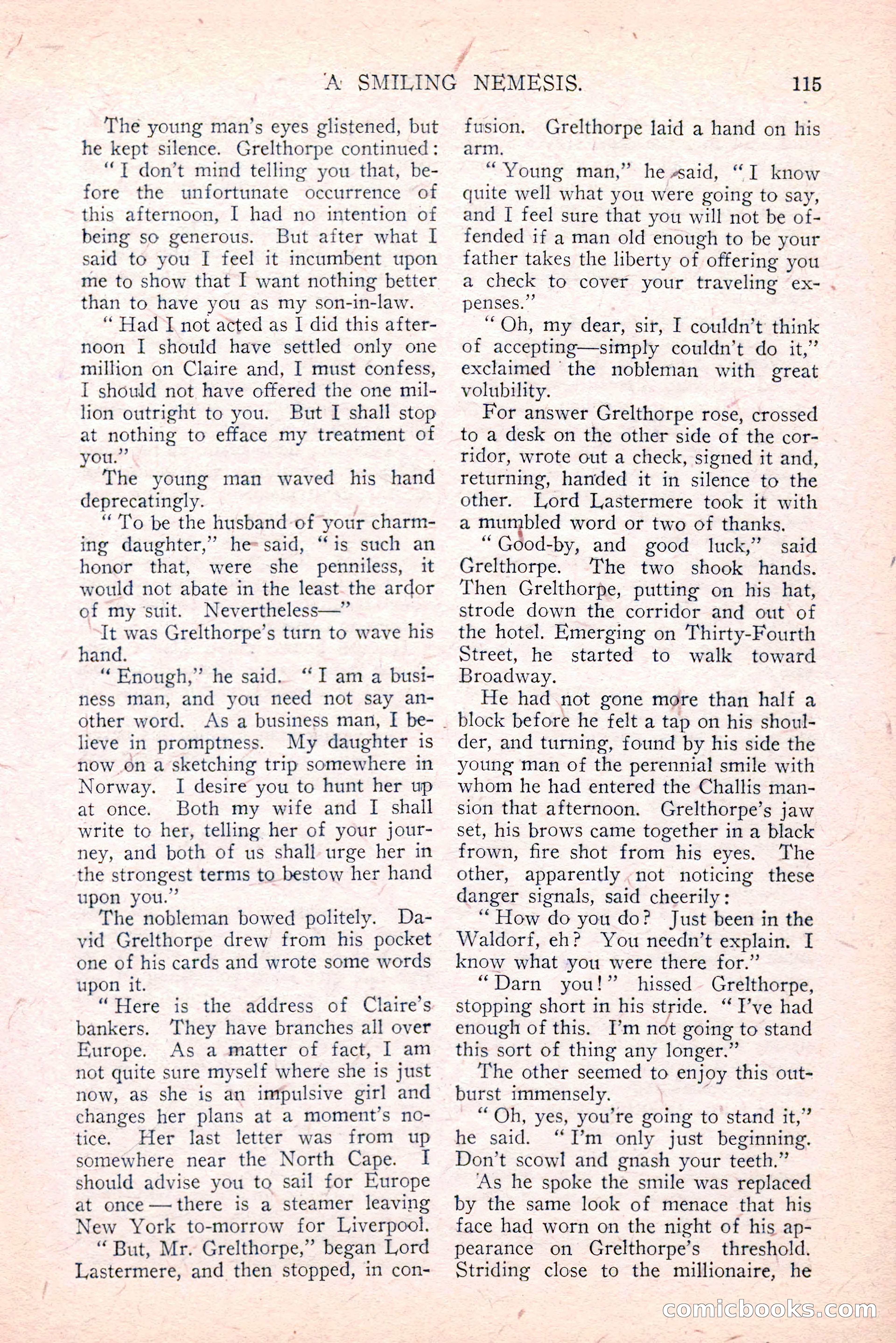
A restored page from Pulp Fiction, 1914. Page through the whole issue in the reader above.
📄 Transcribed text from this page (OCR, searchable)
Machine-transcribed from the original scan — historical spelling and the odd misread are preserved.
A: SMILING NEMESIS. The young man’s eyes glistened, but he kept silence. Grelthorpe continued: “T don’t mind telling you that, be- fore the unfortunate occurrence of this afternoon, I had no intention of being so generous. But after what I said to you I feel it incumbent upon me to show that I want nothing better than to have you as my son-in-law. “ Had I not acted as I did this after- noon I should have settled only one million on Claire and, I must confess, I should not have offered the one mil- lion outright to you. But I shall stop at nothing to efface my treatment of you.” | The young man waved his hand deprecatingly. “To be the husband of your charm- ing daughter,” he said, “is such an honor that, were she penniless, it would not abate in the least. the ardor of my ‘suit. Nevertheless—” It was Grelthorpe’s turn to wave his hand. “Enough,” he said. “I am a busi- ness man, and you need not say an- other word. lieve in promptness. My daughter is now on a sketching trip somewhere in Norway. I desire you to hunt her up at once. Both my wife and I shall write to her, telling her of your jour- ney, and both of us shall urge her in the strongest terms to bestow her hand upon you.” The nobleman bowed politely. Da- vid Grelthorpe drew from his pocket one of his cards and wrote some words upon it. “Here is the address of Claire’s bankers. They have branches all over Europe. As a matter of fact, I am not quite sure myself where she is just now, as she is an impulsive girl and changes her plans at a moment’s no- tice. Her last letter was from up somewhere near the North Cape. I should advise you to sail for Europe at once — there is a steamer leaving New York to-morrow for Liverpool. “But, Mr. Grelthorpe,” began Lord Lastermere, and then stopped, in con- As a business man, [ be- - J 115 fusion. Grelthorpe laid a hand on his arm. “Young man,” he said, “I know quite well what you were going to say, and I feel sure that you will not be of- fended if a man old enough to be your father takes the liberty of offering you a check to cover your traveling ex- . penses.” “Oh, my dear, sir, I couldn’t think of accepting—simply couldn’t do it,” exclaimed ‘the nobleman with great volubility. For answer Grelthorpe rose, crossed to a desk on the other side of the cor- ridor, wrote out a check, signed it and, returning, handed it in silence to the other. Lord Lastermere took it with a mumbled word or two of thanks. ‘“ Good-by, and good luck,” said Grelthorpe. The two shook hands. Then Grelthorpe, putting on his hat, strode down the corridor and out of the hotel. Emerging on Thirty-Fourth Street, he started to walk toward Broadway. He had not gone more than half a block before he felt a tap on his shoul- der, and turning, found by his side the young man of the perennial smile with whom he had entered the Challis man- sion that afternoon. Grelthorpe’s jaw set, his brows came together in a black frown, fire shot from his eyes. The other, apparently not noticing these danger signals, said cheerily: “How do you do? Just been in the Waldorf, eh? You needn’t explain. I know what you were there for.” “Darn you!” hissed Grelthorpe, stopping short in his stride. “‘ I’ve had enough of this. I’m not going to stand this sort of thing any longer.” The other seemed to enjoy this out- burst immensely. “Oh, yes, you’re going to stand it,” he said. “I’m only just beginning. Don’t scowl and gnash your teeth.” As he spoke the smile was replaced by the same look of menace that his face had worn on the night of his ap- pearance on Grelthorpe’s threshold. Striding close to the millionaire, he CORmMICLOOOKS a. (C@