
Pulp Fiction, 1914 · page 112 of 258
The Argosy, August 1914 — page 112: what you’re looking at
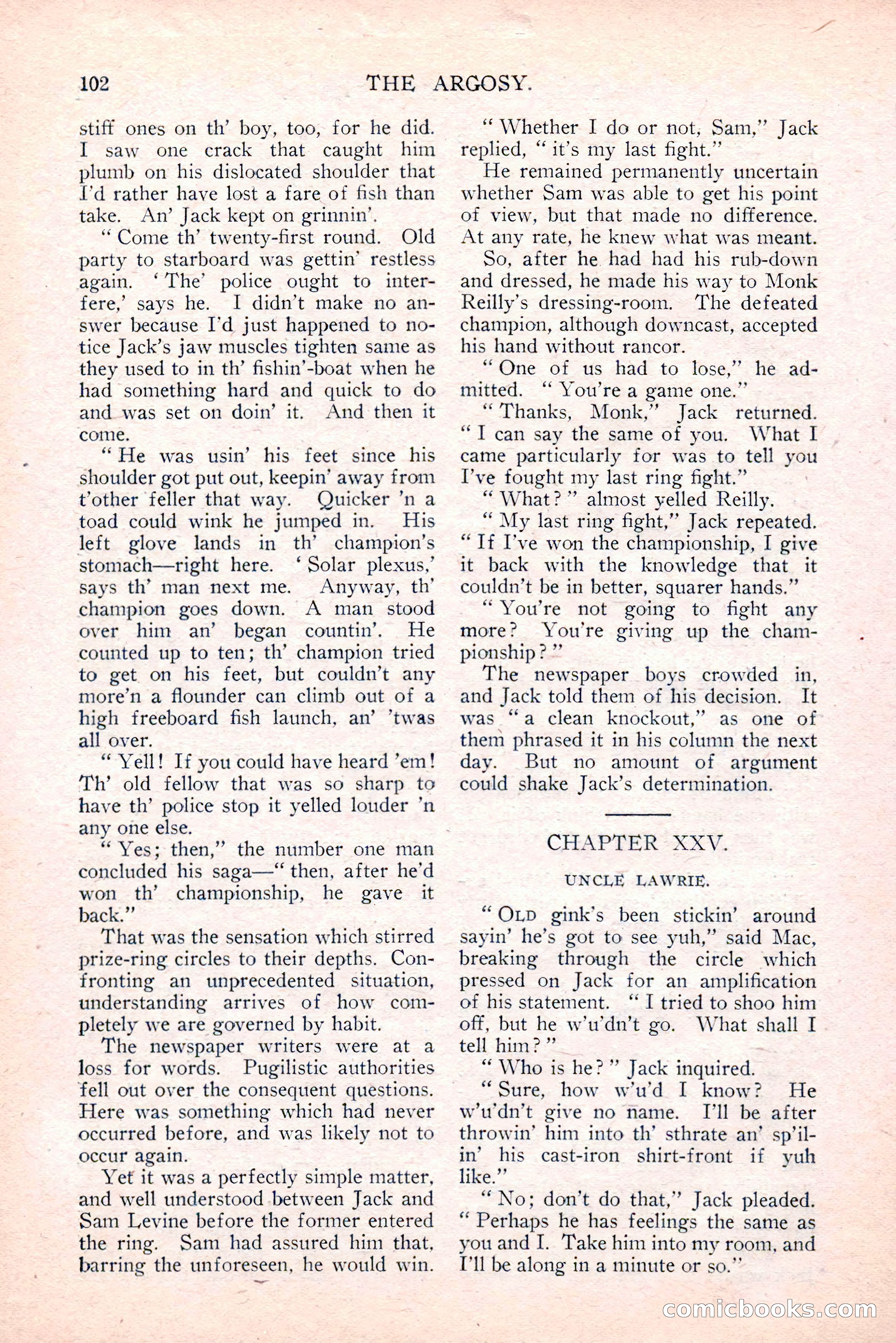
A restored page from Pulp Fiction, 1914. Page through the whole issue in the reader above.
📄 Transcribed text from this page (OCR, searchable)
Machine-transcribed from the original scan — historical spelling and the odd misread are preserved.
102 stiff ones on th’ boy, too, for he did. I saw one crack that caught him plumb on his dislocated shoulder that I'd rather have lost a fare of fish than take. An’ Jack kept on grinnin’, “Come th’ twenty-first round. Old party to starboard was gettin’ restless again. ‘The’ police ought to inter- fere,’ says he. I didn’t make no an- swer because I'd just happened to no- tice Jack’s jaw muscles tighten same as they used to in th’ fishin’-boat when he had something hard and quick to do and was set on doin’ it. And then it come. “He was usin’ his feet since his shoulder got put out, keepin’ away from t’other feller that way. Quicker ’n a toad could wink he jumped in. His left glove lands in th’ champion’s stomach—tright here. ‘Solar plexus,’ says th’ man next me. Anyway, th’ champion goes down. A man stood over him an’ began countin’. He counted up to ten; th’ champion tried to get on his feet, but couldn’t any more’n a flounder can climb out of a high freeboard fish launch, an’ ’twas all over. “Yell! If you could have heard ’em! Th’ old fellow that was so sharp to have th’ police stop it yelled louder ’n any one else. “Yes; then,” the number one man concluded his saga—‘‘ then, after he'd won th’ championship, he gave it back.” That was the sensation which stirred prize-ring circles to their depths. Con- fronting an unprecedented situation, understanding arrives of how com- pletely we are governed by habit. The newspaper writers were at a loss for words. Pugilistic authorities fell out over the consequent questions. Here was something which had never occurred before, and was likely not to occur again. Yet it was a perfectly simple matter, and well understood between Jack and Sam Levine before the former entered the ring. Sam had assured him that, barring the unforeseen, he would win. — THE ARGOSY. “Whether I do or not, Sam,” Jack replied, “it’s my last fight.”’ He remained permanently uncertain whether Sam was able to get his point of view, but that made no difference. At any rate, he knew what was meant. So, after he had had his rub-down and dressed, he made his way to Monk Reilly’s dressing-room. ‘The defeated champion, although downcast, accepted his hand without rancor. “One of us had to lose,” he ad- mitted. ‘ You’re a game one.” ‘Thanks, Monk,’ Jack returned. “T can say the same of you. What I came particularly for was to tell you I’ve fought my last ring fight.” “What?” almost yelled Reilly. “ My last ring fight,” Jack repeated. “Tf I’ve won the championship, I give it back with the knowledge that it couldn’t be in better, squarer hands.” “You're not going to fight any more? You're giving up the cham- pionship ? ””’ The newspaper boys crowded in, and Jack told them of his decision. It was “a clean knockout,” as one of them phrased it in his column the next day. But no amount of argument could shake Jack’s determination. CHAPTER XXV. UNCLE LAWRIE. “Op gink’s been stickin’ around sayin’ he’s got to see yuh,” said Mac, breaking through the circle which pressed on Jack for an amplification of his statement. ‘ I tried to shoo him off, but he w’u’dn’t go. What shall I tell him?” “Who is he?” Jack inquired. “Sure, how w’u’d I know? He w'u'dn’t give no name. I'll be after throwin’ him into th’ sthrate an’ sp’il- in’ his cast-iron shirt-front if yuh like.” “No; don’t do that,’ Jack pleaded. “Perhaps he has feelings the same as you and I. Take him into my room, and [ll be along in a minute or so.”’ CORMICLOOOkKS (C@)