
Pulp Fiction, 1914 · page 108 of 258
The Argosy, August 1914 — page 108: what you’re looking at
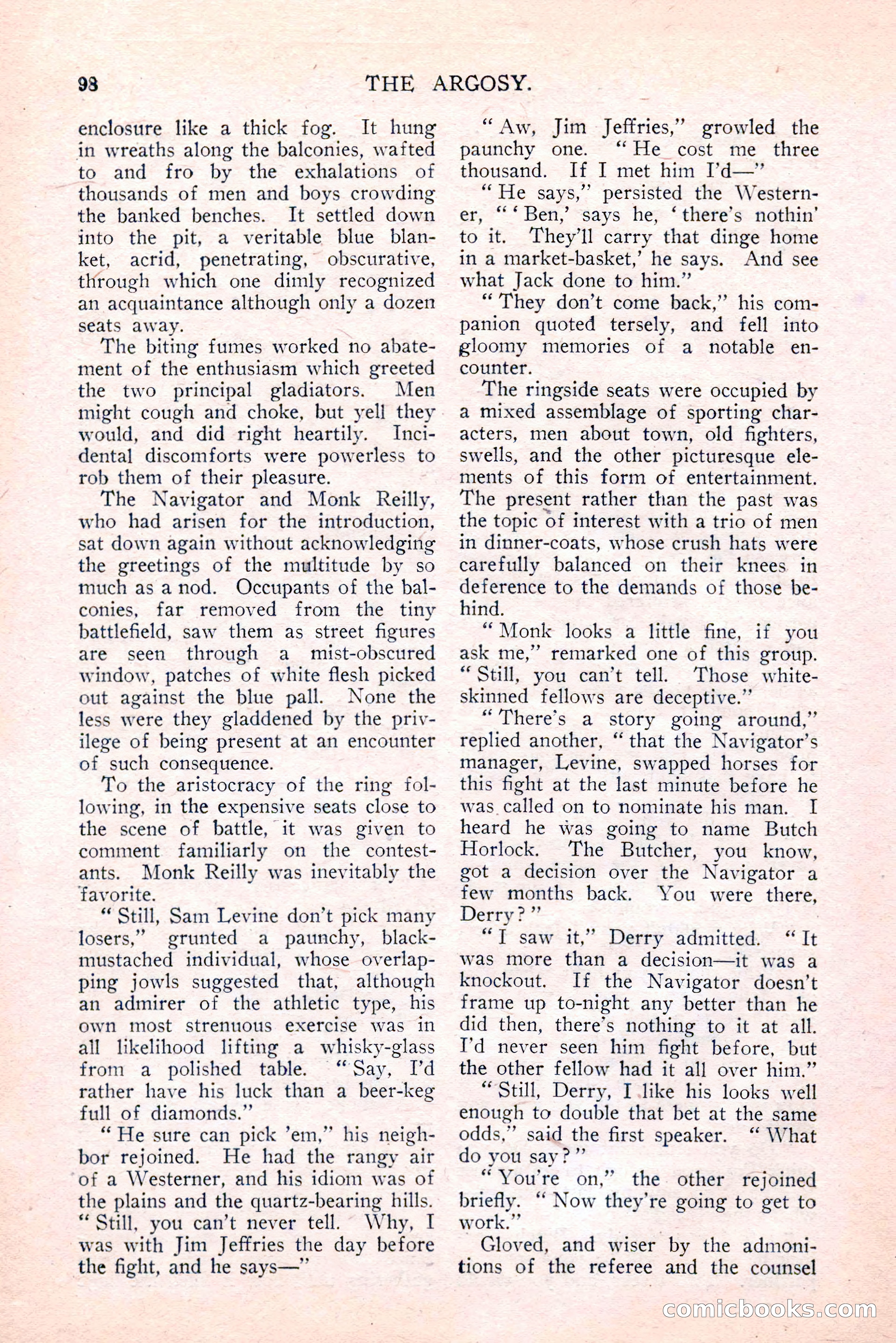
A restored page from Pulp Fiction, 1914. Page through the whole issue in the reader above.
📄 Transcribed text from this page (OCR, searchable)
Machine-transcribed from the original scan — historical spelling and the odd misread are preserved.
98 enclosure like a thick fog. It hung in wreaths along the balconies, wafted to and fro by the exhalations of thousands of men and boys crowding the banked benches. It settled down into the pit, a veritable blue blan- ket, acrid, penetrating, obscurative, through which one dimly recognized an acquaintance although only a dozen seats away. The biting fumes worked no abate- ment of the enthusiasm which greeted the two principal gladiators. Men might cough and choke, but yell they would, and did right heartily. Inci- dental discomforts were powerless to rob them of their pleasure. The Navigator and Monk Reilly, who had arisen for the introduction, sat down again without acknowledging the greetings of the multitude by so much as anod. Occupants of the bal- conies, far removed from the tiny battlefield, saw them as street figures are seen through a _ mist-obscured window, patches of white flesh picked out against the blue pall. None the less were they gladdened by the priv- ilege of being present at an encounter of such consequence. To the aristocracy of the ring fol- lowing, in the expensive seats close to the scene of battle, it was given to comment familiarly on the contest- ants. Monk Reilly was inevitably the favorite. Still, Sam Levine don’t pick many losers,” grunted a paunchy, black- mustached individual, whose overlap- ping jowls suggested that, although an admirer of the athletic type, his own most strenuous exercise was in all likelihood lifting a whisky-glass from a polished table. “Say, [d rather have his luck than a beer-keg full of diamonds.” “ He sure can pick ’em,” his neigh- bor rejoined. He had the rangy air of a Westerner, and his idiom was of the plains and the quartz-bearing hills. * Still, you can’t never tell.“ Why, I was with Jim Jeffries the day before the fight, and he says—”’ THE ARGOSY. “Aw, Jim Jeffries,’ growled the paunchy one. “He cost me three thousand. If I met him I’d—” “He says,’ persisted the Western- er, “* Ben,’ says he, ‘there’s nothin’ to it. They'll carry that dinge home in a market-basket,’ he says. And see what Jack done to him.” “They don’t come back,’ his com- panion quoted tersely, and fell into gloomy memories of a notable en- counter. The ringside seats were occupied by a mixed assemblage of sporting char- acters, men about town, old fighters, swells, and the other picturesque ele- ments of this form of entertainment. The present rather than the past was the topic of interest with a trio of men in dinner-coats, whose crush hats were carefully balanced on their knees in deference to the demands of those be- hind. “Monk looks a little fine, if you ask me,” remarked one of this group. * Still, you can’t tell. Those white- skinned fellows are deceptive.” “There’s a story going around,” replied another, “that the Navigator’s manager, Levine, swapped horses for this fight at the last minute before he was called on to nominate his man. I heard he was going to name Butch Horlock. The Butcher, you know, got a decision over the Navigator a few months back. You were there, Derry? ”’ . “JT saw it,” Derry admitted. “It was more than a decision—it was a knockout. If the Navigator doesn’t frame up to-night any better than he did then, there’s nothing to it at all. I'd never seen him fight before, but the other fellow had it all over him.” “Still, Derry, I like his looks well enough to double that bet at the same odds,” said the first speaker. ‘“ What do you say?” “You're on,” the other rejoined briefly. “ Now they’re going to get to work.” 3 Gloved, and wiser by the admoni- tions of the referee and the counsel S ECOMMICLOO® (C@