
Pulp Fiction, 1914 · page 81 of 268
The Argosy, Vol. 75, No. 4 — page 81: what you’re looking at
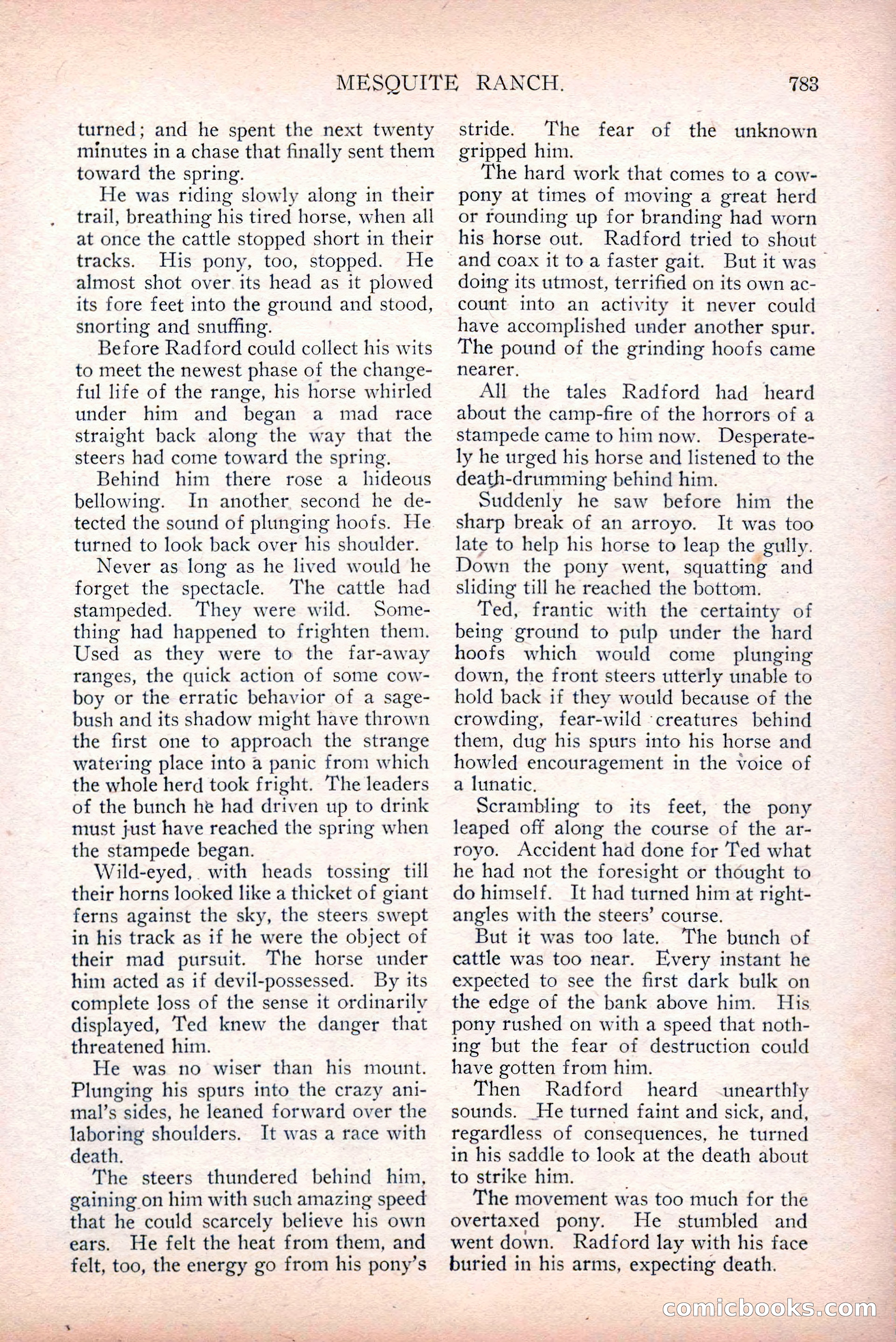
A restored page from Pulp Fiction, 1914. Page through the whole issue in the reader above.
📄 Transcribed text from this page (OCR, searchable)
Machine-transcribed from the original scan — historical spelling and the odd misread are preserved.
MESQUITE RANCH. turned; and he spent the next twenty minutes in a chase that finally sent them toward the spring. He was riding slowly along in their trail, breathing his tired horse, when all at once the cattle stopped short in their tracks. His pony, too, stopped. He almost shot over its head as it plowed its fore feet into the ground and stood, snorting and snuffing. Before Radford could collect his wits to meet the newest phase of the change- ful life of the range, his horse whirled under him and began a mad _ race straight back along the way that the steers had come toward the spring. Behind him there rose a_ hideous bellowing. In another second he de- tected the sound of plunging hoofs. He turned to look back over his shoulder. Never as long as he lived would he forget the spectacle. The cattle had stampeded. ‘They were wild. Some- thing had happened to frighten them. Used as they were to the far-away ranges, the quick action of some cow- boy or the erratic behavior of a sage- bush and its shadow might have thrown the first one to approach the strange watering place into a panic from which the whole herd took fright. The leaders of the bunch he had driven up to drink must just have reached the spring when the stampede began. Wild-eyed,. with heads tossing till their horns looked like a thicket of giant ferns against the sky, the steers swept in his track as if he were the object of their mad pursuit. The horse under him acted as if devil-possessed. By its complete loss of the sense it ordinarily displayed, Ted knew the danger that threatened him. He was no wiser than his mount. Plunging his spurs into the crazy ani- mal’s sides, he leaned forward over the laboring shoulders. It was a race with death. The steers thundered behind him, gaining on him with such amazing speed that he could scarcely believe his own ears. He felt the heat from them, and felt, too, the energy go from his pony’s 783 stride. The fear of the unknown gripped him. The hard work that comes to a cow- pony at times of moving a great herd or rounding up for branding had worn his horse out. Radford tried to shout and coax it to a faster gait. doing its utmost, terrified on its own ac- count into an activity it never could have accomplished under another spur. The pound of the grinding hoofs came nearer. All the tales Radford had heard about the camp-fire of the horrors of a stampede came to him now. Desperate- ly he urged his horse and listened to the death-drumming behind him. Suddenly he saw before him the sharp break of an arroyo. It was too late to help his horse to leap the gully. Down the pony went, squatting and sliding till he reached the bottom. Ted, frantic with the certainty of being ground to pulp under the hard hoofs which would come plunging down, the front steers utterly unable to hold back if they would because of the crowding, fear-wild creatures behind them, dug his spurs into his horse and howled encouragement in the voice of a lunatic. Scrambling to its feet, the pony leaped off along the course of the ar- royo. Accident had done for Ted what he had not the foresight or thought to do himself. It had turned him at right- angles with the steers’ course. But it was too late. The bunch of cattle was too near. Every instant he expected to see the first dark bulk on the edge of the bank above him. His pony rushed on with a speed that noth- ing but the fear of destruction could have gotten from him. Then Radford heard -unearthly sounds. He turned faint and sick, and, regardless of consequences, he turned in his saddle to look at the death about to strike him. The movement was too much for the overtaxed pony. He stumbled and went down. Radford lay with his face buried in his arms, expecting death. Gomichbooks But it was Eon