
Pulp Fiction, 1914 · page 73 of 268
The Argosy, Vol. 75, No. 4 — page 73: what you’re looking at
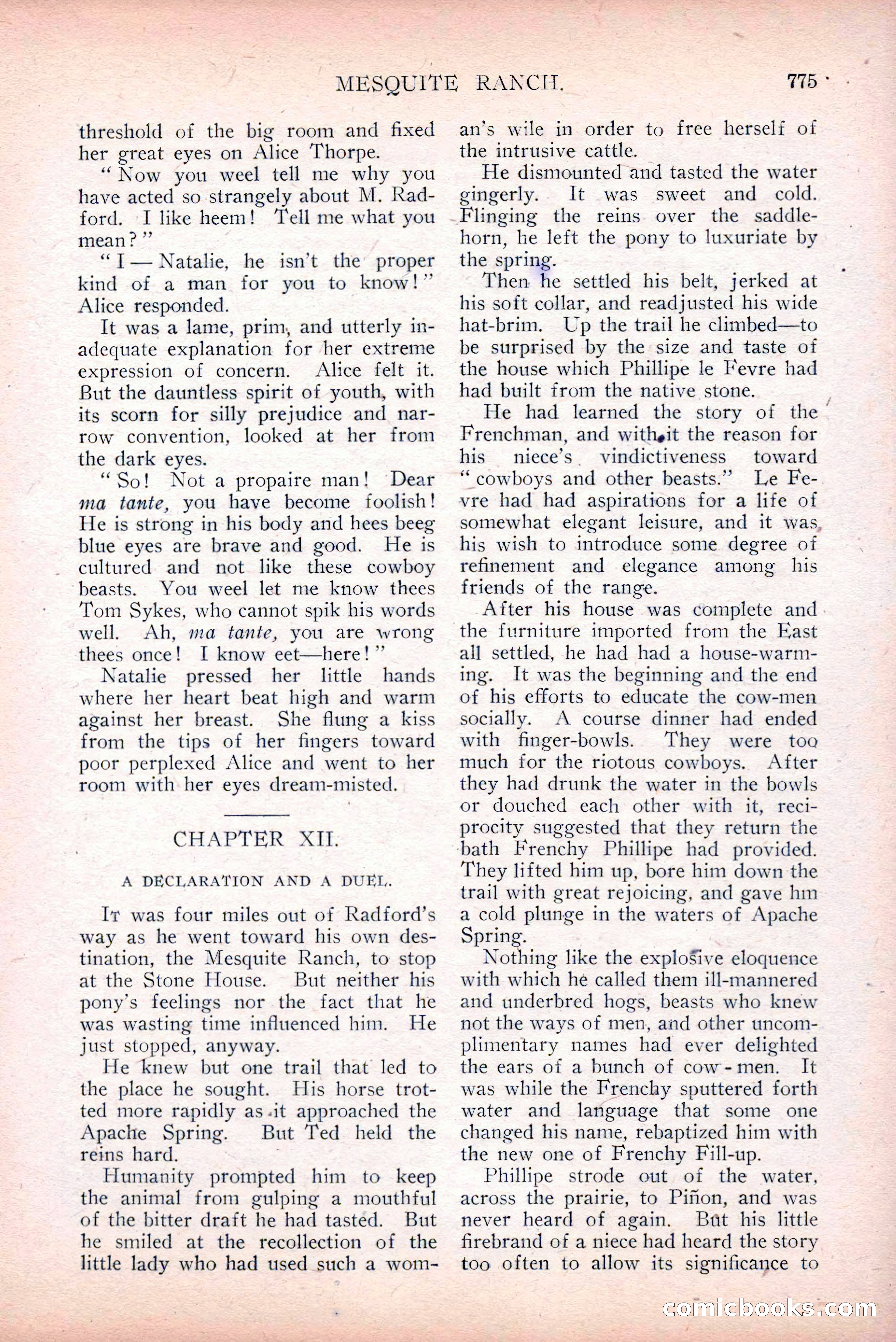
A restored page from Pulp Fiction, 1914. Page through the whole issue in the reader above.
📄 Transcribed text from this page (OCR, searchable)
Machine-transcribed from the original scan — historical spelling and the odd misread are preserved.
MESQUITE RANCH. threshold of the big room and fixed her great eyes on Alice Thorpe. ‘““Now you weel tell me why you have acted so strangely about M. Rad- ford. I like heem! ‘Tell me what you mean? ”’ “| — Natalie, he isn’t the proper kind of a man for you to know!” Alice responded. It was a lame, prim, and utterly in- adequate explanation for her extreme expression of concern. Alice felt it. But the dauntless spirit of youth, with its scorn for silly prejudice and nar- row convention, looked at her from the dark eyes. “So! Not a propaire man! Dear ma tante, you have become foolish! He is strong in his body and hees beeg blue eyes are brave and good. He is cultured and not like these cowboy beasts. You weel let me know thees Tom Sykes, who cannot spik his words well. Ah, ma tante, you are wrong thees once! I know eet—here! ” Natalie pressed her little hands where her heart beat high and warm against her breast. She flung a kiss from the tips of her fingers toward poor perplexed Alice and went to her room with her eyes dream-misted. CHAPTER XII. A DECLARATION AND A DUEL. It was four miles out of Radford’s way as he went toward his own des- tination, the Mesquite Ranch, to stop at the Stone House. But neither his pony’s feelings nor the fact that he was wasting time influenced him. He just stopped, anyway. He knew but one trail that led to the place he sought. His horse trot- ted more rapidly as .it approached the Apache Spring. But Ted held the reins hard. 3 Humanity prompted him to keep the animal from gulping a mouthful of the bitter draft he had tasted. But he smiled at the recollection of the little lady who had used such a wom- an’s wile in order to free herself of the intrusive cattle. He dismounted and tasted the water gingerly. It was sweet and cold. Flinging the reins over the saddle- horn, he left the pony to luxuriate by the spring. Then he settled his belt, jerked at his soft collar, and readjusted his wide hat-brim. Up the trail he climbed—to be surprised by the size and taste of the house which Phillipe le Fevre had had built from the native stone. 775 * He had learned the story of the’ Frenchman, and withegit the reason for his niece’s vindictiveness toward “cowboys and other beasts.” Le Fe- vre had had aspirations for a life of somewhat elegant leisure, and it was, his wish to introduce some degree of refinement and elegance among his friends of the range. After his house was complete and the furniture imported from the East all settled, he had had a house-warm- ing. It was the beginning and the end of his efforts to educate the cow-men socially. A course dinner had ended with finger-bowls. They were toa much for the riotous cowboys. After they had drunk the water in the bowls or douched each other with it, reci- procity suggested that they return the bath Frenchy Phillipe had provided. They lifted him up, bore him down the trail with great rejoicing, and gave hm a cold plunge in the waters of Apache Spring. Nothing like the exploSive eloquence with which he called them ill-mannered and underbred hogs, beasts who knew not the ways of men, and other uncom- plimentary names had ever delighted the ears of a bunch of cow-men. It was while the Frenchy sputtered forth water and language that some one changed his name, rebaptized him with the new one of Frenchy Fill-up. Phillipe strode out of the water, across the prairie, to Pifion, and was never heard of again. Bat his little firebrand of a niece had heard the story too often to allow its significance to MICLOOOKS: (C@ (C@)