
Pulp Fiction, 1914 · page 69 of 268
The Argosy, Vol. 75, No. 4 — page 69: what you’re looking at
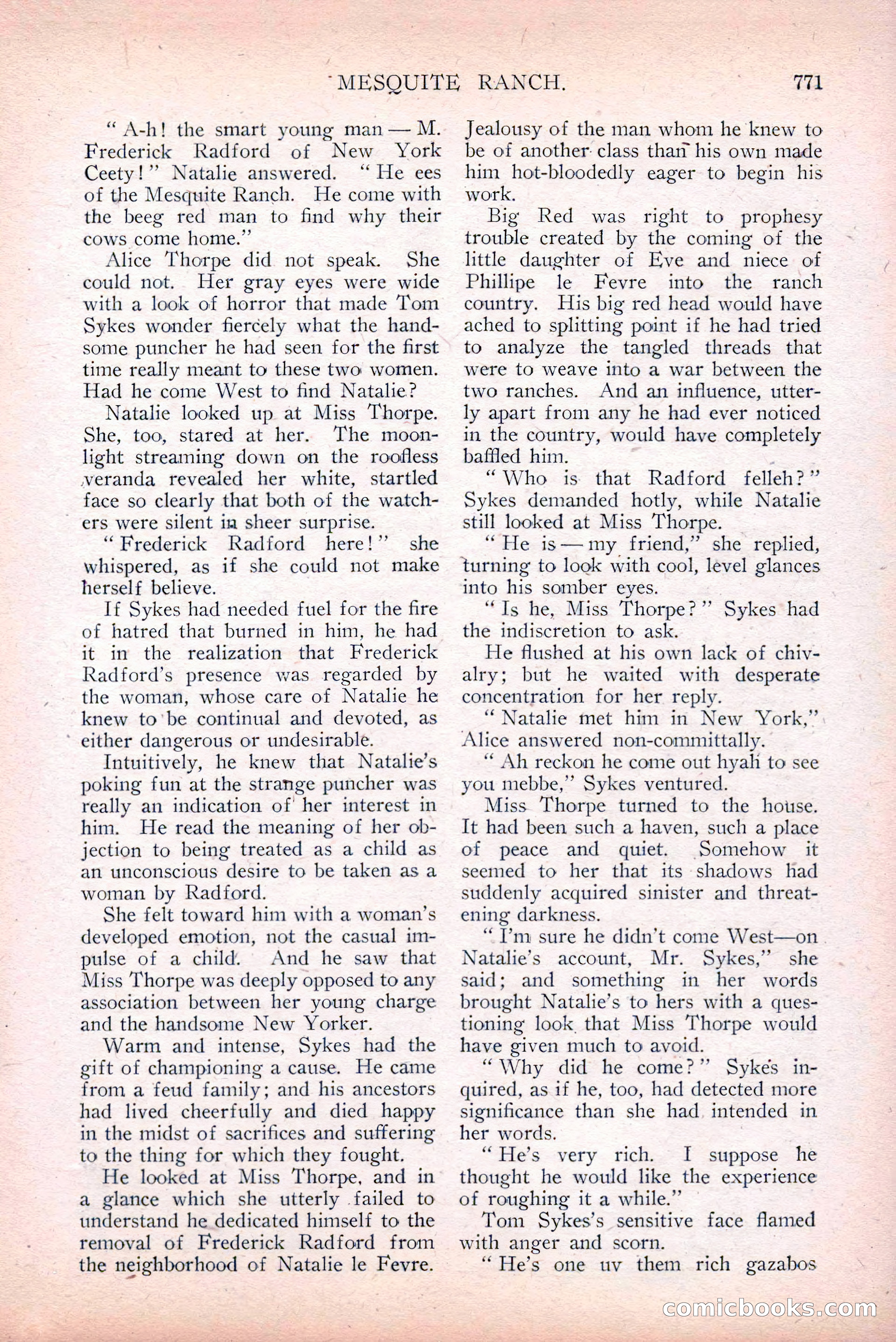
A restored page from Pulp Fiction, 1914. Page through the whole issue in the reader above.
📄 Transcribed text from this page (OCR, searchable)
Machine-transcribed from the original scan — historical spelling and the odd misread are preserved.
“MESQUITE RANCH. “A-h! the smart young man — M. Frederick Radford of New York Ceety!”’ Natalie answered. “ He ees of the Mesquite Ranch. He come with the beeg red man to find why their cows come home.” Alice Thorpe did not speak. She could not. Her gray eyes were wide with a look of horror that made Tom Sykes wonder fiercely what the hand- some puncher he had seen for the first time really meant to these two women. Had he come West to find Natalie? Natalie looked up at Miss Thorpe. She, too, stared at her. The moon- light streaming down on the roofless veranda revealed her white, startled face so clearly that both of the watch- ers were silent im sheer surprise. “Frederick Radford here!’ she whispered, as if she could not make herself believe. If Sykes had needed fuel for the fire of hatred that burned in him, he had it in the realization that Frederick Radford’s presence was regarded by the woman, whose care of Natalie he knew to’be continual and devoted, as ’ either dangerous or undesirable. Intuitively, he knew that Natalie’s poking fun at the strange puncher was really an indication of her interest in him. He read the meaning of her ob- jection to being treated as a child as an unconscious desire to be taken as a woman by Radford. She felt toward him with a woman’s developed emotion, not the casual im- pulse of a child. And he saw that Miss Thorpe was deeply opposed to any association between her young charge and the handsome New Yorker. Warm and intense, Sykes had the gift of championing a cause. He came from a feud family; and his ancestors had lived cheerfully and died happy in the midst of sacrifices and suffering to the thing for which they fought. He looked at Miss Thorpe, and in a glance which she utterly failed to understand he dedicated himself to the removal of Frederick Radford from the neighborhood of Natalie le Fevre. 771 Jealousy of the man whom he knew to be of another. class than his own made him hot-bloodedly eager to begin his work, Big Red was right to prophesy trouble created by the coming of the little daughter of Eve and niece of Phillipe le Fevre into the ranch country. His big red head would have ached to splitting point if he had tried to analyze the tangled threads that were to weave into a war between the two ranches. And an influence, utter- ly apart from any he had ever noticed in the country, would have completely baffled him. : “Who is that Radford felleh?” Sykes demanded hotly, while Natalie still looked at Miss Thorpe. ‘He is—my friend,” she replied, turning to look with cool, level glances into his somber eyes. “Ts he, Miss Thorpe?’”’ Sykes had the indiscretion to ask. He flushed at his own lack of chiv- alry; but he waited with desperate concentration for her reply. ‘Natalie met him in New York,” Alice answered non-committally. “Ah reckon he come out hyah to see you mebbe,” Sykes ventured. Miss Thorpe turned to the house. It had been such a haven, such a place of peace and quiet. Somehow it seemed to her that its shadows had suddenly acquired sinister and threat- ening darkness. “Tm sure he didn’t come West—on Natalie’s account, Mr. Sykes,” she said; and something in her words brought Natalie’s to hers with a ques- tioning look that Miss Thorpe would have given much to avoid. “Why did he come?” Sykes in- quired, as if he, too, had detected more significance than she had. intended in her words. “He’s very rich. I suppose he thought he would like the experience of roughing it a while.” Tom Sykes’s sensitive face flamed with anger and scorn. ‘“He’s one uv them rich gazabos EORNICLOOOKS (E©)