
Pulp Fiction, 1914 · page 56 of 268
The Argosy, Vol. 75, No. 4 — page 56: what you’re looking at
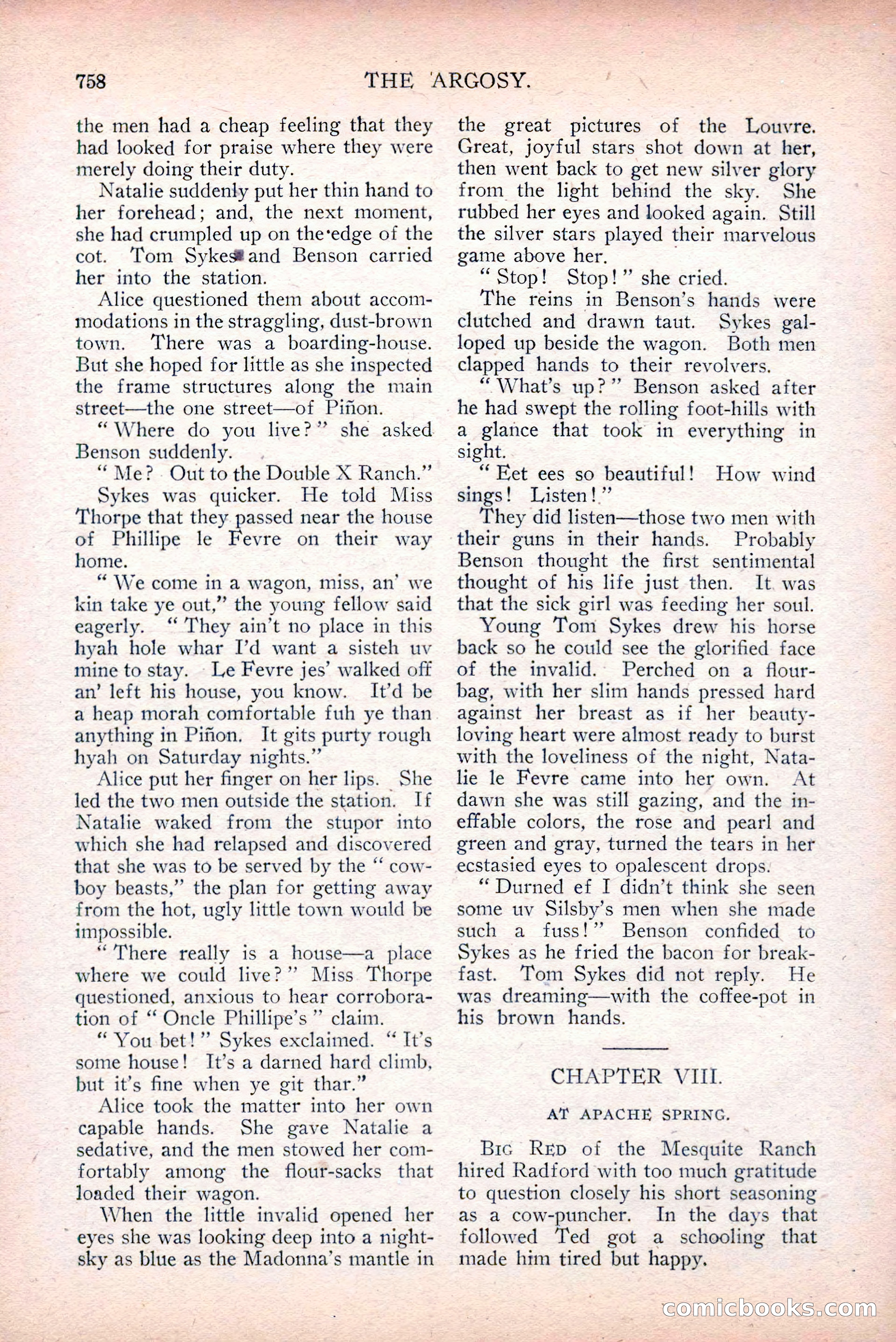
A restored page from Pulp Fiction, 1914. Page through the whole issue in the reader above.
📄 Transcribed text from this page (OCR, searchable)
Machine-transcribed from the original scan — historical spelling and the odd misread are preserved.
758 the men had a cheap feeling that they had looked for praise where they were merely doing their duty. Natalie suddenly put her thin hand to her forehead; and, the next moment, she had crumpled up on the‘edge of the cot. Tom Sykes#and Benson carried her into the station. Alice questioned them about accom- modations in the straggling, dust-brown town. There was a boarding-house. But she hoped for little as she inspected the frame structures along the main street—the one street—of Pifion. “Where do you live?” she asked Benson suddenly. “Me? Out to the Double X Ranch.” Sykes was quicker. He told Miss Thorpe that they passed near the house of Phillipe le Fevre on their way home. “We come in a wagon, miss, an’ we kin take ye out,” the young fellow said eagerly. “ They ain’t no place in this hyah hole whar I’d want a sisteh uv mine to stay. Le Fevre jes’ walked off an’ left his house, you know. It'd be a heap morah comfortable fuh ye than anything in Pifion, It gits purty rough hyah on Saturday nights.” Alice put her finger on her lips. She led the two men outside the station. If Natalie waked from the stupor into which she had relapsed and discovered that she was to be served by the “ cow- boy beasts,” the plan for getting away from the hot, ugly little town would be impossible. “There really is a house—a place where we could live?” Miss Thorpe questioned, anxious to hear corrobora- tion of *‘ Oncle Phillipe’s ” claim. “You bet!’’ Sykes exclaimed. “ It’s some house! It’s a darned hard climb, but it’s fine when ye git thar.” Alice took the matter into her own capable hands. She gave Natalie a sedative, and the men stowed her com- fortably among the flour-sacks that loaded their wagon. When the little invalid opened her ~ eyes she was looking deep into a night- sky as blue as the Madonna’s mantle in THE 'ARGOSY. the great pictures of the Louvre. Great, joyful stars shot down at her, then went back to get new silver glory from the light behind the sky. She rubbed her eyes and looked again. Still the silver stars played their marvelous game above her. “Stop! Stop!” she cried. The reins in Benson’s hands were clutched and drawn taut. Sykes gal- loped up beside the wagon. Both men clapped hands to their revolvers. ““What’s up?” Benson asked after he had swept the rolling foot-hills with a glance that took in everything in sight. “Eet ees so beautiful! sings! Listen!’ They did listen—those two men with their guns in their hands. Probably Benson thought the first sentimental thought of his life just then. It. was that the sick girl was feeding her soul. Young Tom Sykes drew his horse back so he could see the glorified face of the invalid. Perched on a flour- bag, with her slim hands pressed hard against her breast as if her beauty- loving heart were almost ready to burst with the loveliness of the night, Nata- lie le Fevre came into her own. At dawn she was still gazing, and the in- effable colors, the rose and pearl and green and gray, turned the tears in her ecstasied eyes to opalescent drops. “Durned ef I didn’t think she seen some uv Silsby’s men when she made such a fuss!” Benson confided to Sykes as he fried the bacon for break- fast. Tom Sykes did not reply. He was dreaming—with the coffee-pot in his brown hands. How wind CHAPTER VIII. AT APACHE SPRING. Bic Rep of the Mesquite Ranch hired Radford with too much gratitude to question closely his short seasoning as a cow-puncher. In the days that followed Ted got a schooling that made him tired but happy. Comicoooks (C@)