
Pulp Fiction, 1914 · page 243 of 268
The Argosy, Vol. 75, No. 4 — page 243: what you’re looking at
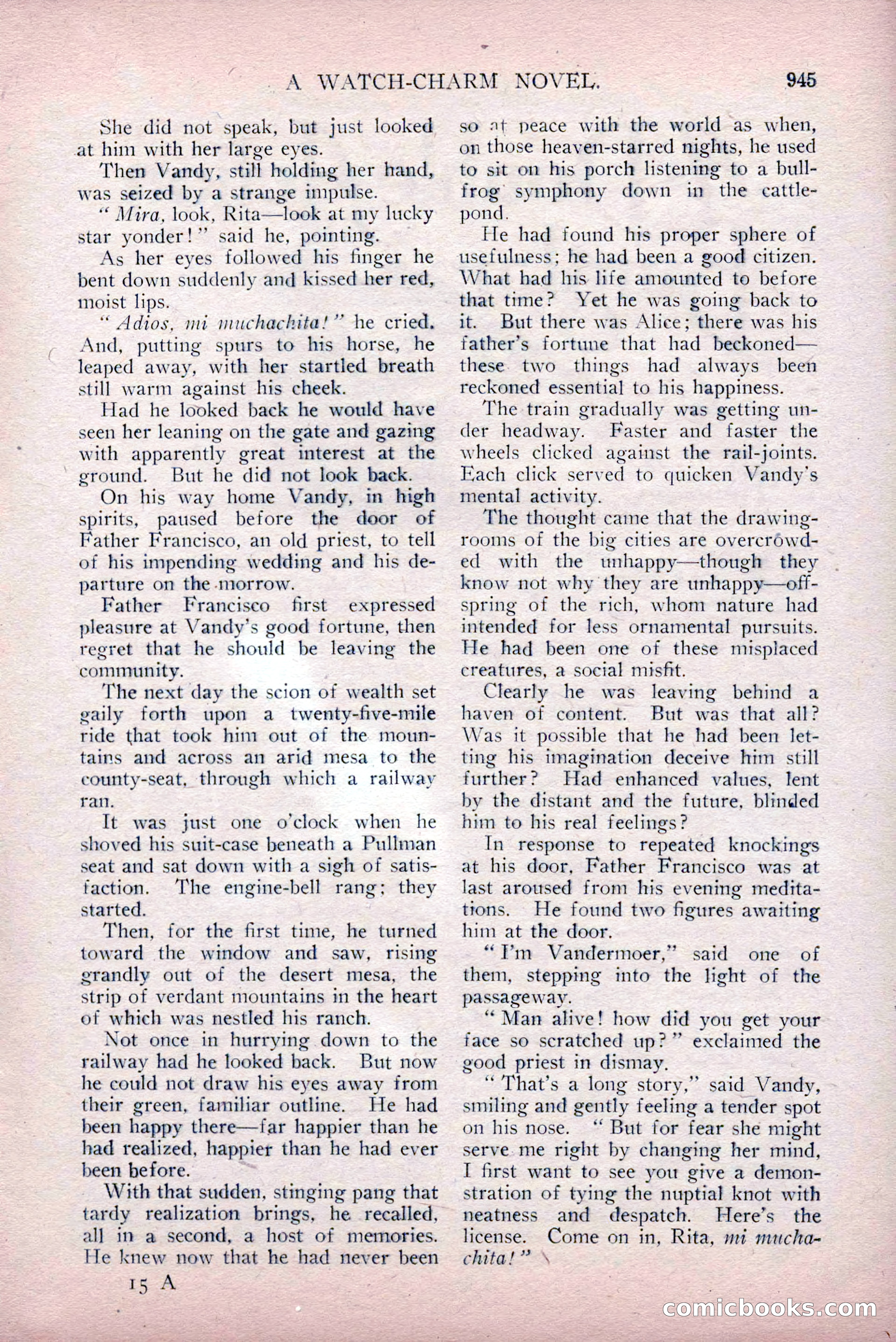
A restored page from Pulp Fiction, 1914. Page through the whole issue in the reader above.
📄 Transcribed text from this page (OCR, searchable)
Machine-transcribed from the original scan — historical spelling and the odd misread are preserved.
A WATCH-CHARM NOVEL, She did not speak, but just looked at him with her large eyes. Then Vandy, still holding her hand, was seized by a strange impulse. ‘* Mira, look, Rita—look at my lucky star yonder!” said he, pointing. As her eyes followed his finger he bent down suddenly and kissed her red, moist lips. “ Adios, mi muchachita!” he cried. And, putting spurs to his horse, he leaped away, with her startled breath still warm against his cheek. Had he looked back he would have seen her leaning on the gate and gazing with apparently great interest at the ground. But he did not look back. On his way home Vandy, in high spirits, paused before the door of Father Francisco, an old priest, to tell of his impending wedding and his de- parture on the morrow. Father Francisco first expressed pleasure at Vandy’s good fortune, then regret that he should be leaving the community. The next day the scion of wealth set gaily forth upon a_twenty-five-mile ride that took him out of the moun- tains and across an arid mesa to the county-seat, through which a railway rai. It was just one o'clock when he shoved his suit-case beneath a Pullman seat and sat down with a sigh of satis- faction. ‘The engine-bell rang; they started. Then, for the first time, he turned toward the window and saw, rising erandly out of the desert mesa, the strip of verdant mountains in the heart of which was nestled his ranch. Not once in hurrying down to the railway had he looked back. But now he could not draw his eyes away from their green, familiar outline. He had been happy there—far happier than he had realized, happier than he had ever been before. With that sudden, stinging pang that tardy realization brings, he recalled, all in a second, a host of memories. He knew now that he had never been I5 A - 945 so at peace with the world as when, on those heaven-starred nights, he used to sit on his porch listening to a bull- frog symphony down in the cattle- pond, He had found his proper sphere of usefulness; he had been a good citizen. What had his life amounted to before that time? Yet he was going back to it. But there was Alice; there was his father’s fortune that had beckoned— these. two things had always been reckoned essential to his happiness. The train gradually was getting un- der headway. Faster and faster the wheels clicked against the rail-joints. Fach click served to quicken Vandy’s mental activity. The thought came that the drawing- rooms of the big cities are overcr6wd- ed with the twnhappy—though they know not why they are unhappy—off- spring of the rich, whom nature had intended for less ornamental pursuits. He had been one of these misplaced creatures, a social misfit. Clearly he was leaving behind a haven of content. But was that all? Was it possible that he had been let- ting his imagination deceive him still further? Had enhanced values, lent by the distant and the future, blinded him to his real feelings? In response to repeated knockings at his door, Father Francisco was at last aroused from his evening medita- trons. He found two figures awaiting him at the door. “Pim Vandermoer,” said one of them, stepping into the light of the passageway. ‘Man alive! how did you get your face so scratched up?” exclaimed the good priest in dismay. * That’s a long story,” said Vandy, smiling and gently feeling a tender spot on his nose. “ But for fear she might serve me right by changing her mind, I first want to see you give a demon- stration of tying the nuptial knot with neatness and despatch. Here’s the license. Come on in, Rita, mt mtucha- chita!” \ .OOKS (ECV AMIE (EO)