
Pulp Fiction, 1914 · page 237 of 268
The Argosy, Vol. 75, No. 4 — page 237: what you’re looking at
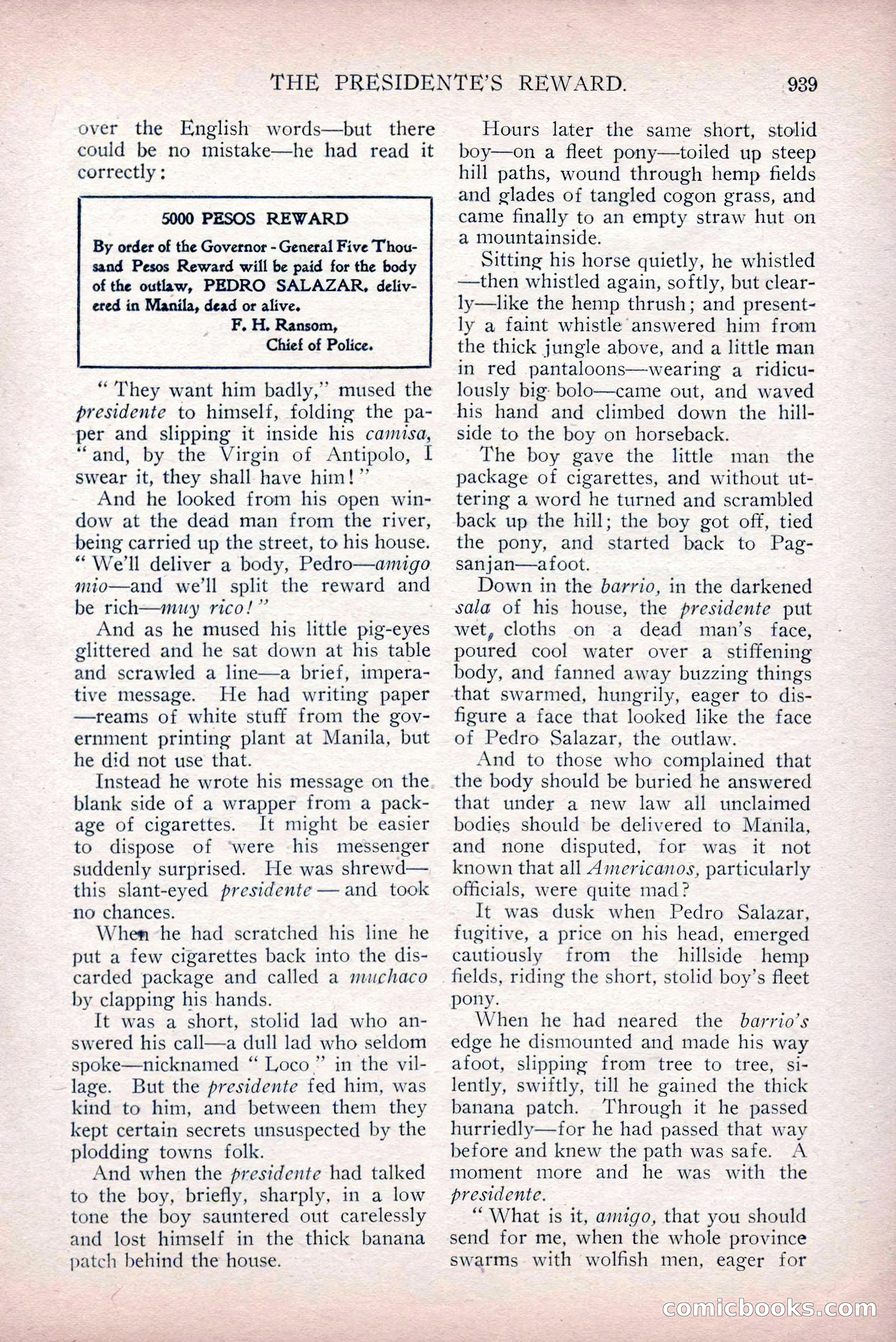
A restored page from Pulp Fiction, 1914. Page through the whole issue in the reader above.
📄 Transcribed text from this page (OCR, searchable)
Machine-transcribed from the original scan — historical spelling and the odd misread are preserved.
THE PRESIDENTE’S REWARD. over the English words—but there could be no mistake—he had read it correctly : 5000 PESOS REWARD By order of the Governor - General Five Thou- sand Pesos Reward will be paid for the body of the outlaw, PEDRO SALAZAR, deliv- ered in Manila, dead or alive. F, H. Ransom, Chief of Police. “They want him badly,’ mused the presidente to himself, folding the pa- per and slipping it inside his camusa, “and, by the Virgin of Antipolo, I swear it, they shall have him!” And he looked from his open win- dow at the dead man from the river, being carried up the street, to his house. “We'll deliver a body, Pedro—amigo mio—and we'll split the reward and be rich—muy rico!” And as he mused his little pig-eyes glittered and he sat down at his table and scrawled a line—a brief, impera- tive message. He had writing paper —reams of white stuff from the gov- ernment printing plant at Manila, but he did not use that. Instead he wrote his message on the blank side of a wrapper from a pack- age of cigarettes. It might be easier to dispose of ‘were his messenger suddenly surprised. He was shrewd— this slant-eyed presidente — and took no chances. When ‘he had scratched his line he put a few cigarettes back into the dis- carded package and called a muchaco by clapping his hands. It was a short, stolid lad who an- swered his call—a dull lad who seldom spoke—nicknamed “ Loco.” in the vil- lage. But the presidente fed him, was kind to him, and between them they kept certain secrets unsuspected by the plodding towns folk. And when the presidente had talked to the boy, briefly, sharply, in a low tone the boy sauntered out carelessly and lost himself in the thick banana patch behind the house. 939 Hours later the same short, stolid boy—on a fleet pony—toiled up steep hill paths, wound through hemp fields and glades of tangled cogon grass, and came finally to an empty straw hut on a mountainside. Sitting his horse quietly, he whistled —then whistled again, softly, but clear- ly—like the hemp thrush; and present- ly a faint whistle answered him from the thick jungle above, and a little man in red pantaloons—wearing a ridicu- lously big- bolo—came out, and waved his hand and climbed down the hill- side to the boy on horseback. The boy gave the little man the package of cigarettes, and without ut- tering a word he turned and scrambled back up the hill; the boy got off, tied the pony, and started back to Pag- sanjan—a foot. Down in the barrio, in the darkened sala of his house, the presidente put wet, cloths on a dead man’s face, poured cool water over a stiffening body, and fanned away buzzing things that swarmed, hungrily, eager to dis- figure a face that looked like the face of Pedro Salazar, the outlaw. And to those who complained that the body should be buried he answered that under a new law all unclaimed bodies should be delivered to Manila, and none disputed, for was it not known that all Americanos, particularly officials, were quite mad? It was dusk when Pedro Salazar, fugitive, a price on his head, emerged cautiously from the hillside hemp fields, riding the short, stolid boy’s fleet pony. When he had neared the barrio’s edge he dismounted and made his way afoot, slipping from tree to tree, si- lently, swiftly, till he gained the thick banana patch. ‘Through it he passed hurriedly—for he had passed that way before and knew the path was safe. A moment more and he was with the presidente. “What is it, amigo, that you should send for me, when the whole province swarms with wolfish men, eager for EOPMICLOOOKS (E@)