
Pulp Fiction, 1914 · page 217 of 268
The Argosy, Vol. 75, No. 4 — page 217: what you’re looking at
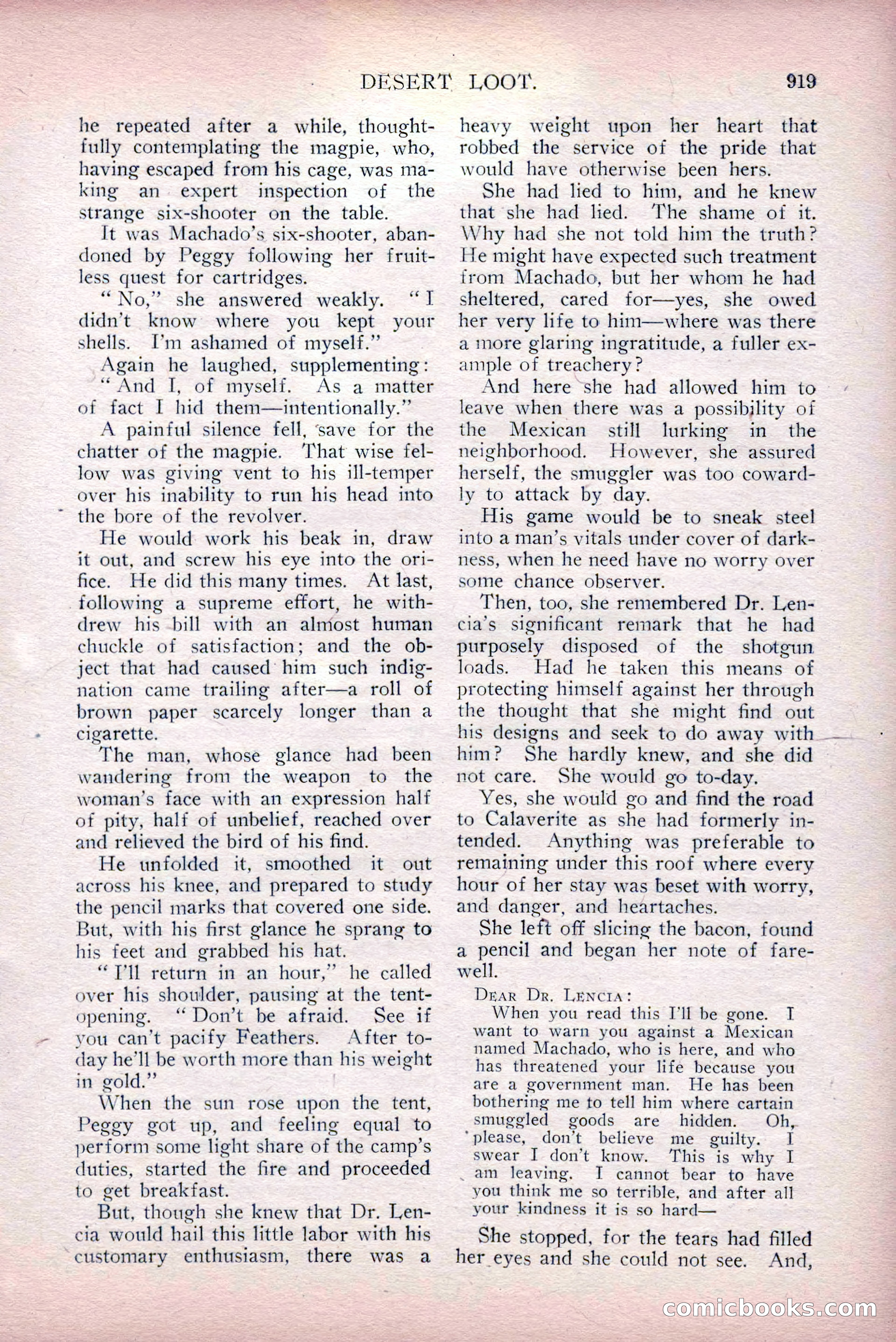
A restored page from Pulp Fiction, 1914. Page through the whole issue in the reader above.
📄 Transcribed text from this page (OCR, searchable)
Machine-transcribed from the original scan — historical spelling and the odd misread are preserved.
DESERT LOOT. he repeated after a while, thought- fully contemplating the magpie, who, having escaped from his cage, was ma- king an expert inspection of the strange six-shooter on the table. It was Machado’s six-shooter, aban- doned by Peggy following her fruit- less quest for cartridges. “No,” she answered weakly. “I didn’t know where you kept your shells. I’m ashamed of myself.” Again he laughed, supplementing: “And I, of myself. As a matter of fact I hid them—intentionally.” A painful silence fell, save for the chatter of the magpie. That wise fel- low was giving vent to his ill-temper over his inability to run his head into the bore of the revolver. He would work his beak in, draw it out, and screw his eye into the ori- fice. He did this many times. At last, following a supreme effort, he with- drew his -bill with an almost human chuckle of satisfaction; and the ob- ject that had caused him such indig- nation came trailing after—a roll of brown paper scarcely longer than a cigarette. The man, whose glance had been wandering from the weapon to the woman’s face with an expression half of pity, half of unbelief, reached over and relieved the bird of his find. He unfolded it, smoothed it out across his knee, and prepared to study the pencil marks that covered one side. But, with his first glance he sprang to his feet and grabbed his hat. “T'll return in an hour,” he called over his shoulder, pausing at the tent- opening. ‘“ Don’t be afraid. See if you can’t pacify Feathers. After to- day he’ll be worth more than his weight in gold.” When the sun rose upon the tent, Peggy got up, and feeling equal to perform some light share of the camp’s duties, started the fire and proceeded to get breakfast. But, though she knew that Dr. Len- cia would hail this little labor with his customary enthusiasm, there was a 913 heavy weight upon her heart that robbed the service of the pride that would have otherwise been hers. She had lied to him, and he knew that she had lied. The shame of it. Why had she not told him the truth? He might have expected such treatment from Machado, but her whom he had sheltered, cared for—yes, she owed her very life to him—where was there a more glaring ingratitude, a fuller ex- ample of treachery? And here she had allowed him to leave when there was a possibjlity of the Mexican still lurking in the neighborhood. However, she assured herself, the smuggler was too coward- ly to attack by day. His game would be to sneak steel into a man’s vitals under cover of dark- ness, when he need have no worry over some chance observer. Then, too, she remembered Dr. Len- cia’s significant remark that he had purposely disposed of the shotgun loads. Had he taken this means of protecting himself against her through the thought that she might find out his designs and seek to do away with ~ him? She hardly knew, and she did not care. She would go to-day. Yes, she would go and find the road to Calaverite as she had formerly in- tended. Anything was preferable to remaining under this roof where every hour of her stay was beset with worry, and danger, and heartaches. She left off slicing the bacon, found a pencil and began her note of fare- well. Dear Dr. LENCIA: When you read this I'll be gone. I want to warn you against a Mexican named Machado, who is here, and who has threatened your life because you are a government man. He has been bothering me to tell him where cartain smuggled goods are hidden. Oh, ‘please, don’t believe me guilty. I swear I don’t know. ‘This is why I _am leaving. I cannot bear to have you think me so terrible, and after all your kindness it is so hard— She stopped, for the tears had filled her eyes and she could not see. And, EOPMIC LOOKS (E@)