
Pulp Fiction, 1914 · page 176 of 268
The Argosy, Vol. 75, No. 4 — page 176: what you’re looking at
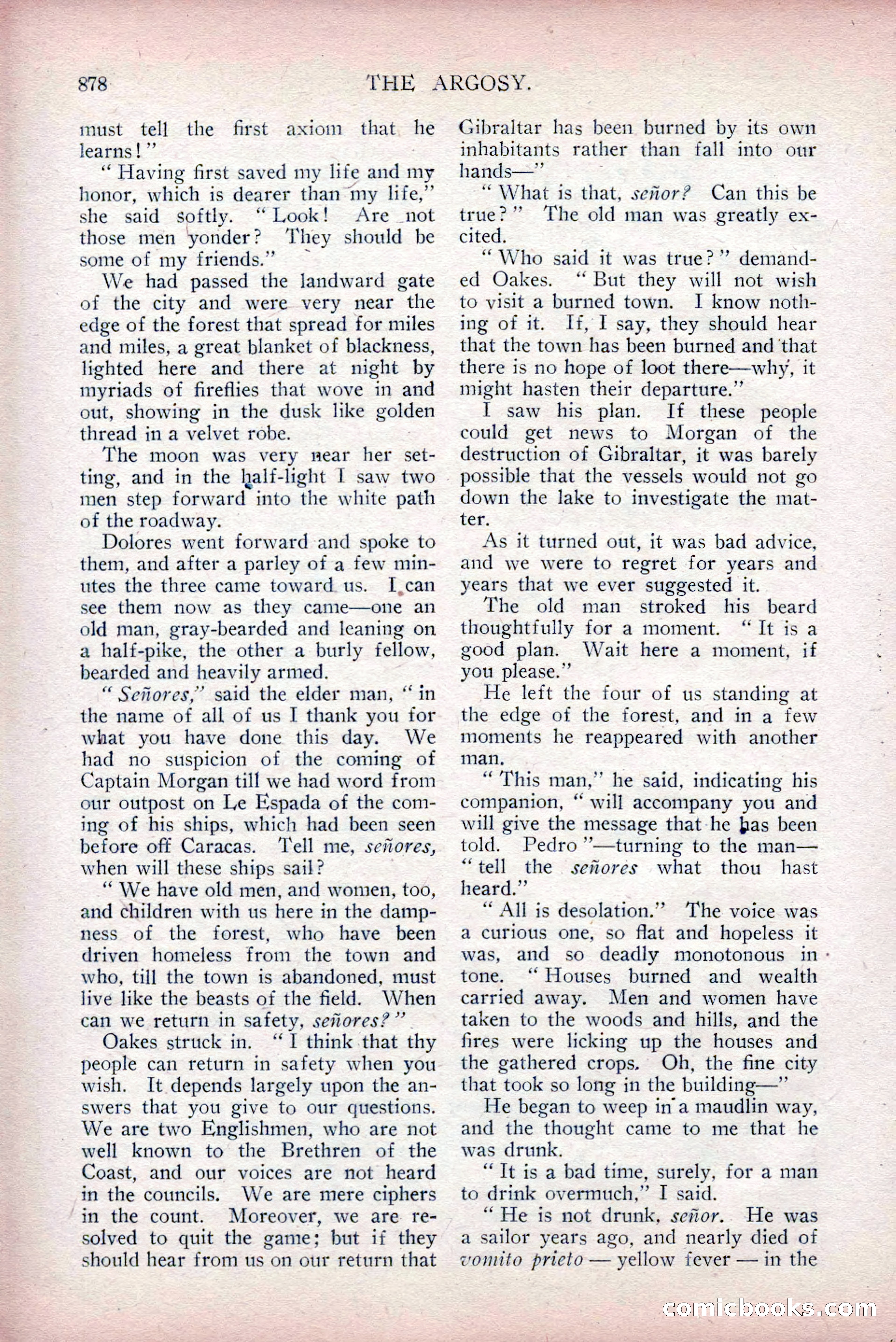
A restored page from Pulp Fiction, 1914. Page through the whole issue in the reader above.
📄 Transcribed text from this page (OCR, searchable)
Machine-transcribed from the original scan — historical spelling and the odd misread are preserved.
878 THE ARGOSY. must tell the first axiom that he learns!” ‘“ Having first saved my life and my honor, which is dearer than my life,” she said softly. ‘Look! Are not those men yonder? ‘They should be some of my friends.” We had passed the landward gate of the city and were very near the edge of the forest that spread for miles and miles, a great blanket of blackness, lighted here and there at night by myriads of fireflies that wove in and out, showing in the dusk like golden thread in a velvet robe. The moon was very near her set- ting, and in the half-light I saw two men step forward into the white path of the roadway. Dolores went forward and spoke to them, and after a parley of a few min- utes the three came toward us. I,can see them now as they came—one an old man, gray-bearded and leaning on a half-pike, the other a burly fellow, bearded and heavily armed. “ Seiores,’ said the elder man, “ in the name of all of us I thank you for what you have done this day. We had no suspicion of the coming of Captain Morgan till we had word from our outpost on Le Espada of the com- ing of his ships, which had been seen before off Caracas. Tell me, sevores, when will these ships sail? “ We have old men, and women, too, and children with us here in the damp- ness of the forest, who have been driven homeless from the town and who, till the town is abandoned, must live like the beasts of the field. When can we return in safety, seviores?”’ Oakes struck in. “I think that thy people can return in safety when you wish. It depends largely upon the an- swers that you give to our questions. We are two Englishmen, who are not well known to the Brethren of the Coast, and our voices are not heard in the councils. We are mere ciphers in the count. Moreover, we are re- solved to quit the game; but if they should hear from us on our return that ce Gibraltar has been burned by its own inhabitants rather than fall into our hands—”’ ; “What is that, senor? Can this be true?” The old man was greatly ex- cited. “Who said it was true?” demand- ed Oakes. “ But they will not wish to visit a burned town. I know noth- ing of it. If, I say, they should hear that the town has been burned and that there is no hope of loot there—why, it might hasten their departure.” I saw his plan. If these people could get news to Morgan of the destruction of Gibraltar, it was barely possible that the vessels would not go down the lake to investigate the mat- ter. As it turned out, it was bad advice, and we were to regret for years and years that we ever suggested it. The old man stroked his beard thoughtfully for a moment. “It is a good plan. Wait here a moment, if you please.” He left the four of us standing at the edge of the forest, and in a few moments he reappeared with another man, “This man,’’ he said, indicating his companion, “ will accompany you and will give the message that -he Bas been told. Pedro ’’—turning to the man— “tell the senores what thou hast heard.” “All is desolation.” ‘The voice was a curious one, so flat and hopeless it was, and so deadly monotonous in - tone. ‘‘ Houses burned and wealth carried away. Men and women have taken to the woods and hills, and the fires were licking up the houses and the gathered crops. Oh, the fine city that took so long in the building—” He began to weep in a maudlin way, and the thought came to me that he was drunk. “It is a bad time, surely, for a man to drink overmuch,” I said. “ He is not drunk, sevior. He was a sailor years ago, and nearly died of vomito prieto — yellow fever — in the EOPMMICOOOKS (C@)