
Pulp Fiction, 1914 · page 151 of 268
The Argosy, Vol. 75, No. 4 — page 151: what you’re looking at
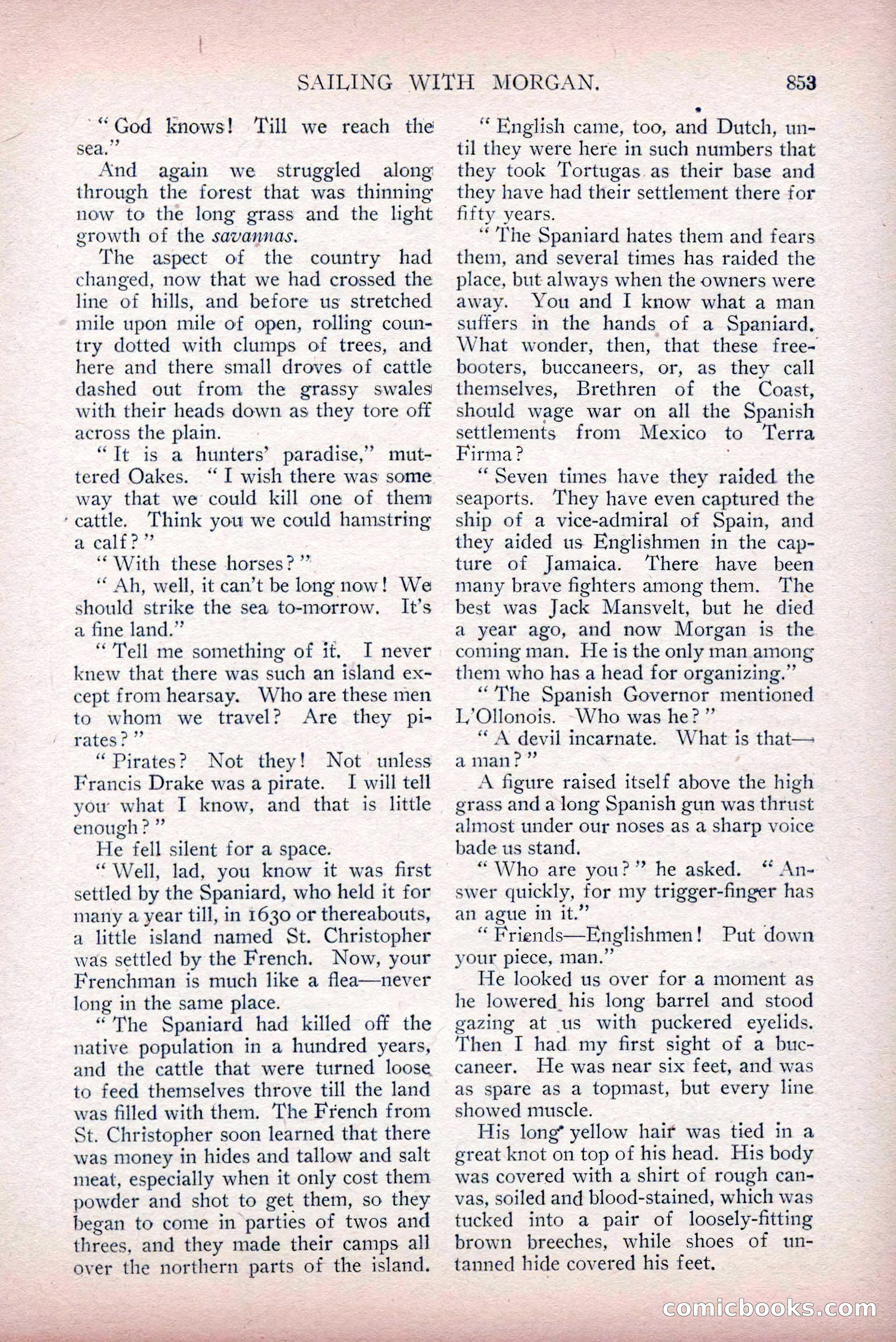
A restored page from Pulp Fiction, 1914. Page through the whole issue in the reader above.
📄 Transcribed text from this page (OCR, searchable)
Machine-transcribed from the original scan — historical spelling and the odd misread are preserved.
SAILING WITH MORGAN, “God knows! Till we reach the sea,” And again we struggled along through the forest that was thinning now to the long grass and the light erowth of the savannas. The aspect of the country had changed, now that we had crossed the line of hills, and before us stretched mile upon mile of open, rolling coun- try dotted with clumps of trees, and here and there small droves of cattle dashed out from the grassy swales with their heads down as they tore off across the plain. “Tt is a hunters’ paradise,’ mut- tered Oakes. ‘I wish there was some way that we could kill one of them ‘cattle. Think you we could hamstring a calf?” ‘With these horses? ”’ ‘* Ah, well, it can’t be long now! We should strike the sea to-morrow. It’s a fine land.” “Tell me something of it. I never knew that there was such an island ex- cept from hearsay. Who are these men to whom we travel? Are they pi- rates?” “Pirates? Not they! Not unless Francis Drake was a pirate. I will tell yow what I know, and that is little enough?” He fell silent for a space. “Well, lad, you know it was first settled by the Spaniard, who held it for many a year till, in 1630 or thereabouts, a little island named St. Christopher was settled by the French. Now, your Frenchman is much like a flea—never long in the same place. “The Spaniard had killed off the native population in a hundred years, and the cattle that were turned loose to feed themselves throve till the land was filled with them. The French from St. Christopher soon learned that there was money in hides and tallow and salt meat, especially when it only cost them powder and shot to get them, so they began to come in parties of twos and threes, and they made their camps all over the northern parts of the island. ee ee RSS ee Ca . = A = . ee ee Se a ee oe ee ee 803 ‘English came, too, and Dutch, un- til they were here in such numbers that they took Tortugas as their base and they have had their settlement there for fifty years. ‘The Spaniard hates them and fears them, and several times has raided the place, but always when the owners were away. You and I know what a man suffers in the hands of a Spaniard, What wonder, then, that these free- booters, buccaneers, or, as they call themselves, Brethren of the Coast, should wage war on all the Spanish settlements from Mexico to Terra Firma? “Seven times have they raided the seaports. They have even captured the ship of a vice-admiral of Spain, and they aided us Englishmen in the cap- ture of Jamaica. There have been many brave fighters among them. The best was Jack Mansvelt, but he died a year ago, and now Morgan is the coming man. He is the only man among them who has a head for organizing.” “The Spanish Governor mentioned L,’Ollonois. -Who was he? ” “A devil incarnate. What is that— aman?” A figure raised itself above the high erass and a long Spanish gun was thrust almost under our noses as a sharp voice bade us stand. “Who are you?” he asked. “ An- swer quickly, for my trigger-finger has an ague in it.” “ Friends—Englishmen! your piece, man.” He looked us over for a moment as he lowered_his long barrel and stood gazing at us with puckered eyelids. Then I had my first sight of a buc- caneer. He was near six feet, and was as spare as a topmast, but every line showed muscle. His long* yellow hair was tied in a ereat knot on top of his head. His body was covered with a shirt of rough can- vas, soiled and blood-stained, which was tucked into a pair of loosely-fitting brown breeches, while shoes of un- tanned hide covered his feet. Put down Eomichbooks (E@)