
Pulp Fiction, 1914 · page 147 of 268
The Argosy, Vol. 75, No. 4 — page 147: what you’re looking at
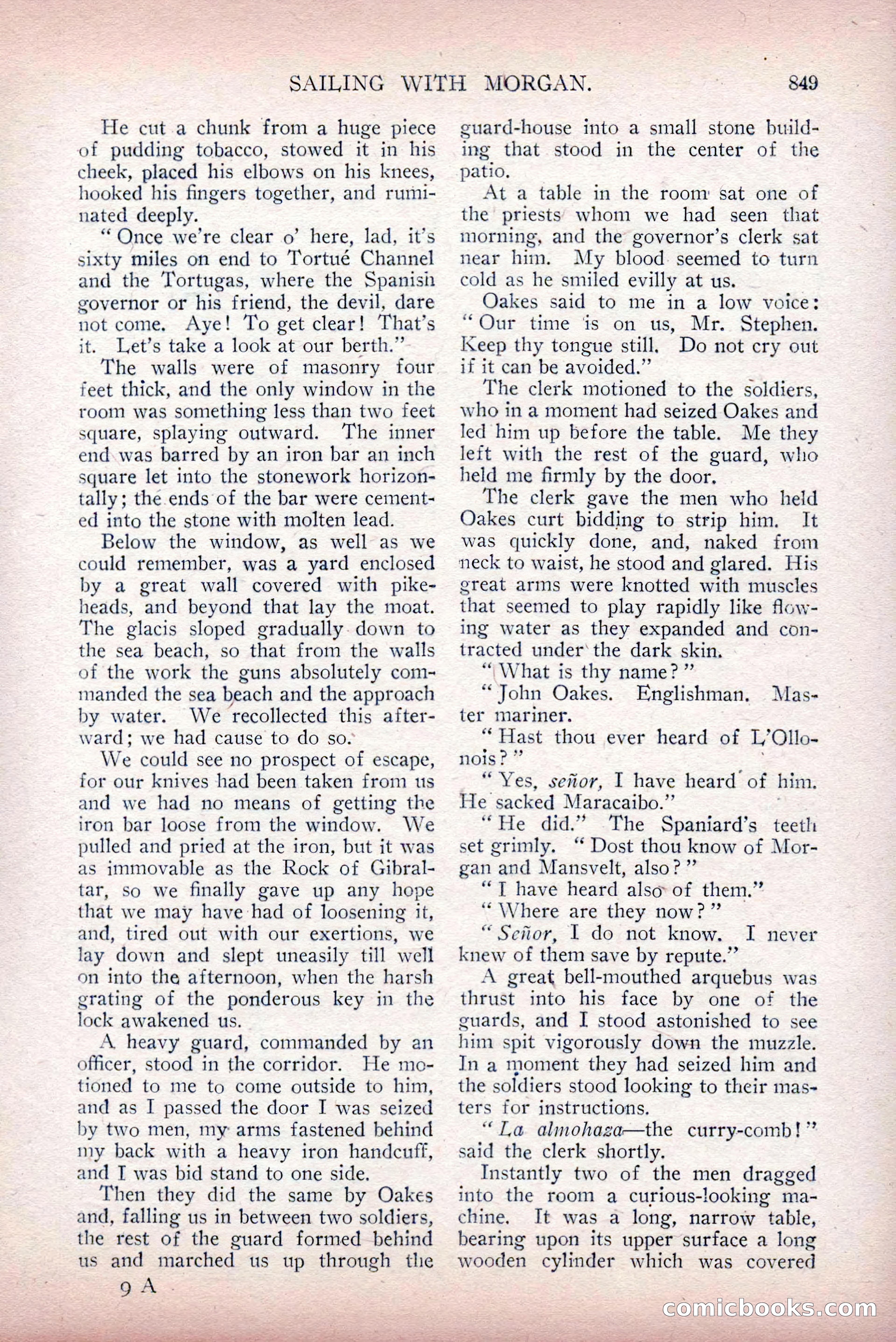
A restored page from Pulp Fiction, 1914. Page through the whole issue in the reader above.
📄 Transcribed text from this page (OCR, searchable)
Machine-transcribed from the original scan — historical spelling and the odd misread are preserved.
a es a > SAILING WITH MORGAN. He cut a chunk from a huge piece of pudding tobacco, stowed it in his cheek, placed his elbows on his knees, hooked his fingers together, and rumi- nated deeply. “Once we're clear o’ here, lad, it’s sixty miles on end to Tortué Channel and the Tortugas, where the Spanish governor or his friend, the devil, dare not come, Aye! To get clear! That’ s it. Let’s take a look at our berth.” The walls were of masonry four feet thick, and the only window in the room was something less than two feet square, splaying outward. The inner end was barred by an iron bar an inch square let into the stonework horizon- tally; the ends of the bar were cement- ed into the stone with molten lead. Below the window, as well as we could remember, was a yard enclosed by a great wall covered with pike- heads, and beyond that lay the moat. The glacis sloped gradually. down to the sea beach, so that from the walls of the work the guns absolutely com-~ manded the sea beach and the approach by water. We recollected this after- ward; we had cause to do so. We could see no prospect of escape, for our knives had been taken from us and we had no means of getting the iron bar loose from the window. We pulled and pried at the iron, but it was as immovable as the Rock of Gibral- tar, so we finally gave up any hope that we may have ‘had of loosening it, and, tired out with our exertions, we lay down and slept uneasily till well on into the afternoon, when the harsh grating of the ponderous key in the lock awakened us. A heavy guard, commanded by an officer, stood in the corridor. He mo- tioned to me to come outside to him, and as I passed the door I was seized by two men, my arms fastened behind my back with a heavy iron handcuff, and IT was bid stand to one side. Then they did the same by Oakes and, falling us in between two soldiers, the rest of the guard formed behind us and marched us up through the 849 gcuard-house into a small stone build- ing that stood in the center of the patio. At a table in the room sat one of the priests whom we had seen that morning, and the governor’s clerk sat near him. My blood: seemed to turn cold as he smiled evilly at us, Oakes said to me in a low voice: “Our time is on us, Mr. Stephen. KKeep thy tongue still, Do not cry out if it can be avoided.” The clerk motioned to the soldiers, who in a moment had seized Oakes and led him up before the table. Me they left with the rest of the guard, who held me firmly by the door, The clerk gave the men who held Oakes curt bidding to strip him. It was quickly done, and, naked from neck to waist, he stood and glared. His great arms were knotted with muscles that seemed to play rapidly like flow- ing water as they expanded and con- tracted under‘ the dark skin, “|What is thy name? ” “John Oakes. Englishman, ter mariner. “Hast thou ever heard of L’Olllo- nois? ” “Yes, seftor, I have heard of him. He sacked Maracaibo. as ‘He did.” The Spaniard’s teeth set grimly. “ Dost thou know of Mor- gan and Mansvelt, also?” “T have heard also of them.” ‘Where are they now?” “ Senor, | do not know. knew of them save by repute.” A great bell-mouthed arquebus was thrust into his face by one of the guards, and I stood astonished to see him spit vigorously down the muzzle. In a moment they had seized him and the soldiers stood looking to their mas- ters for instructions, “La almohaza—the curry-comb!” said the clerk shortly. Instantly two of the men dragged into the reom a curious-looking ma- chine. It was a long, narrow “table, bearing upon its upper surface a long wooden cylinder which was covered I never im ws) Eomichoo (E@)