
Pulp Fiction, 1914 · page 137 of 268
The Argosy, Vol. 75, No. 4 — page 137: what you’re looking at
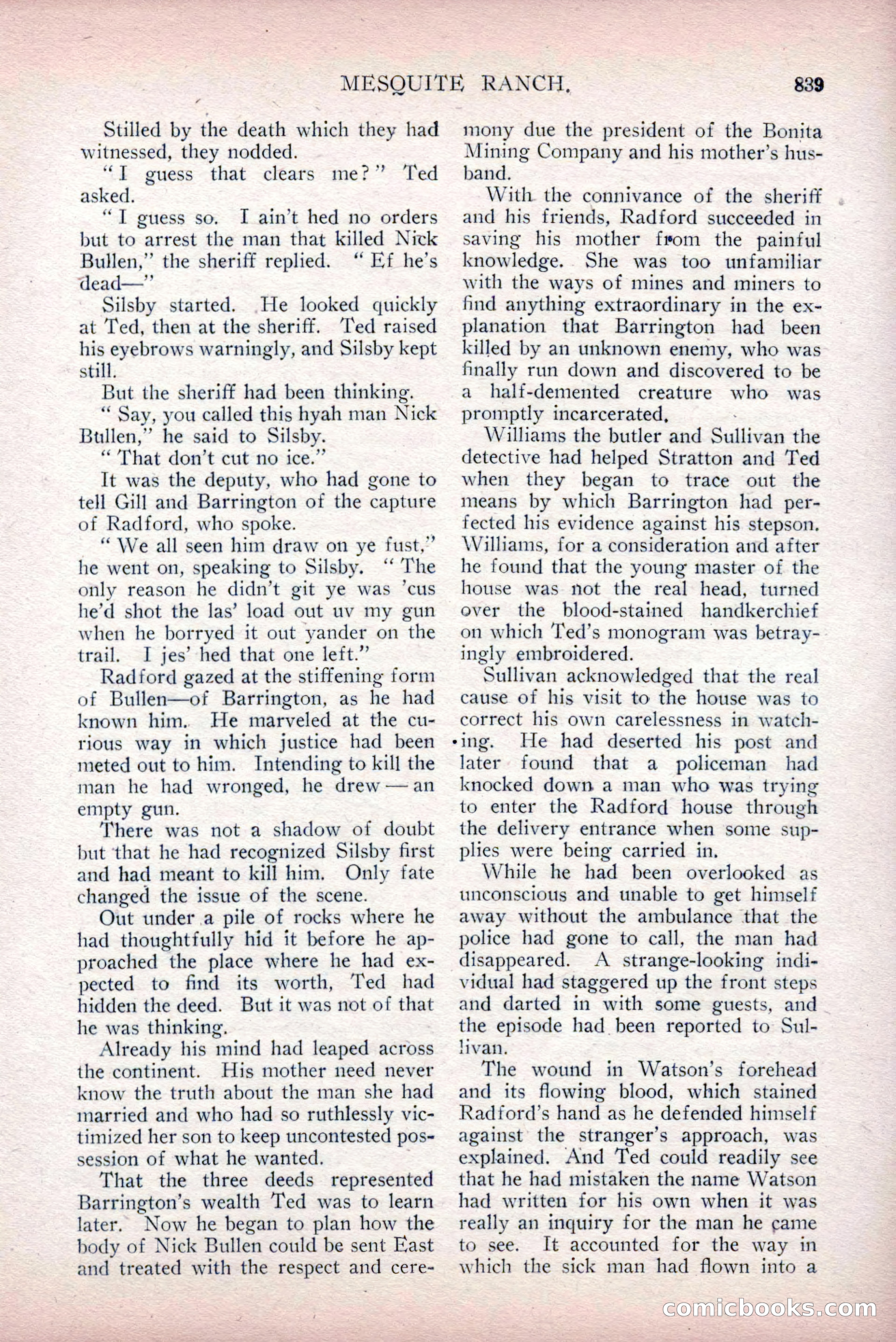
A restored page from Pulp Fiction, 1914. Page through the whole issue in the reader above.
📄 Transcribed text from this page (OCR, searchable)
Machine-transcribed from the original scan — historical spelling and the odd misread are preserved.
MESQUITE RANCH, A Stilled by the death which they had witnessed, they nodded. ““T guess that clears asked. “TI guess so. I ain’t hed no orders but to arrest the man that killed Nick Bullen,” the sheriff replied. “ Ef he’s dead—”’ Silsby started. He looked quickly at Ted, then at the sheriff. Ted raised his eyebrows warningly, and Silsby kept stall. But the sheriff had been thinking. “ Say, you called this hyah man Nick Bullen,’ he said to Silsby. “That don’t cut no ice.” It was the deputy, who had gone to tell Gill and Barrington of the capture of Radford, who spoke. 3 “We all seen him draw on ye fust,” he went on, speaking to Silsby. “ The only reason he didn’t git ye was ‘cus he’d shot the las’ load out uv my gun when he borryed it out yander on the trail. I jes’ hed that one left.” Radford gazed at the stiffening form of Bullen—of Barrington, as he had known him. He marveled at the cu- rious way in which justice had been meted out to him. Intending to kill the man he had wronged, he drew — an empty gun. There was not a shadow of doubt but that he had recognized Silsby first and had meant to kill him. Only fate changed the issue of the scene. Out under .a pile of rocks where he had thoughtfully hid it before he ap- proached the place where he had ex- pected to find its worth, Ted had hidden the deed. But it was not of that he was thinking. Already his mind had leaped across the continent. His mother need never know the truth about the man she had married and who had so ruthlessly vic- timized her son to keep uncontested pos- session of what he wanted. That the three deeds represented Barrington’s wealth Ted was to learn later. Now he began to plan how the body of Nick Bullen could be sent East and treated with the respect and cere- me?” ‘Ted 839 mony due the president of the Bonita Mining Company and his mother’s hus- band. With the connivance of the sheriff and his friends, Radford sueceeded in saving his mother from the painful knowledge. She was too unfamiliar with the ways of mines and miners to find anything extraordinary in the ex- planation that Barrington had been killed by an unknown enemy, who was finally run down and discovered to be a half-demented creature who was promptly incarcerated, Williams the butler and Suslliv an the detective had helped Stratton and Ted when they began to trace out the means by which Barrington had per- fected his evidence against his stepson. Williams, for a consideration and after he found that the young master of the house was not the real head, turned over the blood-stained handkerchief on which Ted’s monogram was betray- ingly embroidered. Sullivan acknowledged that the real cause of his visit to the house was to correct his own carelessness in watch- -ing. He had deserted his post and later found that a policeman had knocked down a man who was trying to enter the Radford house through the delivery entrance when some sup- plies were being carried in, While he had been overlooked as unconscious and unable to get himself away without the ambulance that the police had gone to call, the man had disappeared. A _ strange-looking indi- vidual had staggered up the front steps and darted in with some guests, and the episode had been reported to Sul- livan., The wound in Watson’s forehead and its flowing blood, which stained Radford’s hand as he defended himself against the stranger's approach, was explained. And Ted could readily see that he had mistaken the name Watson had written for his own when it was really an inquiry for the man he came to see. It accounted for the way in which the sick man had flown into a NOOLKS COME (E@)