
Pulp Fiction, 1914 · page 113 of 268
The Argosy, Vol. 75, No. 4 — page 113: what you’re looking at
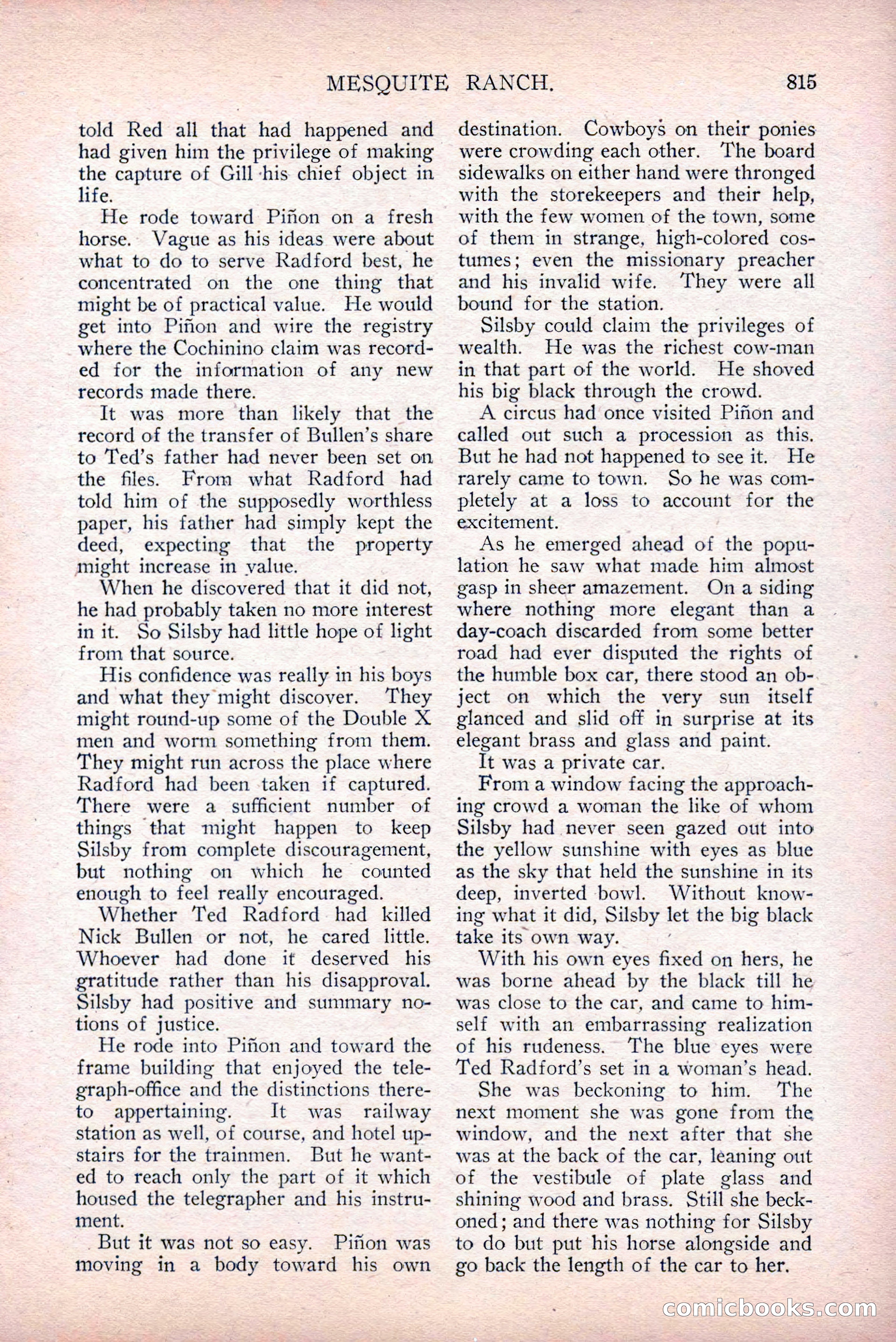
A restored page from Pulp Fiction, 1914. Page through the whole issue in the reader above.
📄 Transcribed text from this page (OCR, searchable)
Machine-transcribed from the original scan — historical spelling and the odd misread are preserved.
MESQUITE RANCH. told Red all that had happened and had given him the privilege of making the capture of Gill-his chief object in life. He rode toward Pinon on a fresh horse. Vague as his ideas were about what to do to serve Radford best, he concentrated on the one thing that might be of practical value. He would get into Pifon and wire the registry where the Cochinino claim was record- ed for the information of any new records made there. It was more than likely that the record of the transfer of Bullen’s share to Ted’s father had never been set on the files. From what Radford had told him of the supposedly worthless paper, his father had simply kept the deed, expecting that the property might increase in value. When he discovered that it did not, he had probably taken no more interest in it. So Silsby had little hope of light from that source. His confidence was really in his boys and what they might discover. They might round-up some of the Double X men and worm something from them. They might run across the place where Radford had been taken if captured. There were a sufficient number of things that might happen to keep Silsby from complete discouragement, but nothing on which he counted enough to feel really encouraged. Whether Ted Radford had killed Nick Bullen or not, he cared little. Whoever had done it deserved his gratitude rather than his disapproval. Silsby had positive and summary no- tions of justice. He rode into Pifion and toward the frame building that enjoyed the tele- graph-office and the distinctions there- to appertaining. It was railway station as well, of course, and hotel up- stairs for the trainmen. But he want- ed to reach only the part of it which housed the telegrapher and his instru- ment. . But it was not so easy. Pifion was moving in a body toward his own 815 destination. Cowboys on their ponies were crowding each other. The board sidewalks on either hand were thronged with the storekeepers and their help, with the few women of the town, some of them in strange, high-colored cos- tumes; even the missionary preacher and his invalid wife. ‘They were all bound for the station. Silsby could claim the privileges of wealth. He was the richest cow-man in that part of the world. He shoved his big black through the crowd. A circus had once visited Pinon and called out such a procession as this. But he had not happened to see it. He rarely came to town. So he was com- pletely at a loss to account for the excitement. As he emerged ahead of the popu- lation he saw what made him almost gasp in sheer amazement. On a siding where nothing more elegant than a day-coach discarded from some better road had ever disputed the rights of the humble box car, there stood an ob- ject on which the very sun _ itself glanced and slid off in surprise at its elegant brass and glass and paint. It was a private car. From a window facing the approach- ing crowd a woman the like of whom Silsby had never seen gazed out into the yellow sunshine with eyes as blue as the sky that held the sunshine in its deep, inverted bowl. Without know- ing what it did, Silsby let the big black take its own way. With his own eyes fixed on hers, he was borne ahead by the black till he was close to the car, and came to him- self with an embarrassing realization of his rudeness. The blue eyes were Ted Radford’s set in a woman’s head. She was beckoning to him. The next moment she was gone from the window, and the next after that she was at the back of the car, leaning out of the vestibule of plate glass and shining wood and brass. Still she beck- oned; and there was nothing for Silsby to do but put his horse alongside and go back the length of the car to her. ECOPMICLOOOKS (E@)