
Pulp Fiction, 1912 · page 81 of 238
The Argosy, April 1912 — page 81: what you’re looking at
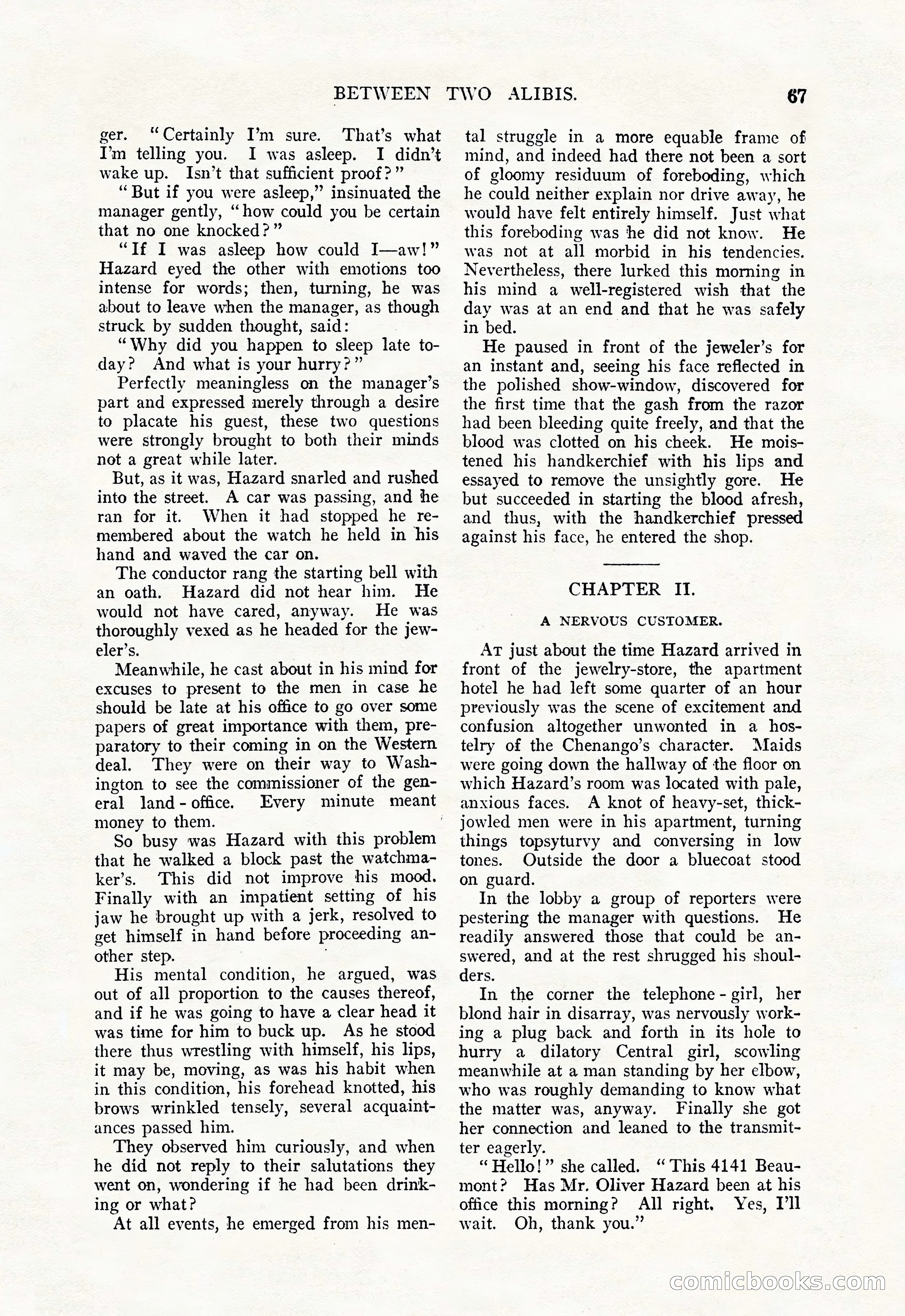
A restored page from Pulp Fiction, 1912. Page through the whole issue in the reader above.
📄 Transcribed text from this page (OCR, searchable)
Machine-transcribed from the original scan — historical spelling and the odd misread are preserved.
BETWEEN TWO ALIBIS. ger. “Certainly I’m sure. That’s what I’m telling you. I was asleep. I didn’t wake up. Isn’t that sufficient proof?” ‘But if you were asleep,” insinuated the manager gently, “how could you be certain that no one knocked?” “Tf I was asleep how could I—aw!” Hazard eyed the other with emotions too intense for words; then, turning, he was about to leave when the manager, as though struck by sudden thought, said: , “Why did you happen to sleep late to- day? And what is your hurry?” Perfectly meaningless on the manager’s part and expressed merely through a desire to placate his guest, these two questions were strongly brought to both their minds not a great while later. But, as it was, Hazard snarled and rushed into the street. A car was passing, and he ran for it. When it had stopped he re- membered about the watch he held in his hand and waved the car on. The conductor rang the starting bell with an oath. Hazard did not hear him. He would not have cared, anyway. He was thoroughly vexed as he headed for the jew- eler’s. 7 Meanwhile, he cast about in his mind for excuses to present to the men in case he should be late at his office to go over some papers of great importance with them, pre- paratory to their coming in on the Western deal. They were on their way to Wash- ington to see the commissioner of the gen- eral land - office. money to them. So busy was Hazard with this problem that he walked a block past the watchma- ker’s. This did not improve his mood. Finally with an impatient setting of his jaw he brought up with a jerk, resolved to get himself in hand before proceeding an- other step. ? His mental condition, he argued, was out of all proportion to the causes thereof, and if he was going to have a clear head it was time for him to buck up. As he stood there thus wrestling with himself, his lips, it may be, moving, as was his habit when in this condition, his forehead knotted, his brows wrinkled tensely, several acquaint- ances passed him. They observed him curiously, and when he did not reply to their salutations they went on, wondering if he had been drink- ing or what? At all events, he emerged from his men- Every minute meant 67 tal struggle in a more equable frame of mind, and indeed had there not been a sort of gloomy residuum of foreboding, which he could neither explain nor drive away, he would have felt entirely himself. Just what this foreboding was he did not know. He was not at all morbid in his tendencies. Nevertheless, there lurked this morning in his mind a well-registered wish that the day was at an end and that he was safely in bed. He paused in front of the jeweler’s for an instant and, seeing his face reflected in the polished show-window, discovered for the first time that the gash from the razor had been bleeding quite freely, and that the blood was clotted on his cheek. He mois- tened his handkerchief with his lips and essayed to remove the unsightly gore. He but succeeded in starting the blood afresh, and thus, with the handkerchief pressed against his face, he entered the shop. CHAPTER II. A NERVOUS CUSTOMER. AT just about the time Hazard arrived in front of the jewelry-store, the apartment hotel he had left some quarter of an hour previously was the scene of excitement and confusion altogether unwonted in a hos- telry of the Chenango’s character. Maids were going down the hallway of the floor on which Hazard’s room was located with pale, anxious faces. A knot of heavy-set, thick- jowled men were in his apartment, turning things topsyturvy and conversing in low tones. Outside the door a bluecoat stood on guard. In the lobby a group of reporters were pestering the manager with questions. He readily answered those that could be an- swered, and at the rest shrugged his shoul- ders. In the corner the telephone - girl, her blond hair in disarray, was nervously work- ing a plug back and forth in its hole to hurry a dilatory Central girl, scowling meanwhile at a man standing by her elbow, who was roughly demanding to know what the matter was, anyway. Finally she got her connection and leaned to the transmit- ter eagerly. “Hello!” she called. ‘This 4141 Beau- mont? Has Mr. Oliver Hazard been at his office this morning? All right, Yes, Ill wait. Oh, thank you.” (CO Ghook