
Pulp Fiction, 1912 · page 79 of 238
The Argosy, April 1912 — page 79: what you’re looking at
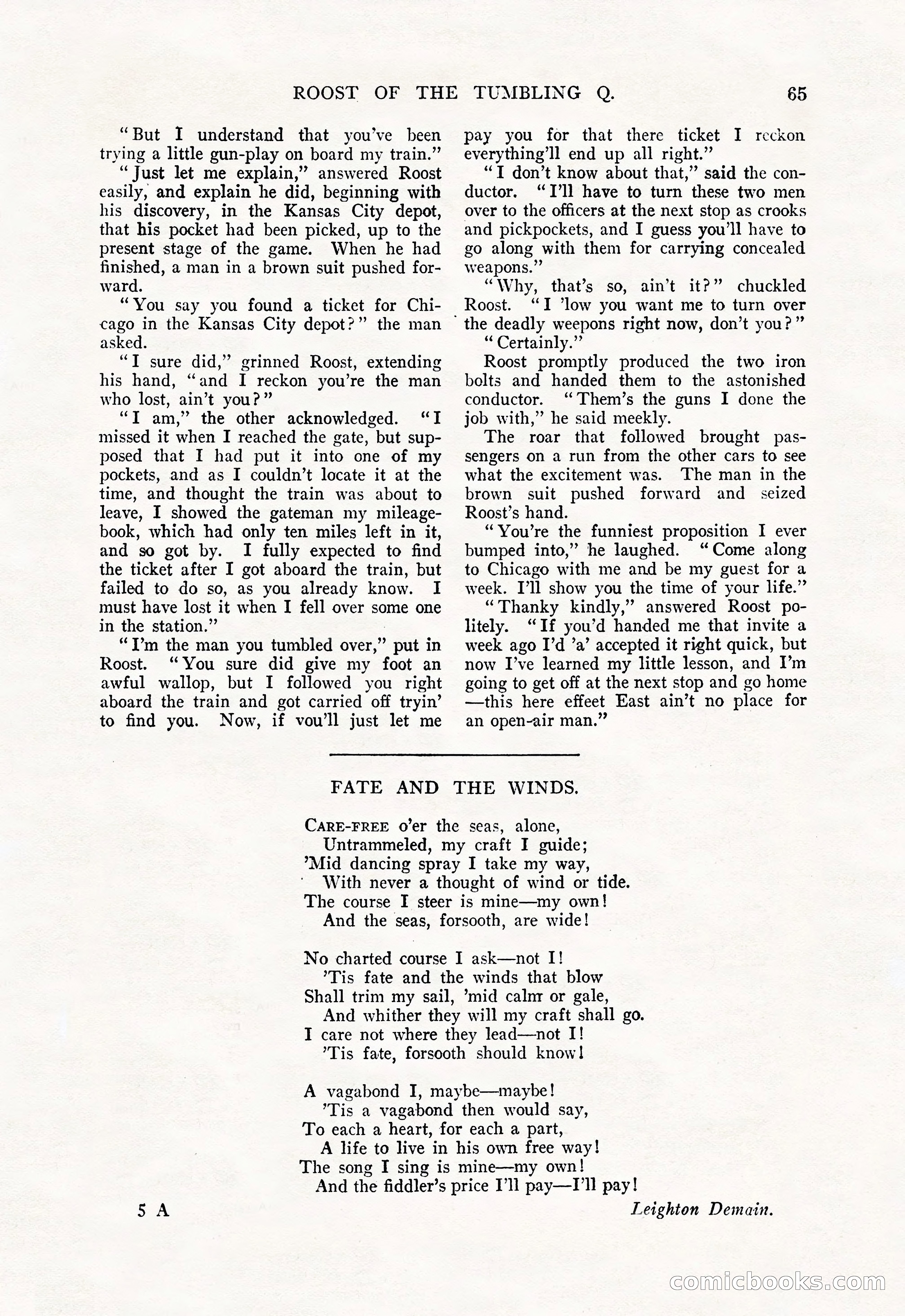
A restored page from Pulp Fiction, 1912. Page through the whole issue in the reader above.
📄 Transcribed text from this page (OCR, searchable)
Machine-transcribed from the original scan — historical spelling and the odd misread are preserved.
ROOST OF THE TUMBLING Q. “But I understand that you’ve been trying a little gun-play on board my train.” “Just let me explain,” answered Roost easily, and explain he did, beginning with his discovery, in the Kansas City depot, that his pocket had been picked, up to the present stage of the game. When he had finished, a man in a brown suit pushed for- ward. “You say you found a ticket for Chi- cago in the Kansas City depot?” the man asked. “T sure did,” grinned Roost, extending his hand, “and I reckon you’re the man who lost, ain’t you?” ‘“T am,” the other acknowledged. “I missed it when I reached the gate, but sup- posed that I had put it into one of my pockets, and as I couldn’t locate it at the time, and thought the train was about to leave, I showed the gateman my mileage- book, which had only ten miles left in it, and so got by. I fully expected to find the ticket after I got aboard the train, but failed to do so, as you already know. I must have lost it when I fell over some one in the station.” . “I’m the man you tumbled over,” put in Roost. “You sure did give my foot an awful wallop, but I followed you right aboard the train and got carried off tryin’ to find you. Now, if vou’ll just let me FATE AND 65 pay you for that there ticket I reckon everything’ll end up all right.” “I don’t know about that,” said the con- ductor. “I’ll have to turn these two men over to the officers at the next stop as crooks and pickpockets, and I guess you’ll have to go along with them for carrying concealed weapons.” “Why, that’s so, ain’t it?” chuckled Roost. “I ‘low you want me to turn over ‘the deadly weepons right now, don’t you?” “ Certainly.” Roost promptly produced the two iron bolts and handed them to the astonished conductor. ‘‘Them’s the guns I done the job with,” he said meekly. The roar that followed brought pas- sengers on a run from the other cars to see what the excitement was. The man in the brown suit pushed forward and _ seized Roost’s hand. “You’re the funniest proposition I ever bumped into,” he laughed. “Come along to Chicago with me and be my guest for a week. J’ll show you the time of your life.” “Thanky kindly,” answered Roost po- litely. “If you’d handed me that invite a week ago I’d ’a’ accepted it right quick, but now I’ve learned my little lesson, and I’m going to get off at the next stop and go home —this here effeet East ain’t no place for an open-air man.” THE WINDS. CARE-FREE o’er the seas, alone, Untrammeled, my craft I guide; ’*Mid dancing spray I take my way, With never a thought of wind or tide. The course I steer is mine—my own! And the seas, forsooth, are wide! No charted course I ask—not I! ’Tis fate and the winds that blow Shall trim my sail, ’mid calm or gale, And whither they will my craft shall go. I care not where they lead—not I! Tis fate, forsooth should know! A vagabond I, maybe—maybe! ’Tis a vagabond then would say, To each a heart, for each a part, A life to live in his own free way! The song I sing is mine—my own! And the fiddler’s price I'l] pay—I’ll pay! Sk Leighton Demain. CoOmicloool. CO