
Pulp Fiction, 1912 · page 60 of 238
The Argosy, April 1912 — page 60: what you’re looking at
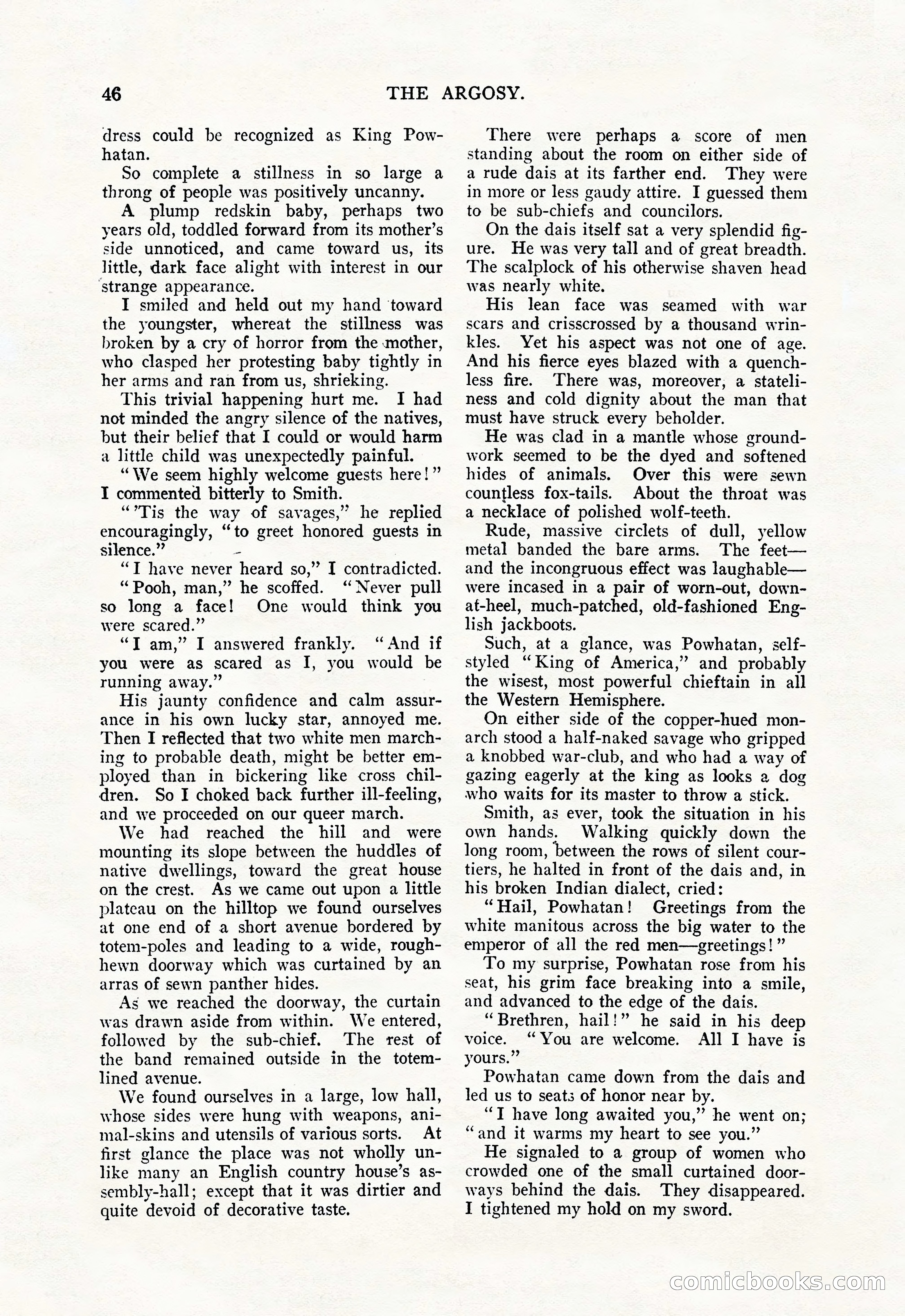
A restored page from Pulp Fiction, 1912. Page through the whole issue in the reader above.
📄 Transcribed text from this page (OCR, searchable)
Machine-transcribed from the original scan — historical spelling and the odd misread are preserved.
46 dress could be recognized as King Pow- hatan. | So complete a stillness in so large a throng of people was positively uncanny. A plump redskin baby, perhaps two years old, toddled forward from its mother’s side unnoticed, and came toward us, its little, dark face alight with interest in our ‘strange appearance. I smiled and held out my hand ‘toward the youngster, whereat the stillness was broken by a cry of horror from the mother, who clasped her protesting baby tightly in her arms and ran from us, shrieking. This trivial happening hurt me. I had not minded the angry silence of the natives, but their belief that I could or would harm a little child was unexpectedly painful. “We seem highly welcome guests here!” I commented bitterly to Smith. “°Tis the way of savages,” he replied encouragingly, “to greet honored guests in silence.” = ‘““T have never heard so,”’ I contradicted. “Pooh, man,” he scoffed. “Never pull so long a face! One would think you were scared.” “JT am,” I answered frankly. ‘“ And if you were as scared as I, you would be running away.” His jaunty confidence and calm assur- ance in his own lucky star, annoyed me. Then I reflected that two white men march- ing to probable death, might be better em- ployed than in bickering like cross chil- dren. So I choked back further ill-feeling, and we proceeded on our queer march. We had reached the hill and were mounting its slope between the huddles of native dwellings, toward the great house on the crest. As we came out upon a little plateau on the hilltop we found ourselves at one end of a short avenue bordered by totem-poles and leading to a wide, rough- hewn doorway which was curtained by an arras of sewn panther hides. As we reached the doorway, the curtain was drawn aside from within. We entered, followed by the sub-chief. The rest of the band remained outside in the totem- lined avenue. We found ourselves in a large, low hall, whose sides were hung with weapons, ani- mal-skins and utensils of various sorts. At first glance the place was not wholly un- like many an English country house’s as- sembly-hall; except that it was dirtier and quite devoid of decorative taste. THE ARGOSY. There were perhaps a score of men standing about the room on either side of a rude dais at its farther end. They were in more or less gaudy attire. I guessed them to be sub-chiefs and councilors. On the dais itself sat a very splendid fig- ure. He was very tall and of great breadth. The scalplock of his otherwise shaven head was nearly white. His lean face was seamed with war scars and crisscrossed by a thousand wrin- kles. Yet his aspect was not one of age. And his fierce eyes blazed with a quench- less fire. ‘There was, moreover, a stateli- ness and cold dignity about the man that must have struck every beholder. He was clad in a mantle whose sround- work seemed to be the dyed and softened hides of animals. Over this were sewn countless fox-tails. About the throat was a necklace of polished wolf-teeth. Rude, massive circlets of dull, yellow metal banded the bare arms. The feet— and the incongruous effect was laughable— were incased in a pair of worn-out, down- at-heel, much-patched, old-fashioned Eng- lish jackboots. Such, at a glance, was Powhatan, self- styled “King of America,” and probably the wisest, most powerful chieftain in all the Western Hemisphere. On either side of the copper-hued mon- arch stood a half-naked savage who gripped a knobbed war-club, and who had a way of gazing eagerly at the king as looks a dog who waits for its master to throw a stick. Smith, as ever, took the situation in his own hands. Walking quickly down the long room, between the rows of silent cour- tiers, he halted in front of the dais and, in his broken Indian dialect, cried: “Hail, Powhatan! Greetings from the white manitous across the big water to the emperor of all the red men—greetings! ” To my surprise, Powhatan rose from his seat, his grim face breaking into a smile, and advanced to the edge of the dais. “Brethren, hail!” he said in his deep voice. “You are welcome. All I have is yours.” Powhatan came down from the dais and led us to seats of honor near by. ‘“T have long awaited you,” he went on; “and it warms my heart to see you.” He signaled to a group of women who crowded one of the small curtained door- ways behind the dais. They disappeared. I tightened my hold on my sword. cComicloool. (CO