
Pulp Fiction, 1912 · page 55 of 238
The Argosy, April 1912 — page 55: what you’re looking at
A restored page from Pulp Fiction, 1912. Page through the whole issue in the reader above.
📄 Transcribed text from this page (OCR, searchable)
Machine-transcribed from the original scan — historical spelling and the odd misread are preserved.
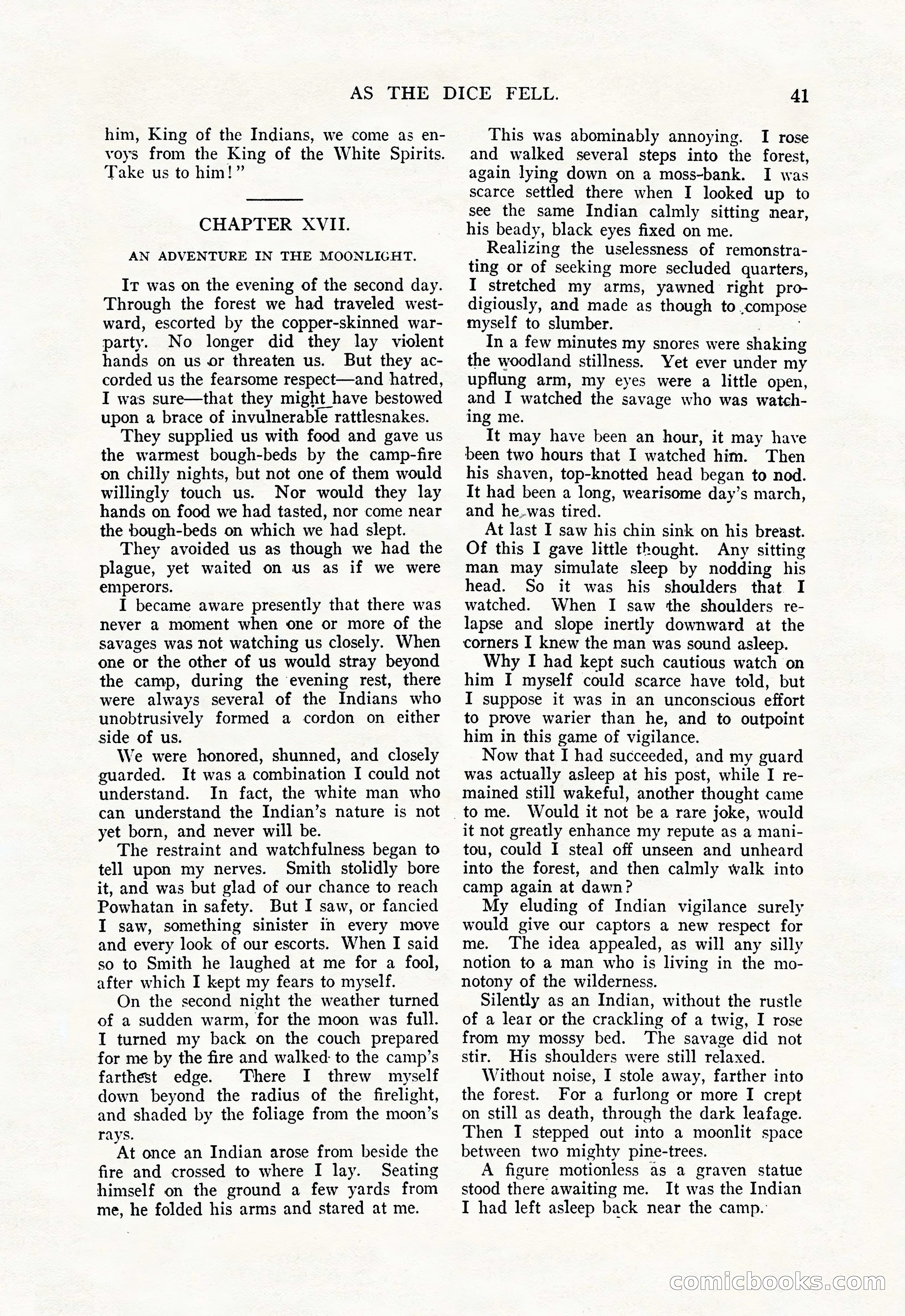
AS THE DICE FELL. him, King of the Indians, we come as en- voys from the King of the White Spirits. Take us to him!” CHAPTER XVII. AN ADVENTURE IN THE MOONLIGHT. Ir was on the evening of the second day. Through the forest we had traveled west- ward, escorted by the copper-skinned war- party. No longer did they lay violent hands on us or threaten us. But they ac- corded us the fearsome respect—and hatred, I was sure—that they might have bestowed upon a brace of invulnerable rattlesnakes. They supplied us with food and gave us the warmest bough-beds by the camp-fire on chilly nights, but not one of them would willingly touch us. Nor would they lay hands on food we had tasted, nor come near the bough-beds on which we had slept. They avoided us as though we had the plague, yet waited on us as if we were emperors. I became aware presently that there was never a moment when one or more of the savages was not watching us closely. When one or the other of us would stray beyond the camp, during the evening rest, there were always several of the Indians who unobtrusively formed a cordon on either side of us. We were honored, shunned, and closely guarded. It was a combination I could not understand. In fact, the white man who can understand the Indian’s nature is not yet born, and never will be. The restraint and watchfulness began to tell upon my nerves. Smith stolidly bore it, and was but glad of our chance to reach Powhatan in safety. But I saw, or fancied I saw, something sinister in every move and every look of our escorts. When I said so to Smith he laughed at me for a fool, after which I kept my fears to myself. On the second night the weather turned of a sudden warm, for the moon was full. I turned my back on the couch prepared for me by the fire and walked: to the camp’s farthest edge. There I threw myself down beyond the radius of the firelight, and shaded by the foliage from the moon’s rays. ‘At once an Indian arose from beside the fire and crossed to where I lay. Seating himself on the ground a few yards from me, he folded his arms and stared at me. 4] This was abominably annoying. I rose and walked several steps into the forest, again lying down on a moss-bank. I was scarce settled there when I looked up to see the same Indian calmly sitting near, his beady, black eyes fixed on me. Realizing the uselessness of remonstra- ting or of seeking more secluded quarters, I stretched my arms, yawned right pro- digiously, and made as though to .compose myself to slumber. , In a few minutes my snores were shaking the woodland stillness. Yet ever under my upflung arm, my eyes were a little open, and I watched the savage who was watch- ing me. It may have been an hour, it may have been two hours that I watched him. Then his shaven, top-knotted head began to nod. It had been a long, wearisome day’s march, and he.was tired. At last I saw his chin sink on his breast. Of this I gave little thought. Any sitting man may simulate sleep by nodding his head. So it was his shoulders that. I watched. When I saw the shoulders re- lapse and slope inertly downward at the corners I knew the man was sound asleep. Why I had kept such cautious watch on him I myself could scarce have told, but I suppose it was in an unconscious effort to prove warier than he, and to outpoint him in this game of vigilance. Now that I had succeeded, and my guard was actually asleep at his post, while I re- mained still wakeful, another thought came tome. Would it not be a rare joke, would it not greatly enhance my repute as a mani- tou, could I steal off unseen and unheard into the forest, and then calmly walk into camp again at dawn? My eluding of Indian vigilance surely would give our captors a new respect for me. ‘The idea appealed, as will any silly notion to a man who is living in the mo- notony of the wilderness. Silently as an Indian, without the rustle of a lear or the crackling of a twig, I rose from my mossy bed. The savage did not stir. His shoulders were still relaxed. Without noise, I stole away, farther into the forest. For a furlong or more I crept on still as death, through the dark leafage. Then I stepped out into a moonlit space between two mighty pine-trees. A figure motionless as a graven statue stood there awaiting me. It was the Indian I had left asleep back near the camp.’ Colm Ghook CO