
Pulp Fiction, 1912 · page 42 of 238
The Argosy, April 1912 — page 42: what you’re looking at
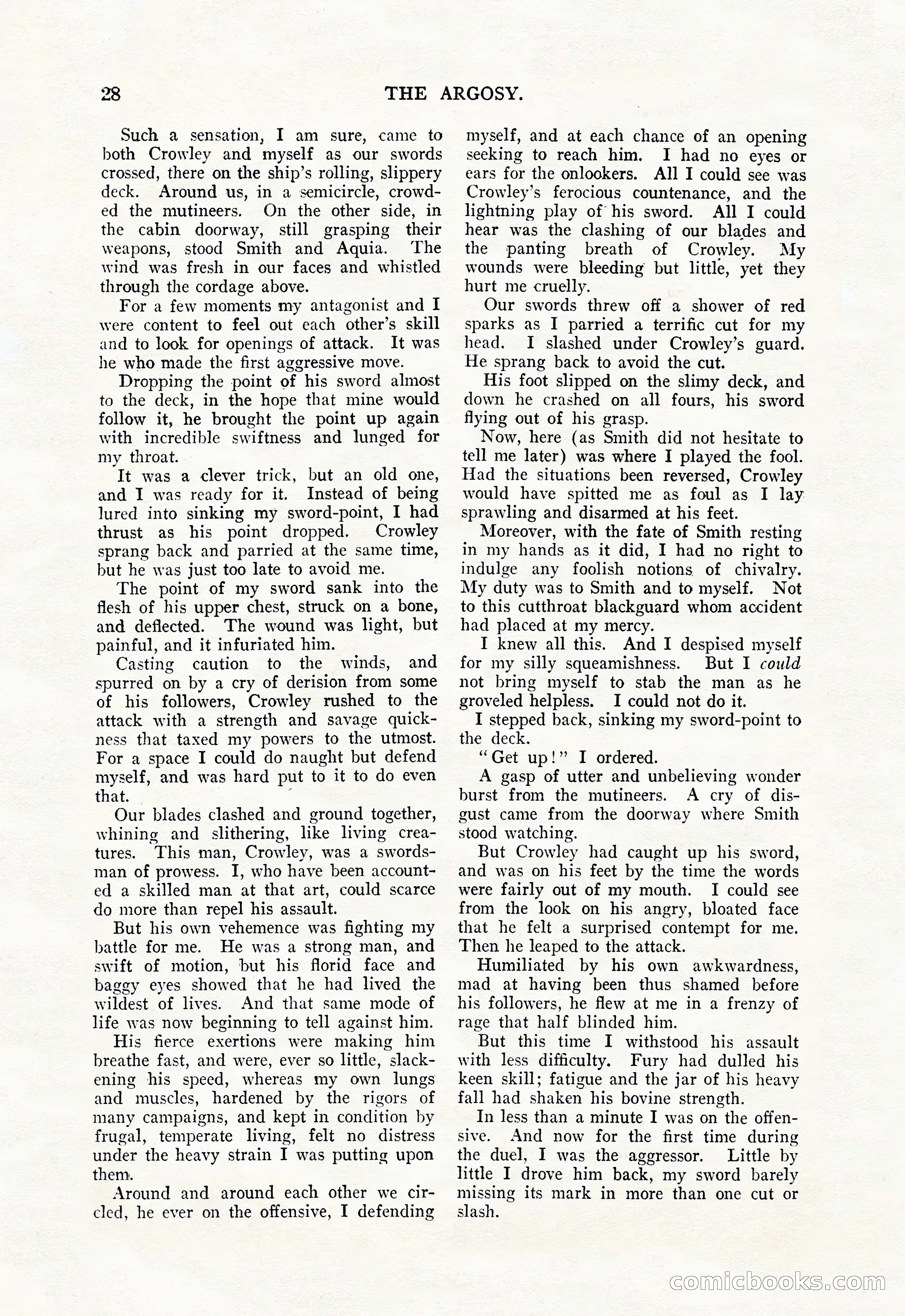
A restored page from Pulp Fiction, 1912. Page through the whole issue in the reader above.
📄 Transcribed text from this page (OCR, searchable)
Machine-transcribed from the original scan — historical spelling and the odd misread are preserved.
28 Such a sensation, I am sure, came to both Crowley and myself as our swords crossed, there on the ship’s rolling, slippery deck. Around us, in a semicircle, crowd- ed the mutineers. On the other side, in the cabin doorway, still grasping their weapons, stood Smith and Aquia. ‘The wind was fresh in our faces and whistled through the cordage above. For a few moments my antagonist and I were content to feel out each other’s skill and to look for openings of attack. It was he who made the first aggressive move. Dropping the point of his sword almost to the deck, in the hope that mine would follow it, he brought the point up again with incredible swiftness and lunged for my throat. It was a clever trick, but an old one, and I was ready for it. Instead of being lured into sinking my sword-point, I had thrust as his point dropped. Crowley sprang back and parried at the same time, but he was just too late to avoid me. The point of my sword sank into the flesh of his upper chest, struck on a bone, and deflected. The wound was light, but painful, and it infuriated him. Casting caution to the winds, and spurred on by a cry of derision from some of his followers, Crowley rushed to the attack with a strength and savage quick- ness that taxed my powers to the utmost. For a space I could do naught but defend myself, and was hard put to it to do even that. | Our blades clashed and ground together, whining and slithering, like living crea- tures. This man, Crowley, was a swords- man of prowess. I, who have been account- ed a skilled man at that art, could scarce do more than repel his assault. But his own vehemence was fighting my battle for me. He was a strong man, and swift of motion, but his florid face and baggy eyes showed that he had lived the wildest of lives. And that same mode of life was now beginning to tell against him. His fierce exertions were making him breathe fast, and were, ever so little, slack- ening his speed, whereas my own lungs and muscles, hardened by the rigors of many campaigns, and kept in condition by frugal, temperate living, felt no distress under the heavy strain I was putting upon them. Around and around each other we cir- cled, he ever on the offensive, I defending THE ARGOSY. myself, and at each chance of an opening seeking to reach him. I had no eyes or ears for the onlookers. All I could see was Crowley’s ferocious countenance, and the lightning play of his sword. All I could hear was the clashing of our blades and the panting breath of Crowley. My wounds were bleeding but little, yet they hurt me cruelly. Our swords threw off a shower of red sparks as I parried a terrific cut for my head. I slashed under Crowley’s guard. He sprang back to avoid the cut. His foot slipped on the slimy deck, and down he crashed on all fours, his sword flying out of his grasp. Now, here (as Smith did not hesitate to tell me later) was where I played the fool. Had the situations been reversed, Crowley would have spitted me as foul as I lay sprawling and disarmed at his feet. Moreover, with the fate of Smith resting in my hands as it did, I had no right to indulge any foolish notions of chivalry. My duty was to Smith and to myself. Not to this cutthroat blackguard whom accident had placed at my mercy. I knew all this. And I despised myself for my silly squeamishness. But I could not bring myself to stab the man as he groveled helpless. I could not do it. I stepped back, sinking my sword-point to the deck. “Get up!” I ordered. A gasp of utter and unbelieving wonder burst from the mutineers. A cry of dis- gust came from the doorway where Smith stood watching. But Crowley had caught up his sword, and was on his feet by the time the words were fairly out of my mouth. I could see from the look on his angry, bloated face that he felt a surprised contempt for me. Then he leaped to the attack. Humiliated by his own awkwardness, mad at having been thus shamed before his followers, he flew at me in a frenzy of rage that half blinded him. But this time I withstood his assault with less difficulty. Fury had dulled his keen skill; fatigue and the jar of his heavy fall had shaken his bovine strength. In less than a minute I was on the offen- sive. And now for the first time during the duel, I was the aggressor. Little by little I drove him back, my sword barely missing its mark in more than one cut or slash. (C(O) Ghook