
Pulp Fiction, 1912 · page 37 of 238
The Argosy, April 1912 — page 37: what you’re looking at
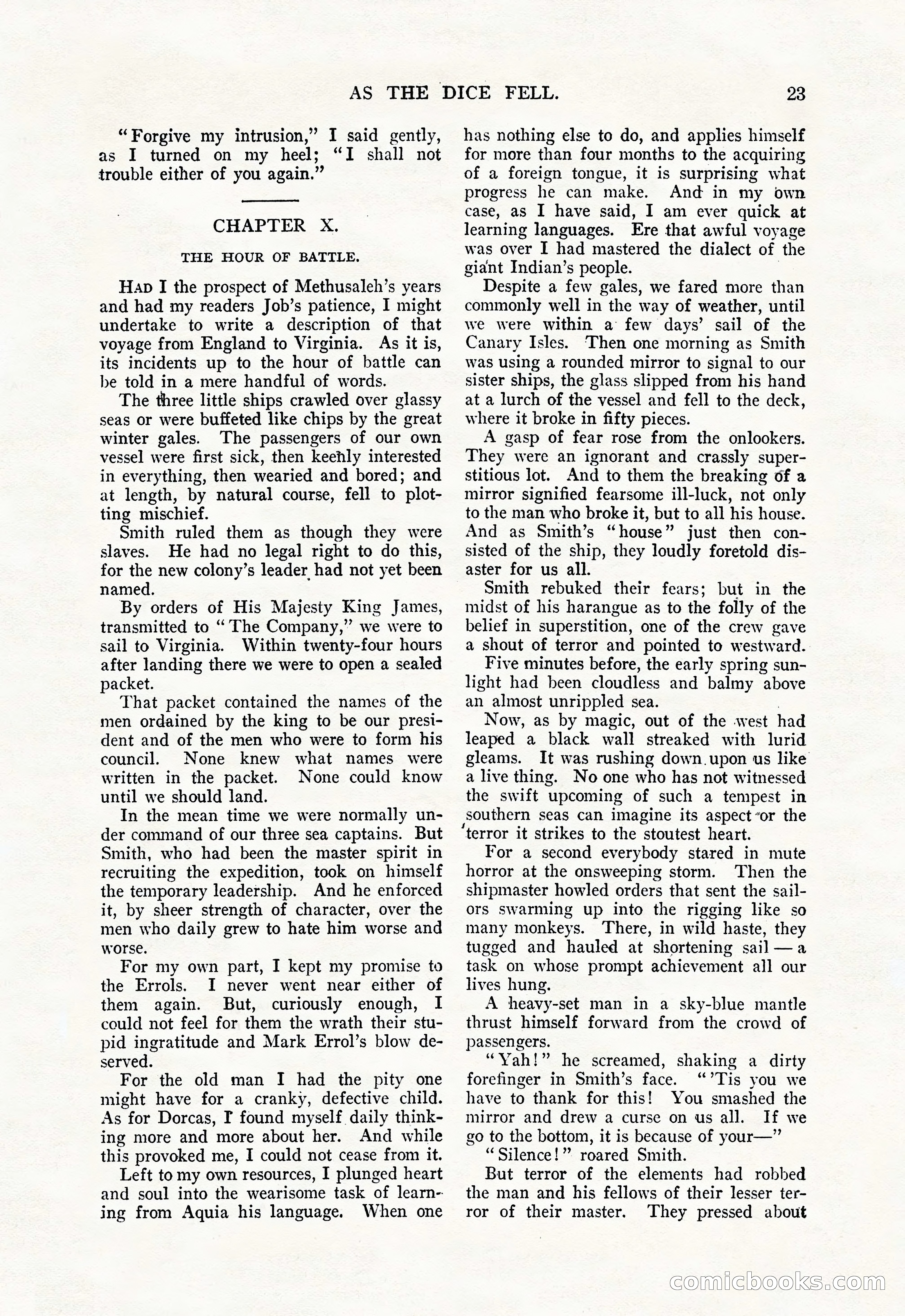
A restored page from Pulp Fiction, 1912. Page through the whole issue in the reader above.
📄 Transcribed text from this page (OCR, searchable)
Machine-transcribed from the original scan — historical spelling and the odd misread are preserved.
AS THE DICE FELL. 23 “Forgive my intrusion,” I said gently, as I turned on my heel; “I shall not trouble either of you again.” CHAPTER X. THE HOUR OF BATTLE. Hap I the prospect of Methusaleh’s years and had my readers Job’s patience, I might undertake to write a description of that voyage from England to Virginia. As it is, its incidents up to the hour of battle can be told in a mere handful of words. The three little ships crawled over glassy seas or were buffeted like chips by the great winter gales. The passengers of our own vessel were first sick, then keenly interested in everything, then wearied and bored; and at length, by natural course, fell to plot- ting mischief. Smith ruled them as though they were slaves. He had no legal right to do this, for the new colony’s leader had not yet been named. By orders of His Majesty King James, transmitted to “The Company,” we were to sail to Virginia. Within twenty-four hours after landing there we were to open a sealed packet. That packet contained the names of the men ordained by the king to be our presi- dent and of the men who were to form his council. None knew what names were written in the packet. None could know until we should land. In the mean time we were normally un- der command of our three sea captains. But Smith, who had been the master spirit in recruiting the expedition, took on himself the temporary leadership. And he enforced it, by sheer strength of character, over the men who daily grew to hate him worse and worse. For my own part, I kept my promise to the Errols. I never went near either of them again. But, curiously enough, I could not feel for them the wrath their stu- pid ingratitude and Mark Errol’s blow de- served. For the old man I had the pity one might have for a cranky, defective child. As for Dorcas, I found myself daily think- ing more and more about her. And while this provoked me, I could not cease from it. Left to my own resources, I plunged heart and soul into the wearisome task of learn- ing from Aquia his language. When one has nothing else to do, and applies himself for more than four months to the acquiring of a foreign tongue, it is surprising what progress he can make. And in my own case, as I have said, I am ever quick at learning languages. Ere that awful voyage was over I had mastered the dialect of ‘the giant Indian’s people. Despite a few gales, we fared more than commonly well in the way of weather, until we were within a few days’ sail of the Canary Isles. Then one morning as Smith was using a rounded mirror to signal to our sister ships, the glass slipped from his hand at a lurch of the vessel and fell to the deck, where it broke in fifty pieces. A gasp of fear rose from the onlookers. They were an ignorant and crassly super- stitious lot. And to them the breaking of a mirror signified fearsome ill-luck, not only to the man who broke it, but to all his house. And as Smith’s “house” just then con- sisted of the ship, they loudly foretold dis- aster for us all. Smith rebuked their fears; but in the midst of his harangue as to the folly of the belief in superstition, one of the crew gave a shout of terror and pointed to westward. Five minutes before, the early spring sun- light had been cloudless and balmy above an almost unrippled sea. Now, as by magic, out of the west had leaped a black wall streaked with lurid gleams. It was rushing down.upon us like a live thing. No one who has not witnessed the swift upcoming of such a tempest in Southern seas can imagine its aspect~or the ‘terror it strikes to the stoutest heart. For a second everybody stared in mute horror at the onsweeping storm. Then the shipmaster howled orders that sent the sail- ors swarming up into the rigging like so many monkeys. There, in wild haste, they tugged and hauled at shortening sail —a task on whose prompt achievement all our lives hung. A heavy-set man in a sky-blue mantle thrust himself forward from the crowd of passengers. “Yah!” he screamed, shaking a dirty forefinger in Smith’s face. “’Tis you we have to thank for this! You smashed the mirror and drew a curse on us all. If we go to the bottom, it is because of your—” “Silence!” roared Smith. But terror of the elements had robbed the man and his fellows of their lesser ter- ror of their master. They pressed about comicaoolks