
Pulp Fiction, 1912 · page 31 of 238
The Argosy, April 1912 — page 31: what you’re looking at
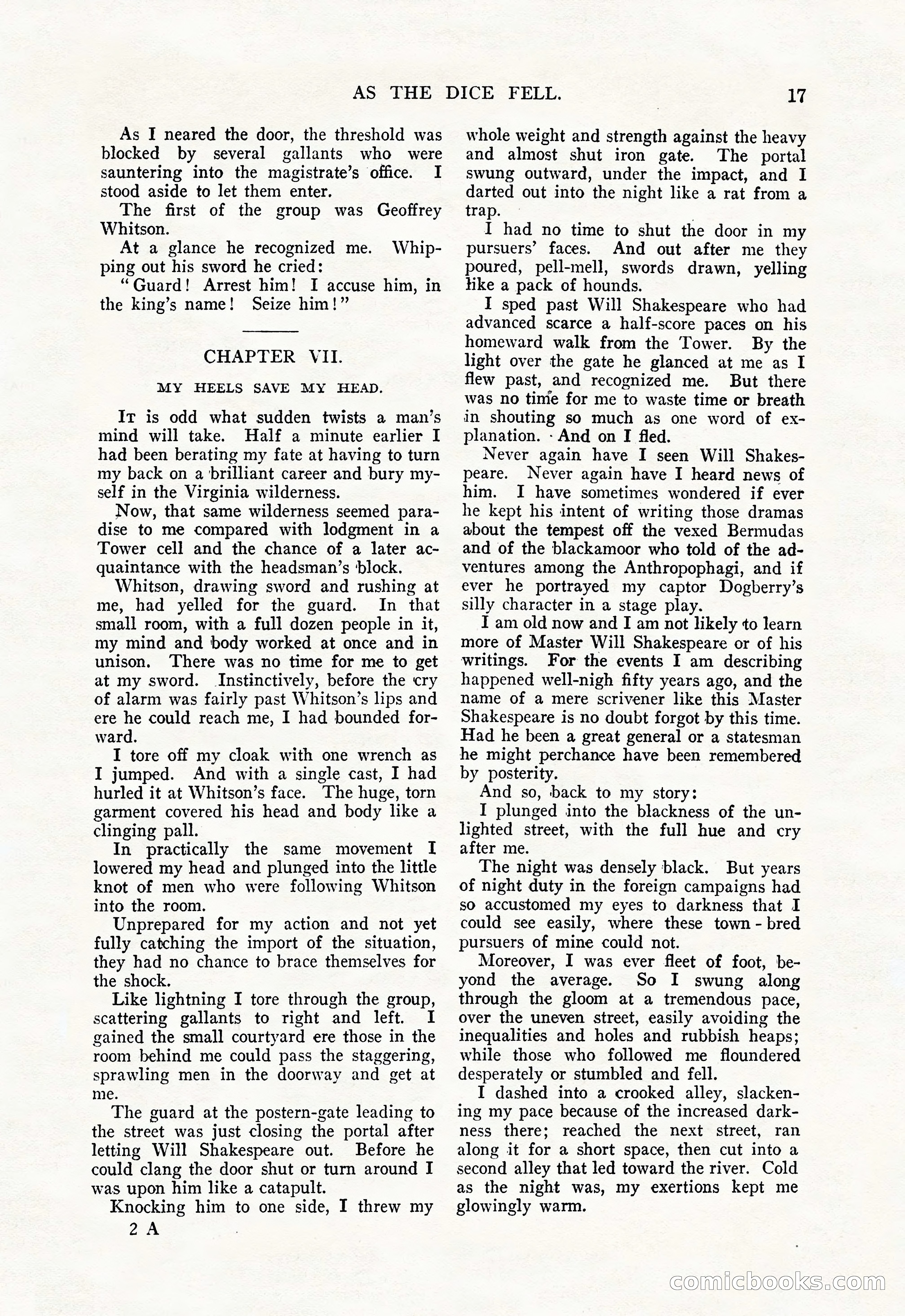
A restored page from Pulp Fiction, 1912. Page through the whole issue in the reader above.
📄 Transcribed text from this page (OCR, searchable)
Machine-transcribed from the original scan — historical spelling and the odd misread are preserved.
AS THE DICE FELL. As I neared the door, the threshold was blocked by several gallants who were sauntering into the magistrate’s office. I stood aside to let them enter. The first of the group was Geoffrey Whitson. At a glance he recognized me. ping out his sword he cried: “Guard! Arrest him! I accuse him, in the king’s name! Seize him!” Whip- CHAPTER VII. MY HEELS SAVE MY HEAD. It is odd what sudden twists a man’s mind will take. Half a minute earlier I had been berating my fate at having to turn my back on a'brilliant career and bury my- self in the Virginia wilderness. Now, that same wilderness seemed para- dise to me compared with lodgment in a Tower cell and the chance of a later ac- quaintance with the headsman’s block. Whitson, drawing sword and rushing at me, had yelled for the guard. In that small room, with a full dozen people in it, my mind and body worked at once and in unison. ‘There was no time for me to get at my sword. Instinctively, before the cry of alarm was fairly past Whitson’s lips and ere he could reach me, I had bounded for- ward. I tore off my cloak with one wrench as I jumped. And with a single cast, I had hurled it at Whitson’s face. The huge, torn garment covered his head and body like a clinging pall. In practically the same movement I lowered my head and plunged into the little knot of men who were following Whitson into the room. Unprepared for my action and not yet fully catching the import of the situation, they had no chance to brace themselves for the shock. Like lightning I tore through the group, scattering gallants to right and left. I gained the small courtyard ere those in the room behind me could pass the staggering, sprawling men in the doorway and get at me. The guard at the postern-gate leading to the street was just closing the portal after letting Will Shakespeare out. Before he could clang the door shut or turn around I was upon him like a catapult. Knocking him to one side, I threw my 24 17 whole weight and strength against the heavy and almost shut iron gate. The portal swung outward, under the impact, and I darted out into the night like a rat from a trap. I had no time to shut the door in my pursuers’ faces. And out after me they poured, pell-mell, swords drawn, yelling hke a pack of hounds. I sped past Will Shakespeare who had advanced scarce a half-score paces on his homeward walk from the Tower. By the light over the gate he glanced at me as I flew past, and recognized me. But there was no time for me to waste time or breath in shouting so much as one word of ex- planation. - And on I fled. Never again have I seen Will Shakes- peare. Never again have I heard news of him. I have sometimes wondered if ever he kept his intent of writing those dramas about the tempest off the vexed Bermudas and of the blackamoor who told of the ad- ventures among the Anthropophagi, and if ever he portrayed my captor Dogberry’s silly character in a stage play. IT am old now and I am not likely to learn more of Master Will Shakespeare or of his writings. For the events I am describing happened well-nigh fifty years ago, and the name of a mere scrivener like this Master Shakespeare is no doubt forgot by this time. Had he been a great general or a statesman he might perchance have been remembered by posterity. And so, back to my story: I plunged into the blackness of the un- lighted street, with the full hue and cry after me. The night was densely black. But years of night duty in the foreign campaigns had so accustomed my eyes to darkness that I could see easily, where these town - bred pursuers of mine could not. Moreover, I was ever fleet of foot, be- yond the average. So I swung along through the gloom at a tremendous pace, over the uneven street, easily avoiding the inequalities and holes and rubbish heaps; while those who followed me floundered desperately or stumbled and fell. I dashed into a crooked alley, slacken- ing my pace because of the increased dark- ness there; reached the next street, ran along it for a short space, then cut into a second alley that led toward the river. Cold as the night was, my exertions kept me glowingly warm. CONMUC NOOK CO