
Pulp Fiction, 1912 · page 26 of 238
The Argosy, April 1912 — page 26: what you’re looking at
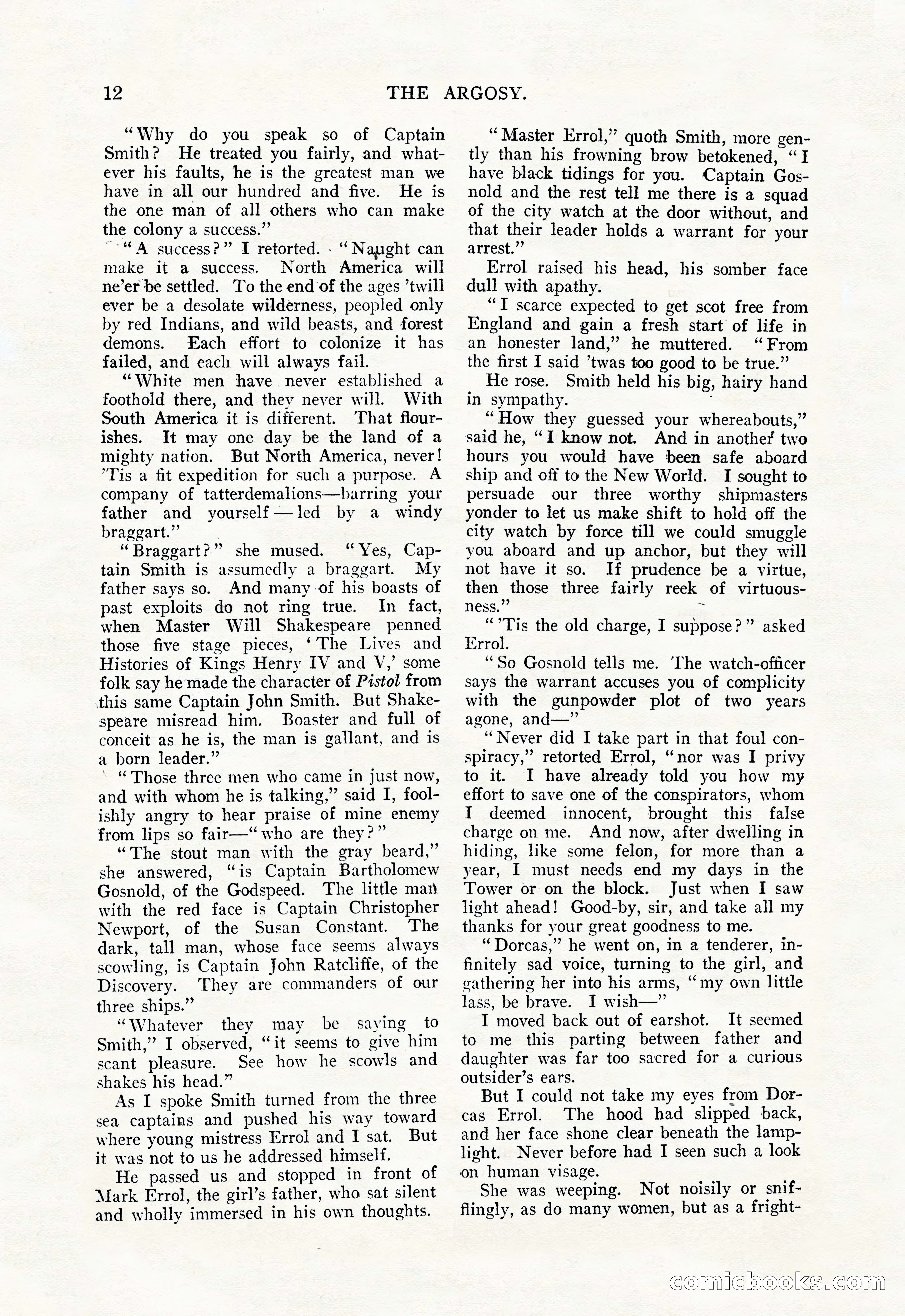
A restored page from Pulp Fiction, 1912. Page through the whole issue in the reader above.
📄 Transcribed text from this page (OCR, searchable)
Machine-transcribed from the original scan — historical spelling and the odd misread are preserved.
12 “Why do you speak so of Captain Smith? He treated you fairly, and what- ever his faults, he is the greatest man we have in all our hundred and five. He is the one man of all others who can make the colony a success.” ~~" A success?” I retorted. - “ Naught can make it a success. North America will ne’er be settled. To the end of the ages ’twill ever be a desolate wilderness, peopled only by red Indians, and wild beasts, and forest demons. Each effort to colonize it has failed, and each will always fail. “White men have never established a foothold there, and thev never will. With South America it is different. That flour- ishes. It may one day be the land of a mighty nation. But North America, never! ‘Tis a fit expedition for such a purpose. A company of tatterdemalions—barring your father and yourself —led by a _ windy braggart.”’ “Brageart?” she mused. “Yes, Cap- tain Smith is assumedly a braggart. My father says so. And many-of his boasts of past exploits do not ring true. In fact, when Master Will Shakespeare penned those five stage pieces, ‘The Lives and Histories of Kings Henry IV and V,’ some folk say he made the character of Pistol from this same Captain John Smith. But Shake- speare misread him. Boaster and full of conceit as he is, the man is gallant, and is a born leader.” ' “Those three men who came in just now, and with whom he is talking,” said I, fool- ishly angry to hear praise of mine enemy from lips so fair—“ who are they?” “The stout man with the gray beard,” she answered, “is Captain Bartholomew Gosnold, of the Godspeed. The little mai with the red face is Captain Christopher Newport, of the Susan Constant. The dark, tall man, whose face seems always scowling, is Captain John Ratcliffe, of the Discovery. They are commanders of our three ships.” “Whatever they may be saying to Smith,” I observed, “it seems to give him scant pleasure. See how he scowls and shakes his head.” As I spoke Smith turned from the three sea captains and pushed his way toward where young mistress Errol and I sat. But it was not to us he addressed himself. He passed us and stopped in front of Mark Errol, the girl’s father, who sat silent and wholly immersed in his own thoughts. b THE ARGOSY. * Master Errol,” quoth Smith, more gen- tly than his frowning brow betokened, “I have black tidings for you. Captain Gos- nold and the rest tell me there is a squad of the city watch at the door without, and that their leader holds a warrant for your arrest.”’ Errol raised his head, his somber face dull with apathy. “T scarce expected to get scot free from England and gain a fresh start of life in an honester land,” he muttered. “From the first I said ’twas too good to be true.” He rose. Smith held his big, hairy hand in sympathy. “How they guessed your whereabouts,” said he, “I know not. And in anothef two hours you would have been safe aboard ship and off to the New World. I sought to persuade our three worthy shipmasters yonder to let us make shift to hold off the city watch by force till we could smuggle you aboard and up anchor, but they will not have it so. If prudence be a virtue, then those three fairly reek of virtuous- ness.” “°Tis the old charge, I suppose?” asked Errol. “So Gosnold tells me. The watch-officer says the warrant accuses you of complicity with the gunpowder plot of two years agone, and—”’ ‘“Never did I take part in that foul con- spiracy,” retorted Errol, “nor was I privy to it. I have already told you how my effort to save one of the conspirators, whom I deemed innocent, brought this false charge on me. And now, after dwelling in hiding, like some felon, for more than a year, I must needs end my days in the Tower or on the block. Just when I saw light ahead! Good-by, sir, and take all my thanks for your great goodness to me. “ Dorcas,” he went on, in a tenderer, 1n- finitely sad voice, turning to the girl, and gathering her into his arms, “my own little lass, be brave. I wish—” I moved back out of earshot. It seemed to me this parting between father and daughter was far too sacred for a curious outsider’s ears. But I could not take my eyes from Dor- cas Errol. The hood had slipped back, and her face shone clear beneath the lamp- light. Never before had I seen such a look on human visage. She was weeping. Not noisily or snif- flingly, as do many women, but as a fright- JOO) (C(O) S