
Pulp Fiction, 1912 · page 20 of 238
The Argosy, April 1912 — page 20: what you’re looking at
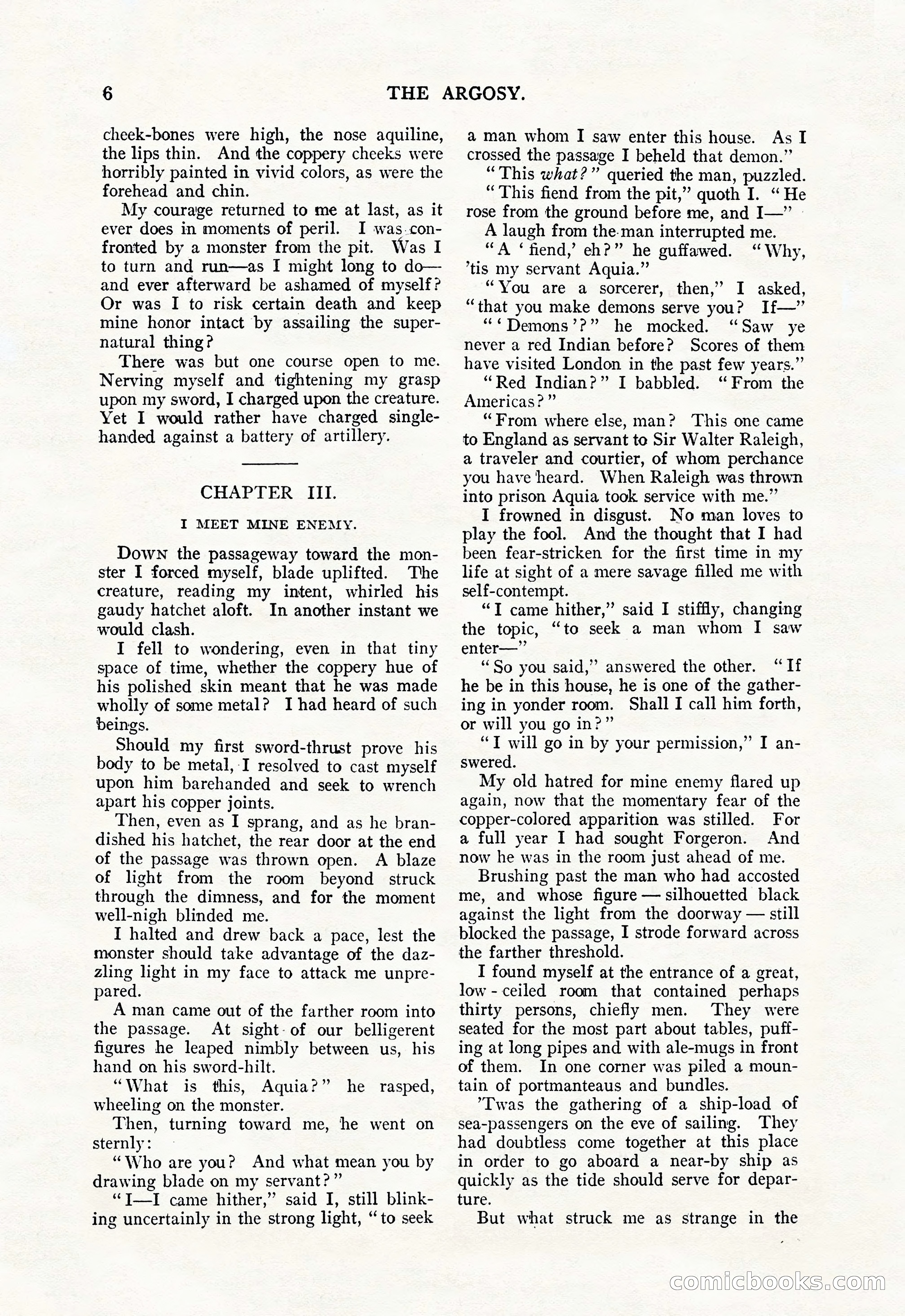
A restored page from Pulp Fiction, 1912. Page through the whole issue in the reader above.
📄 Transcribed text from this page (OCR, searchable)
Machine-transcribed from the original scan — historical spelling and the odd misread are preserved.
6 THE ARGOSY. cheek-bones were high, the nose aquiline, the lips thin. And the coppery cheeks were horribly painted in vivid colors, as were the forehead and chin. My courage returned to me at last, as it ever does in moments of peril. I was.con- fronted by a monster from the pit. Was I to turn and run—as I might long to do— and ever afterward be ashamed of myself? Or was I to risk certain death and keep mine honor intact by assailing the super- natural thing? There was but one course open to me. Nerving myself and tightening my grasp upon my sword, I charged upon the creature. Yet I would rather have charged single- handed against a battery of artillery. CHAPTER III. I MEET MINE ENEMY. Down the passageway toward the mon- ster I forced myself, blade uplifted. The creature, reading my intent, whirled his gaudy hatchet aloft. In another instant we would clash. I fell to wondering, even in that tiny space of time, whether the coppery hue of his polished skin meant that he was made wholly of some metal? I had heard of such beings. Should my first sword-thrust prove his body to be metal, I resolved to cast myself upon him barehanded and seek to wrench apart his copper joints. Then, even as I sprang, and as he bran- dished his hatchet, the rear door at the end of the passage was thrown open. A blaze of light from the room beyond struck through the dimness, and for the moment well-nigh blinded me. I halted and drew back a pace, lest the monster should take advantage of the daz- zling light in my face to attack me unpre- pared. A man came out of the farther room into the passage. At sight- of our belligerent figures he leaped nimbly between us, his hand on his sword-hilt. “What is this, Aquia?” wheeling on the monster. Then, turning toward me, he went on sternly: “Who are your? And what mean you by drawing blade on my servant?” “T_T came hither,” said I, still blink- ing uncertainly in the strong light, “to seek he rasped, a man whom I saw enter this house. As I crossed the passage I beheld that demon.” “This what?” queried the man, puzzled. “This fiend from the pit,” quoth I. “He rose from the ground before me, and I—” | A laugh from the.-man interrupted me. “A ‘fiend,’ eh?” he guffawed. “Why, tis my servant Aquia.” “You are a sorcerer, then,” I asked, “that you make demons serve you? If—” “*Demons’?” he mocked. “Saw ye never a red Indian before? Scores of them have visited London in the past few years.” “Red Indian?” I babbled. “From the Americas?” “From where else, man? This one came to England as servant to Sir Walter Raleigh, a traveler and courtier, of whom perchance you have heard. When Raleigh was thrown into prison Aquia took service with me.” I frowned in disgust. No man loves to play the fool. And the thought that I had been fear-stricken for the first time in my life at sight of a mere savage filled me with self-contempt. “T came hither,” said I stiffly, changing the topic, “to seek a man whom I saw enter—”’ “So you said,” answered the other. “If he be in this house, he is one of the gather- ing in yonder room. Shall I call him forth, or will you go in?” “I will go in by your permission,” I an- swered. My old hatred for mine enemy flared up again, now that the momentary fear of the copper-colored apparition was stilled. For a full year I had sought Forgeron. And now he was in the room just ahead of me. Brushing past the man who had accosted me, and whose figure — silhouetted black against the light from the doorway — still blocked the passage, I strode forward across the farther threshold. I found myself at the entrance of a great, low - ceiled room that contained perhaps thirty persons, chiefly men. They were seated for the most part about tables, puff- ing at long pipes and with ale-mugs in front of them. In one corner was piled a moun- tain of portmanteaus and bundles. "Twas the gathering of a ship-load of sea-passengers on the eve of sailing. They had doubtless come together at this place in order to go aboard a near-by ship as quickly as the tide should serve for depar- ture. But what struck me as strange in the COIN NOOK