
Pulp Fiction, 1912 · page 125 of 238
The Argosy, April 1912 — page 125: what you’re looking at
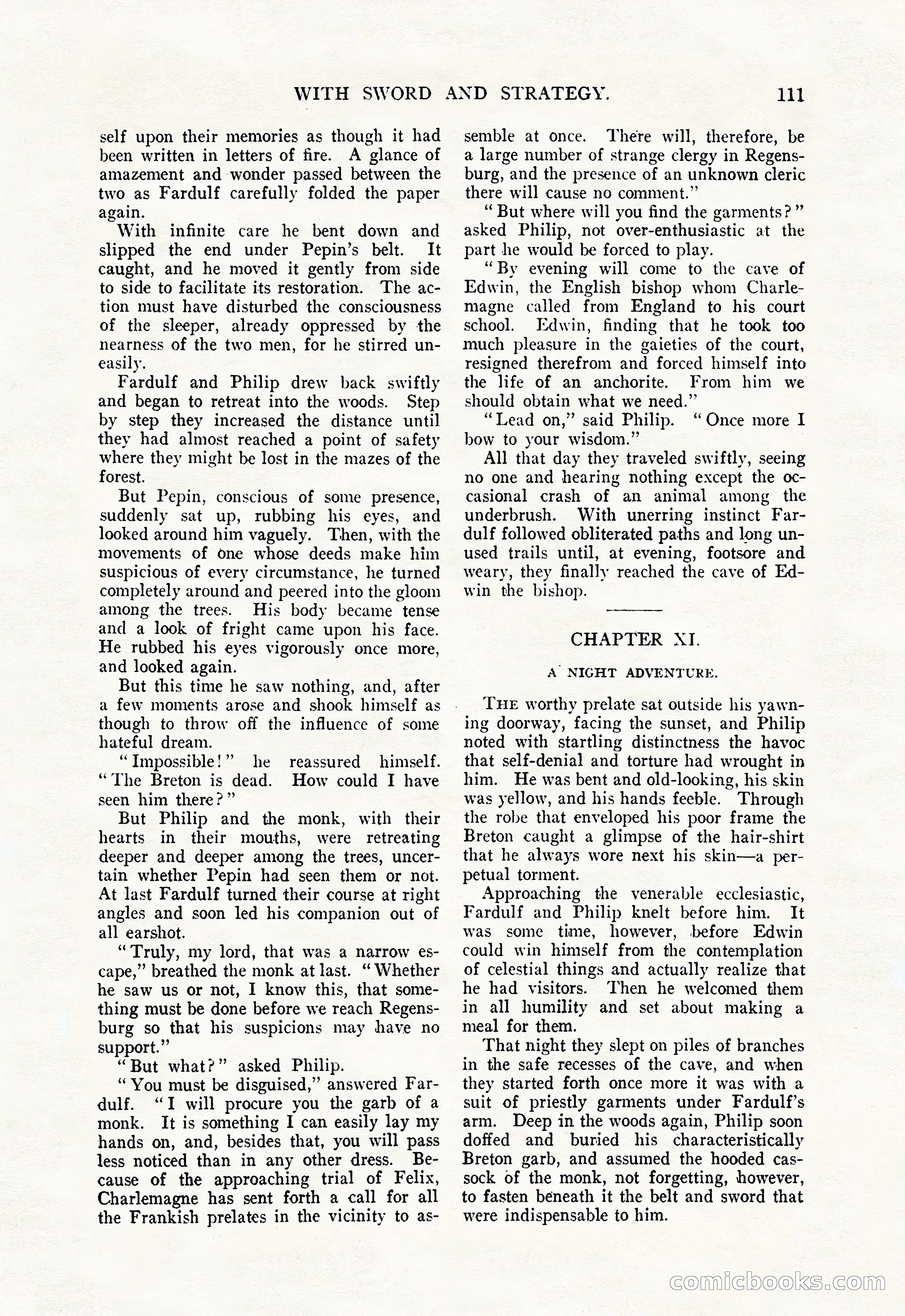
A restored page from Pulp Fiction, 1912. Page through the whole issue in the reader above.
📄 Transcribed text from this page (OCR, searchable)
Machine-transcribed from the original scan — historical spelling and the odd misread are preserved.
WITH SWORD AND STRATEGY. self upon their memories as though it had been written in letters of fire. A glance of amazement and wonder passed between the two as Fardulf carefully folded the paper again. With infinite care he bent down and slipped the end under Pepin’s belt. It caught, and he moved it gently from side to side to facilitate its restoration. The ac- tion must have disturbed the consciousness of the sleeper, already oppressed by the nearness of the two men, for he stirred un- easily. Fardulf and Philip drew back swiftly and began to retreat into the woods. Step by step they increased the distance until they had almost reached a point of safety where they might be lost in the mazes of the forest. But Pepin, conscious of some presence, suddenly sat up, rubbing his eyes, and looked around him vaguely. Then, with the movements of one whose deeds make him suspicious of every circumstance, he turned completely around and peered into the gloom among the trees. His body became tense and a look of fright came upon his face. He rubbed his eyes vigorously once more, and looked again. But this time he saw nothing, and, after a few moments arose and shook himself as though to throw off the influence of some hateful dream. “Impossible!” he reassured himself. “The Breton is dead. How could I have seen him there?” But Philip and the monk, with their hearts in their mouths, were retreating deeper and deeper among the trees, uncer- tain whether Pepin had seen them or not. At last Fardulf turned their course at right angles and soon led his companion out of all earshot. “Truly, my lord, that was a narrow es- cape,” breathed the monk at last. “ Whether he saw us or not, I know this, that some- thing must be done before we reach Regens- burg so that his suspicions may have no support.” “But what?” asked Philip. “You must be disguised,” answered Far- dulf. “I will procure you the garb of a monk. It is something I can easily lay my hands on, and, besides that, you will pass less noticed than in any other dress. Be- cause of the approaching trial of Felix, Charlemagne has sent forth a call for all the Frankish prelates in the vicinity to as- lil semble at once. There will, therefore, be a large number of strange clergy in Regens- burg, and the presence of an unknown cleric there will cause no comment.” ‘But where will you find the garments?” asked Philip, not over-enthusiastic at the part he would be forced to play. “By evening will come to the cave of Edwin, the English bishop whom Charle- magne called from England to his court school. Edwin, finding that he took too much pleasure in the gaieties of the court, resigned therefrom and forced himself into the life of an anchorite. From him we should obtain what we need.” “Lead on,” said Philip. “Once more I bow to your wisdom.” All that day they traveled swiftly, seeing no one and hearing nothing except the oc- casional crash of an animal among the underbrush. With unerring instinct Far- dulf followed obliterated paths and long un- used trails until, at evening, footsore and weary, they finally reached the cave of Ed- win the bishop. CHAPTER NI. A NIGHT ADVENTURE. THE worthy prelate sat outside his yawn- ing doorway, facing the sunset, and Philip noted with startling distinctness the havoc that self-denial and torture had wrought in him. He was bent and old-looking, his skin was yellow, and his hands feeble. Through the robe that enveloped his poor frame the Breton caught a glimpse of the hair-shirt that he always wore next his skin—a per- petual torment. Approaching the venerable ecclesiastic, Fardulf and Philip knelt before him. It was some time, however, before Edwin could win himself from the contemplation of celestial things and actually realize that he had visitors. ‘Then he welcomed them in all humility and set about making a meal for them. That night they slept on piles of branches in the safe recesses of the cave, and when they started forth once more it was with a suit of priestly garments under Fardulf’s arm. Deep in the woods again, Philip soon doffed and buried his characteristically Breton garb, and assumed the hooded cas- sock of the monk, not forgetting, however, to fasten beneath it the belt and sword that were indispensable to him. cComicoool