
Pulp Fiction, 1912 · page 121 of 238
The Argosy, April 1912 — page 121: what you’re looking at
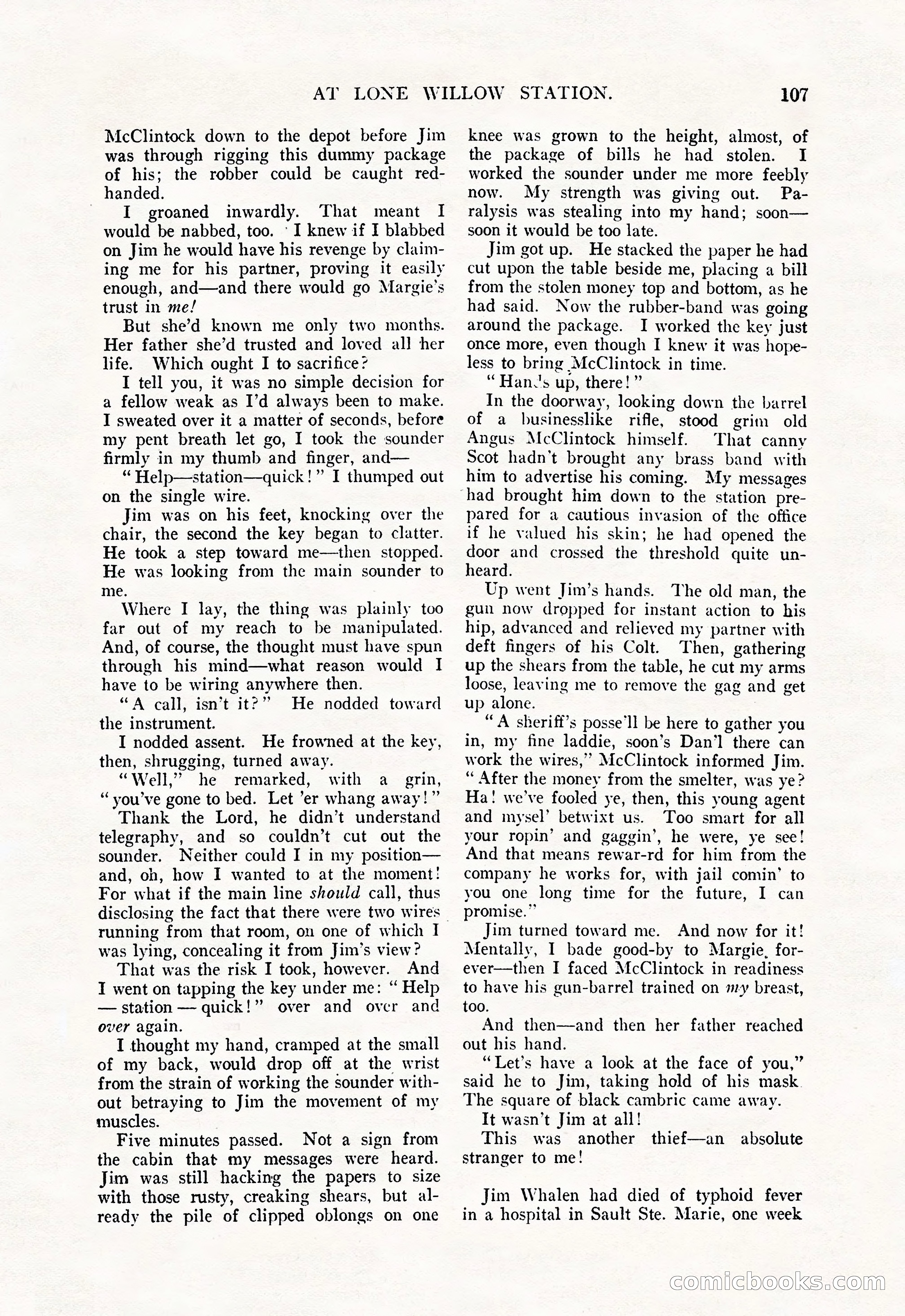
A restored page from Pulp Fiction, 1912. Page through the whole issue in the reader above.
📄 Transcribed text from this page (OCR, searchable)
Machine-transcribed from the original scan — historical spelling and the odd misread are preserved.
AT LONE WILLOW STATION. 107 McClintock down to the depot before Jim was through rigging this dummy package of his; the robber could be caught red- handed. IT groaned inwardly. That meant I would be nabbed, too. ‘I knew if I blabbed on Jim he would have his revenge by claim- ing me for his partner, proving it easily enough, and—and there would go Margie’s trust in me! But she’d known me only two months. Her father she’d trusted and loved all her life. Which ought I to sacrifice? I tell you, it was no simple decision for a fellow weak as I’d always been to make. I sweated over it a matter of seconds, before my pent breath let go, I took the sounder firmly in my thumb and finger, and— “ Help—station—quick!” I thumped out on the single wire. Jim was on his feet, knocking over the chair, the second the key began to clatter. He took a step toward me—then stopped. He was looking from the main sounder to me. Where I lay, the thing was plainly too far out of my reach to be manipulated. And, of course, the thought must have spun through his mind—what reason would I have to be wiring anywhere then. “A call, isn’t it?” He nodded toward the instrument. I nodded assent. He frowned at the key, then, shrugging, turned away. “Well,” he remarked, with a grin, “you've gone to bed. Let ’er whang away!” Thank the Lord, he didn’t understand telegraphy, and so couldn’t cut out the sounder. Neither could I in my position— and, oh, how I wanted to at the moment: For what if the main line should call, thus disclosing the fact that there were two wires — running from that room, on one of which I was lying, concealing it from Jim’s view? That was the risk I took, however. And I went on tapping the key under me: “ Help — station — quick!” over and ovcr and over again. I thought my hand, cramped at the small of my back, would drop off at the wrist from the strain of working the sounder with- out betraying to Jim the movement of my muscles. Five minutes passed. Not a sign from the cabin that my messages were heard. Jim was still hacking the papers to size with those rusty, creaking shears, but al- ready the pile of clipped oblongs on one knee was grown to the height, almost, of the package of bills he had stolen. I worked the sounder under me more feebly now. My strength was giving out. Pa- ralysis was stealing into my hand; soon— soon it would be too late. Jim got up. He stacked the paper he had cut upon the table beside me, placing a bill from the stolen money top and bottom, as he had said. Now the rubber-band was going around the package. I worked the key just once more, even though I knew it was hope- less to bring McClintock in time. ‘ Han.'s up, there!” In the doorway, looking down the barrel of a businesslike rifle, stood grim old Angus McClintock himself. That canny Scot hadn't brought any brass band with him to advertise his coming. My messages ‘had brought him down to the station pre- pared for a cautious invasion of the office if he valued his skin; he had opened the door and crossed the threshold quite un- heard. Up went Jim’s hands. The old man, the gun now dropped for instant action to his hip, advanced and relieved my partner with deft fingers of his Colt. Then, gathering up the shears from the table, he cut my arms loose, leaving me to remove the gag and get up alone. “A sheriff’s posse’ll be here to gather you in, my fine laddie, soon’s Dan’l there can work the wires,’ McClintock informed Jim. ‘ After the money from the smelter, was ye ? Ha: we've fooled ye, then, this young agent and mysel’ betwixt us. Too smart for all your ropin’ and gagein’, he were, ye see! And that means rewar-rd for him from the company he works for, with jail comin’ to you one long time for the future, I can promise. ” Jim turned toward me. And now for it! Mentally, I bade good-by to Margie, for- ever—then I faced McClintock in readiness to have his gun-barrel trained on zy breast, too. And then—and then her father reached out his hand. “Let’s have a look at the face of you,” said he to Jim, taking hold of his mask. The square of black cambric came away. It wasn’t Jim at all! This was another thief—an absolute stranger to me! Jim Whalen had died of typhoid fever in a hospital in Sault Ste. Marie, one week C@Onniclbooolkks