
Pulp Fiction, 1909 · page 98 of 266
The Argosy, Vol. 61, No. 4 — page 98: what you’re looking at
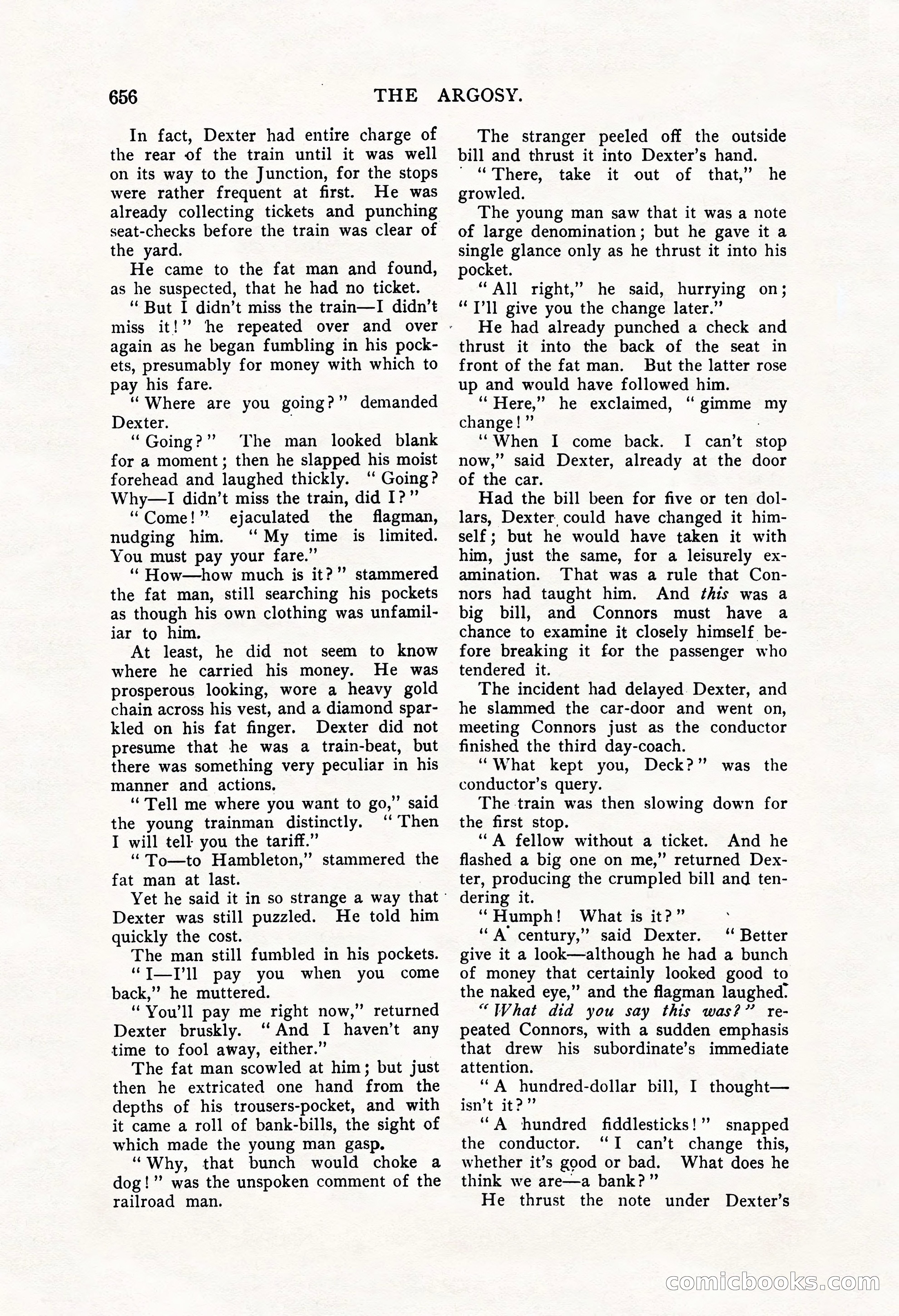
A restored page from Pulp Fiction, 1909. Page through the whole issue in the reader above.
📄 Transcribed text from this page (OCR, searchable)
Machine-transcribed from the original scan — historical spelling and the odd misread are preserved.
656 In fact, Dexter had entire charge of the rear of the train until it was well on its way to the Junction, for the stops were rather frequent at first. He was already collecting tickets and punching seat-checks before the train was clear of the yard. He came to the fat man and found, as he suspected, that he had no ticket. “But I didn’t miss the train—I didn’t miss it!’ he repeated over and over - again as he began fumbling in his pock- ets, presumably for money with which to pay his fare. “Where are you going?” demanded Dexter. “Going?” The man looked blank for a moment; then he slapped his moist forehead and laughed thickly. ‘ Going? Why—I didn’t miss the train, did I?” “Come!” ejaculated the flagman, nudging him. ‘‘My time is limited. You must pay your fare.” ‘“How—how much is it?’’ stammered the fat man, still searching his pockets as though his own clothing was unfamil- iar to him. At least, he did not seem to know where he carried his money. He was prosperous looking, wore a heavy gold chain across his vest, and a diamond spar- kled on his fat finger. Dexter did not presume that he was a train-beat, but there was something very peculiar in his manner and actions. ‘‘Tell me where you want to go,” said the young trainman distinctly. “ Then I will tell you the tariff.” ‘To—to Hambleton,” stammered the fat man at last. Yet he said it in so strange a way that - Dexter was still puzzled. He told him quickly the cost. The man still fumbled in his pockets. “JT—J’ll pay you when you come back,’”’ he muttered. ‘“ Vou’ll pay me right now,” returned Dexter bruskly. ‘And I haven’t any time to fool away, either.” | The fat man scowled at him; but just then he extricated one hand from the depths of his trousers-pocket, and with it came a roll of bank-bills, the sight of which made the young man gasp. “Why, that bunch would choke a dog!” was the unspoken comment of the railroad man. 99 THE ARGOSY. The stranger peeled off the outside bill and thrust it into Dexter’s hand. ' “There, take it out of that,” growled. The young man saw that it was a note of large denomination; but he gave it a single glance only as he thrust it into his pocket. “All right,” he said, hurrying on; “T’ll give you the change later.” He had already punched a check and thrust it into the back of the seat in front of the fat man. But the latter rose up and would have followed him. “Here,” he exclaimed, “ gimme my change! ” “When I come back. I can’t stop now,” said Dexter, already at the door of the car. Had the bill been for five or ten dol- lars, Dexter could have changed it him- self; but he would have taken it with him, just the same, for a leisurely ex- amination. That was a rule that Con- nors had taught him. And ¢his was a big bill, and Connors must have a chance to examine it closely himself be- fore breaking it for the passenger who tendered it. The incident had delayed. Dexter, and he slammed the car-door and went on, meeting Connors just as the conductor finished the third day-coach. “What kept you, Deck?” was the conductor’s query. The train was then slowing down for the first stop. ‘“A fellow without a ticket. And he flashed a big one on me,” returned Dex- ter, producing the crumpled bill and ten- dering it. ‘“Humph! What is it?” ‘A’ century,” said Dexter. ‘ Better give it a look—although he had a bunch of money that certainly looked good to the naked eye,” and the flagman laughed. “What did you say this was?” re- peated Connors, with a sudden emphasis that drew his subordinate’s immediate attention. ‘A hundred-dollar bill, I thought— isn’t it?” “A hundred fiddlesticks!’’ snapped the conductor. “I can’t change this, whether it’s good or bad. What does he think we are—a bank?” He thrust the note under Dexter’s he OO (C