
Pulp Fiction, 1909 · page 91 of 266
The Argosy, Vol. 61, No. 4 — page 91: what you’re looking at
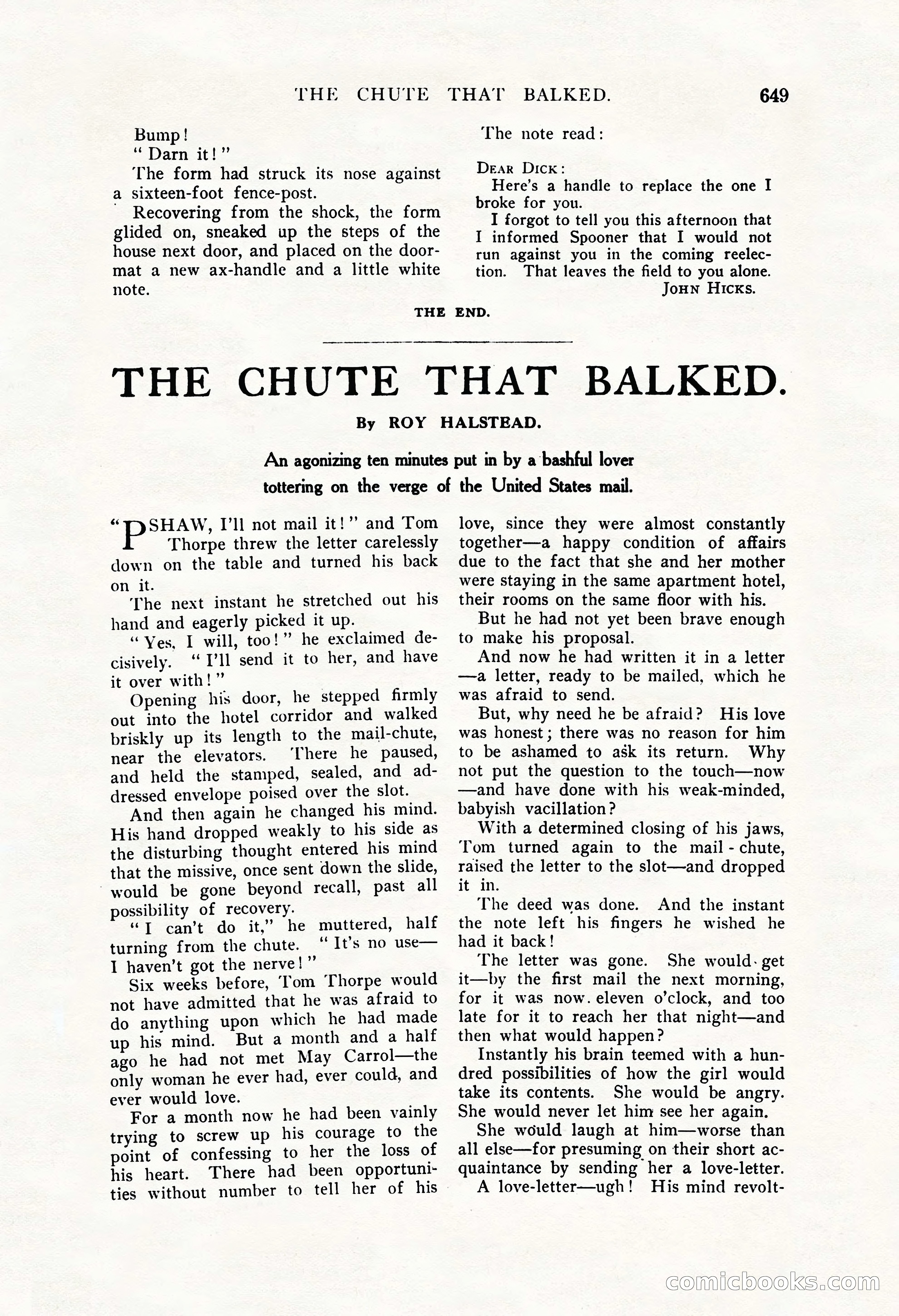
A restored page from Pulp Fiction, 1909. Page through the whole issue in the reader above.
📄 Transcribed text from this page (OCR, searchable)
Machine-transcribed from the original scan — historical spelling and the odd misread are preserved.
THE CHUTE Bump! | Darn it! 2 The form had struck its nose against a sixteen-foot fence-post. ' Recovering from the shock, the form glided on, sneaked up the steps of the house next door, and placed on the door- mat a new ax-handle and a little white note. THAT BALKED. 649 The note read: Dear Dick: Here’s a handle to replace the one I broke for you. I forgot to tell you this afternoon that I informed Spooner that I would not run against you in the coming reelec- tion. That leaves the field to you alone. Joun HIcks. THE END. THE CHUTE THAT BALKED. By ROY HALSTEAD. An agonizing ten minutes put in by a bashful lover tottering on the verge of the United States mail. “Ty SHAW, I’ll not mail it!” and Tom Thorpe threw the letter carelessly down on the table and turned his back on it. The next instant he stretched out his hand and eagerly picked it up. | “Ves, I will, too!’ he exclaimed de- “711 send it to her, and have t”? cisively. it over with | Opening his door, he stepped firmly out into the hotel corridor and walked briskly up its length to the mail-chute, near the elevators. [here he paused, and held the stamped, sealed, and ad- dressed envelope poised over the slot. And then again he changed his mind. His hand dropped weakly to his side as the disturbing thought entered his mind that the missive, once sent down the slide, would be gone beyond recall, past all ibility of recovery. Per ae do it,” ihe muttered, half turning from the chute. “It's no use— I haven’t got the nerve!” Six weeks before, ‘Tom Thorpe would not have admitted that he was afraid to do anything upon which he had made up his mind. But a month and a half ago he had not met May Carrol—the only woman he ever had, ever could, and ever would love. For a month now he had been vainly trying to screw up his courage to the point of confessing to her the loss of his heart. There had been opportunl- ties without number to tell her of his love, since they were almost constantly together—a happy condition of affairs due to the fact that she and her mother were staying in the same apartment hotel, their rooms on the same floor with his. But he had not yet been brave enough to make his proposal. And now he had written it in a letter —a letter, ready to be mailed, which he was afraid to send. But, why need he be afraid? His love was honest; there was no reason for him to be ashamed to ask its return. Why not put the question to the touch—now —and have done with his weak-minded, babyish vacillation ? With a determined closing of his jaws, Tom turned again to the mail - chute, raised the letter to the slot—and dropped it in. The deed was done. And the instant the note left his fingers he wished he had it back! The letter was gone. She would: get it—by the first mail the next morning, for it was now. eleven o’clock, and too late for it to reach her that night—and then what would happen? Instantly his brain teemed with a hun- dred possibilities of how the girl would take its contents. She would be angry. She would never let him see her again. She would laugh at him—worse than all else—for presuming on their short ac- quaintance by sending her a love-letter. A love-letter—ugh! His mind revolt- OO (C C©