
Pulp Fiction, 1909 · page 60 of 266
The Argosy, Vol. 61, No. 4 — page 60: what you’re looking at
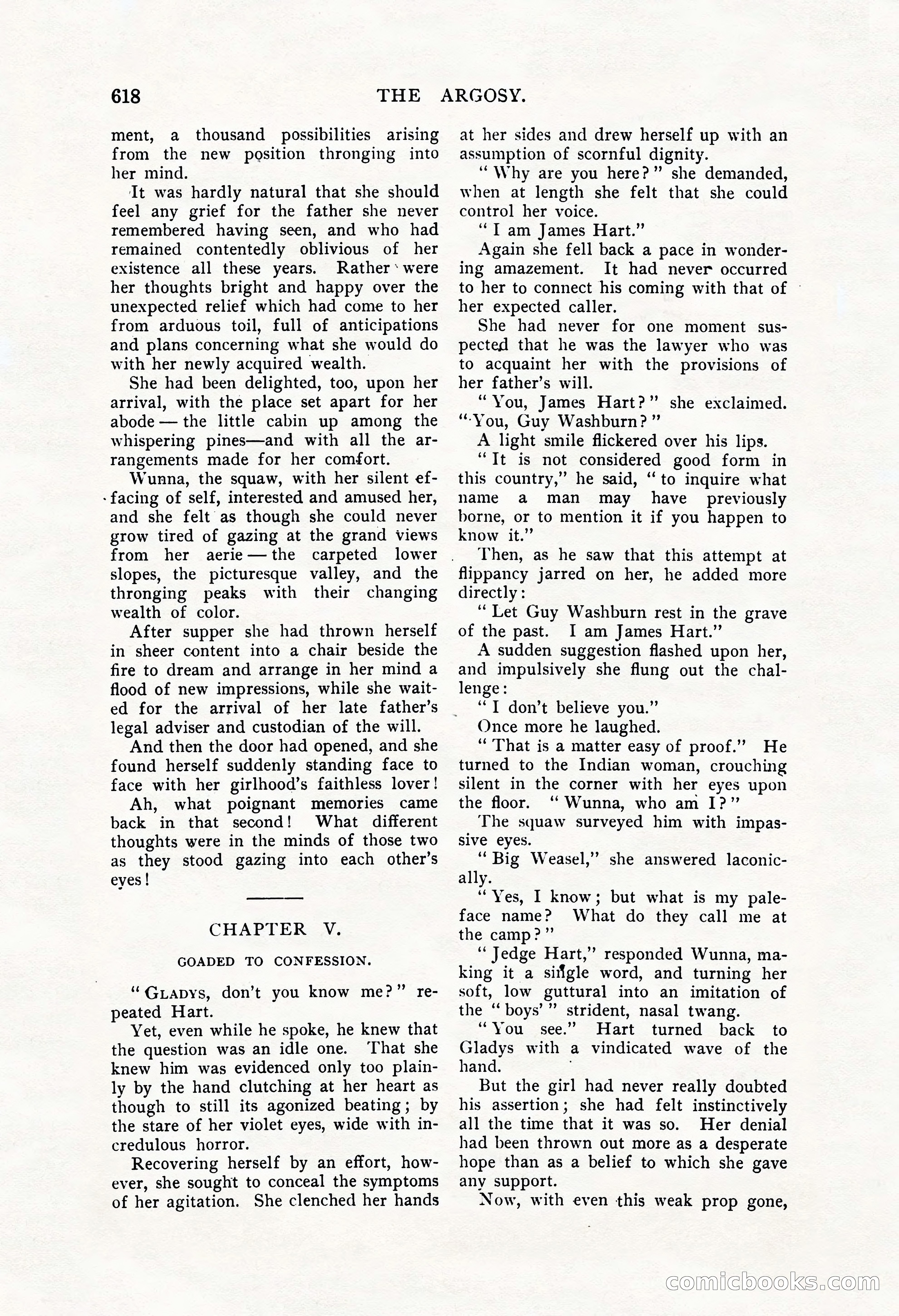
A restored page from Pulp Fiction, 1909. Page through the whole issue in the reader above.
📄 Transcribed text from this page (OCR, searchable)
Machine-transcribed from the original scan — historical spelling and the odd misread are preserved.
618 ment, a thousand possibilities arising from the new position thronging into her mind. It was hardly natural that she should feel any grief for the father she never remembered having seen, and who had remained contentedly oblivious of her existence all these years. Rather * were her thoughts bright and happy over the unexpected relief which had come to her from arduous toil, full of anticipations and plans concerning what she would do with her newly acquired wealth. She had been delighted, too, upon her arrival, with the place set apart for her abode — the little cabin up among the whispering pines—and with all the ar- rangements made for her comfort. Wunna, the squaw, with her silent ef- -facing of self, interested and amused her, and she felt as though she could never grow tired of gazing at the grand views from her aerie—the carpeted lower slopes, the picturesque valley, and the thronging peaks with their changing wealth of color. After supper she had thrown herself in sheer content into a chair beside the fire to dream and arrange in her mind a flood of new impressions, while she wait- ed for the arrival of her late father’s legal adviser and custodian of the will. And then the door had opened, and she found herself suddenly standing face to face with her girlhood’s faithless lover! Ah, what poignant memories came back in that second! What different thoughts were in the minds of those two as they stood gazing into each other’s eves ! CHAPTER V. GOADED TO CONFESSION. ‘“Griapys, don’t you know me?”’ re- peated Hart. Yet, even while he spoke, he knew that the question was an idle one. ‘That she knew him was evidenced only too plain- ly by the hand clutching at her heart as though to still its agonized beating; by the stare of her violet eyes, wide with in- credulous horror. Recovering herself by an effort, how- ever, she sought to conceal the symptoms of her agitation. She clenched her hands THE ARGOSY. at her sides and drew herself up with an assumption of scornful dignity. ‘“Why are you here?” she demanded, when at length she felt that she could control her voice. ‘Tam James Hart.” Again she fell back a pace in wonder- ing amazement. It had never occurred to her to connect his coming with that of © her expected caller. She had never for one moment sus- pected that he was the lawyer who was to acquaint her with the provisions of her father’s will. “You, James Hart?” she exclaimed. “You, Guy Washburn? ” A light smile flickered over his lips. “It is not considered good form in this country,” he said, “to inquire what name a man may have previously borne, or to mention it if you happen to know it.” Then, as he saw that this attempt at flippancy jarred on her, he added more directly: “Let Guy Washburn rest in the grave of the past. I am James Hart.” A sudden suggestion flashed upon her, and impulsively she flung out the chal- lenge: ‘““T don’t believe you.” Once more he laughed. “That is a matter easy of proof.” He turned to the Indian woman, crouching silent in the corner with her eyes upon the floor, ‘ Wunna, who am I?” The squaw surveyed him with impas- Sive eyes. ‘Big Weasel,” she answered laconic- ally. “Yes, I know; but what is my pale- face name? What do they call me at the camp?” ‘ Jedge Hart,” responded Wunna, ma- king it a sillgle word, and turning her soft, low guttural into an imitation of the “ boys’” strident, nasal twang. “You see.” Hart turned back to Gladys with a vindicated wave of the hand. But the girl had never really doubted his assertion; she had felt instinctively all the time that it was so. Her denial had been thrown out more as a desperate hope than as a belief to which she gave any support. Now, with even this weak prop gone, EO OO) (Cc (©