
Pulp Fiction, 1909 · page 57 of 266
The Argosy, Vol. 61, No. 4 — page 57: what you’re looking at
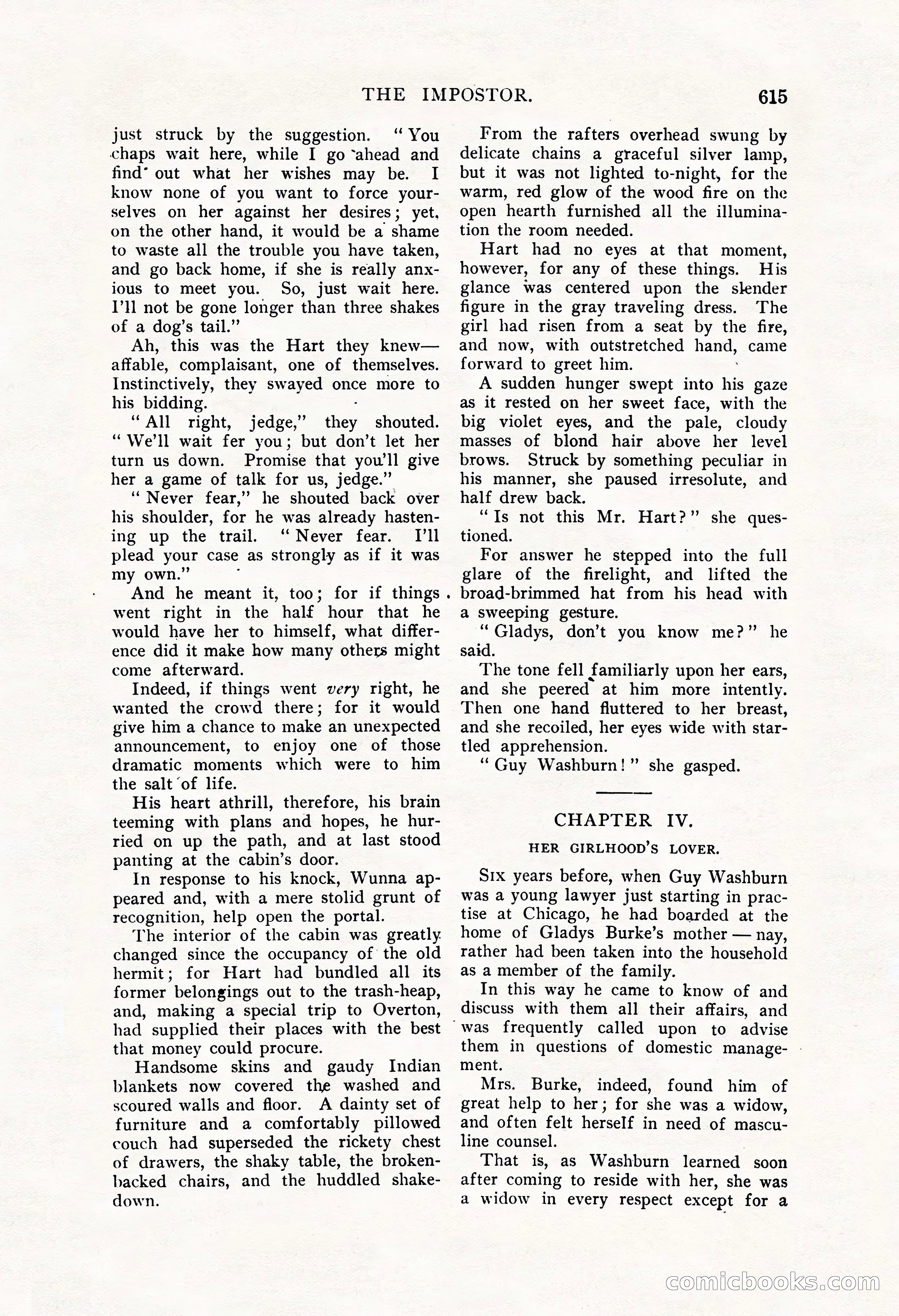
A restored page from Pulp Fiction, 1909. Page through the whole issue in the reader above.
📄 Transcribed text from this page (OCR, searchable)
Machine-transcribed from the original scan — historical spelling and the odd misread are preserved.
THE IMPOSTOR. just struck by the suggestion. ‘ You chaps wait here, while I go ‘ahead and find’ out what her wishes may be. I know none of you want to force your- selves on her against her desires; yet, on the other hand, it would be a shame to waste all the trouble you have taken, and go back home, if she is really anx- ious to meet you. So, just wait here. I’l1 not be gone longer than three shakes of a dog’s tail.” Ah, this was the Hart they knew— affable, complaisant, one of themselves. Instinctively, they swayed once more to his bidding. “All right, jedge,” they shouted. “We'll wait fer you; but don’t let her turn us down. Promise that yow'll give her a game of talk for us, jedge.”’ ‘’ Never fear,” he shouted back over his shoulder, for he was already hasten- ing up the trail. ‘Never fear. [I'll plead your case as strongly as if it was my own.’ And he meant it, too; for if things. went right in the half hour that he would have her to himself, what differ- ence did it make how many others might come afterward. Indeed, if things went very right, he wanted the crowd there; for it would give him a chance to make an unexpected announcement, to enjoy one of those dramatic moments which were to him the salt ‘of life. His heart athrill, therefore, his brain teeming with plans and hopes, he hur- ried on up the path, and at last stood panting at the cabin’s door. In response to his knock, Wunna ap- peared and, with a mere stolid grunt of recognition, help open the portal. The interior of the cabin was greatly. changed since the occupancy of the old hermit; for Hart had bundled all its former belongings out to the trash-heap, and, making a special trip to Overton, had supplied their places with the best that money could procure. Handsome skins and gaudy Indian blankets now covered the washed and scoured walls and floor. <A dainty set of furniture and a comfortably pillowed couch had superseded the rickety chest of drawers, the shaky table, the broken- backed chairs, and the huddled shake- down. 615 From the rafters overhead swung by delicate chains a graceful silver lamp, but it was not lighted to-night, for the warm, red glow of the wood fire on the open hearth furnished all the illumina- tion the room needed. Hart had no eyes at that moment, however, for any of these things. His glance was centered upon the slender figure in the gray traveling dress. The girl had risen from a seat by the fire, and now, with outstretched hand, came forward to greet him. A sudden hunger swept into his gaze as it rested on her sweet face, with the big violet eyes, and the pale, cloudy masses of blond hair above her level brows. Struck by something peculiar in his manner, she paused irresolute, and half drew back. “Is not this Mr. Hart?” she ques- tioned. For answer he stepped into the full glare of the firelight, and lifted the broad-brimmed hat from his head with a sweeping gesture. “Gladys, don’t you know me?” said. The tone fell familiarly upon her ears, and she peered at him more intently. Then one hand fluttered to her breast, and she recoiled, her eyes wide with star- tled apprehension. ‘“Guy Washburn!” she gasped. he CHAPTER IV. HER GIRLHOOD’S LOVER. SIx years before, when Guy Washburn was a young lawyer just starting in prac- tise at Chicago, he had boarded at the home of Gladys Burke’s mother — nay, rather had been taken into the household as a member of the family. In this way he came to know of and discuss with them all their affairs, and -was frequently called upon to advise them in questions of domestic manage- - ment. Mrs. Burke, indeed, found him of great help to her; for she was a widow, and often felt herself in need of mascu- line counsel. That is, as Washburn learned soon after coming to reside with her, she was a widow in every respect except for a EO OO (Cc (©