
Pulp Fiction, 1909 · page 47 of 266
The Argosy, Vol. 61, No. 4 — page 47: what you’re looking at
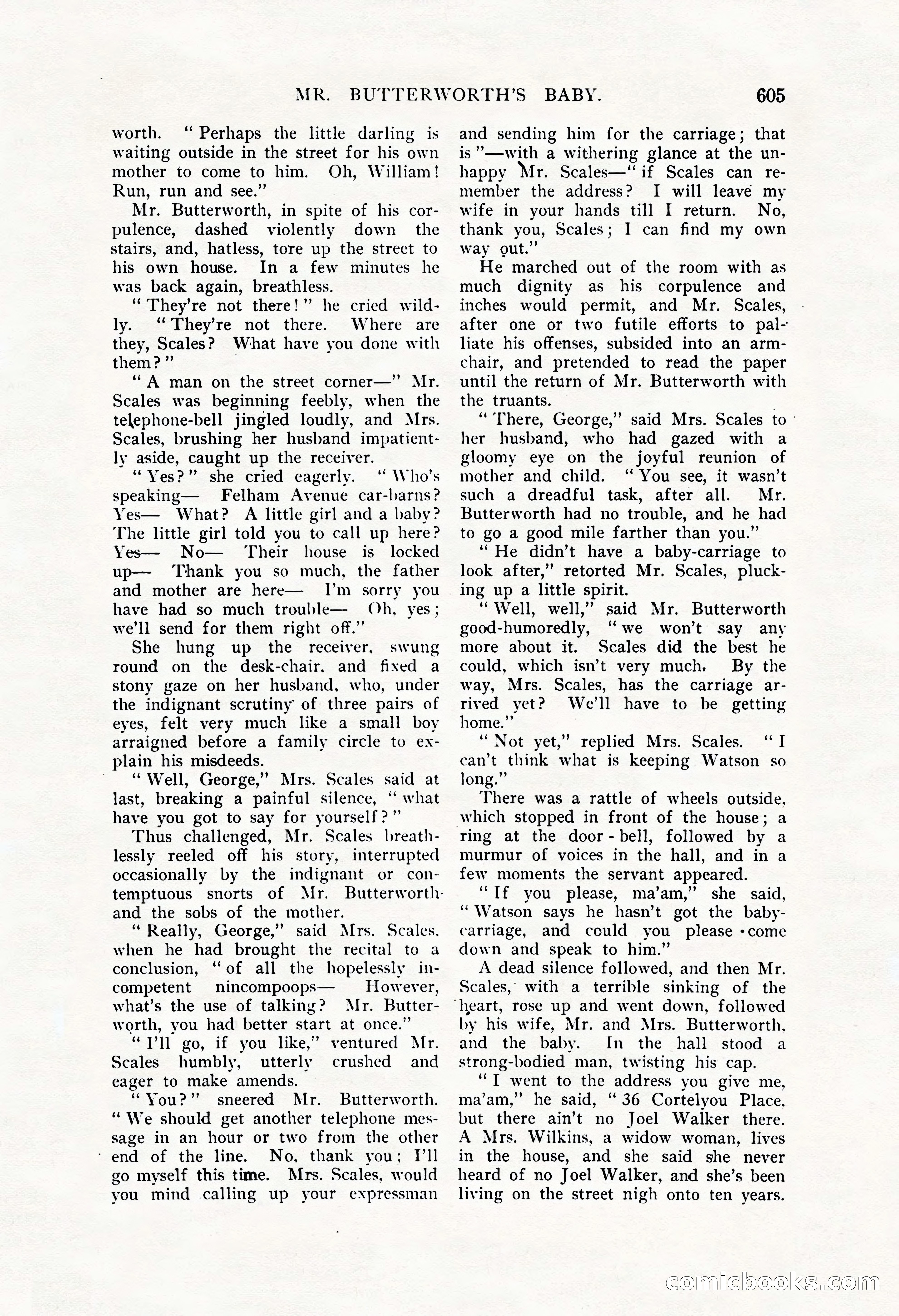
A restored page from Pulp Fiction, 1909. Page through the whole issue in the reader above.
📄 Transcribed text from this page (OCR, searchable)
Machine-transcribed from the original scan — historical spelling and the odd misread are preserved.
MR. BUTTERWORTH?’S' BABY. worth. ‘ Perhaps the little darling is waiting outside in the street for his own mother to come to him. Oh, William! Run, run and see.” Mr. Butterworth, in spite of his cor- pulence, dashed violently down the stairs, and, hatless, tore up the street to his own house. In a few minutes he was back again, breathless. ‘“They’re not there!” he cried wild- Ilya They're. not there = Where <are they, Scales? What have you done with them?” , ‘“A man on the street corner—” Mr. Scales was beginning feebly, when the telephone-bell jingled loudly, and Mrs. Scales, brushing her husband impatient- ly aside, caught up the receiver. “Yes?” she cried eagerly. “ Who’s speaking— Felham Avenue car-barns? Yes— What? A little girl and a baby? The little girl told you to call up here? Yes— No— Their house is locked up— Thank you so much, the father and mother are here— I’m sorry you have had so much trouble— Oh, yes; we'll send for them right off.” She hung up the receiver, swung round on the desk-chair, and fixed a stony gaze on her husband, who, under the indignant scrutiny of three pairs of eyes, felt very much like a small boy arraigned before a family circle to ex- plain his misdeeds. ‘Well, George,” Mrs. Scales said at last, breaking a painful silence, ‘ what have you got to say for yourself?” Thus challenged, Mr. Scales breath- lessly reeled off his story, interrupted occasionally by the indignant or con- temptuous snorts of Mr. and the sobs of the mother. ‘Really, George,” said Mrs. Scales, when he had brought the recital to a conclusion, ‘of all the hopelessly in- competent nincompoops— However, what’s the use of talking? Mr. Butter- worth, you had better start at once.” “T’ll go, if you like,’ ventured Mr. Scales humbly, utterly crushed and eager to make amends. “You?” sneered Mr. Butterworth. “We should get another telephone mes- sage in an hour or two from the other ‘end of the line. No, thank you; Ill go myself this time. Mrs. Scales, would you mind calling up your expressman Butterworth: 605 and sending him for the carriage; that is ’’"—with a withering glance at the un- happy Mr. Scales—“ if Scales can re- member the address? I will leave my wife in your hands till I return. No, thank you, Scales; I can find my own way out.” He marched out of the room with as much dignity as his corpulence and inches would permit, and Mr. Scales, after one or two futile efforts to pal- liate his offenses, subsided into an arm- chair, and pretended to read the paper until the return of Mr. Butterworth with the truants. ‘There, George,” said Mrs. Scales to: her husband, who had gazed with a gloomy eye on the joyful reunion of mother and child. ‘“ You see, it wasn’t such a dreadful task, after all. Mr. Butterworth had no trouble, and he had to go a good mile farther than you.” “He didn’t have a baby-carriage to look after,’ retorted Mr. Scales, pluck- ing up a little spirit. ‘Well, well,” said Mr. Butterworth good-humoredly, ‘we won’t say any more about it. Scales did the best he could, which isn’t very much. By the way, Mrs. Scales, has the carriage ar- rived yet? We'll have to be getting home.” | ‘Not yet,” replied Mrs. Scales. “I can’t think what is keeping Watson so long.” There was a rattle of wheels outside, which stopped in front of the house; a ring at the door- bell, followed by a murmur of voices in the hall, and in a few moments the servant appeared. “If you please, ma’am,” she said, ‘Watson says he hasn’t got the baby- carriage, and could you please -come down and speak to him.” — A dead silence followed, and then Mr. Scales, with a terrible sinking of the ‘heart, rose up and went down, followed by his wife, Mr. and Mrs. Butterworth, and the baby. In the hall stood a strong-bodied man, twisting his cap. “I went to the address you give me, ma’am,” he said, “ 36 Cortelyou Place. but there ain’t no Joel Walker there. A Mrs. Wilkins, a widow woman, lives in the house, and she said she never heard of no Joel Walker, and she’s been living on the street nigh onto ten years. EO OO (©