
Pulp Fiction, 1909 · page 45 of 266
The Argosy, Vol. 61, No. 4 — page 45: what you’re looking at
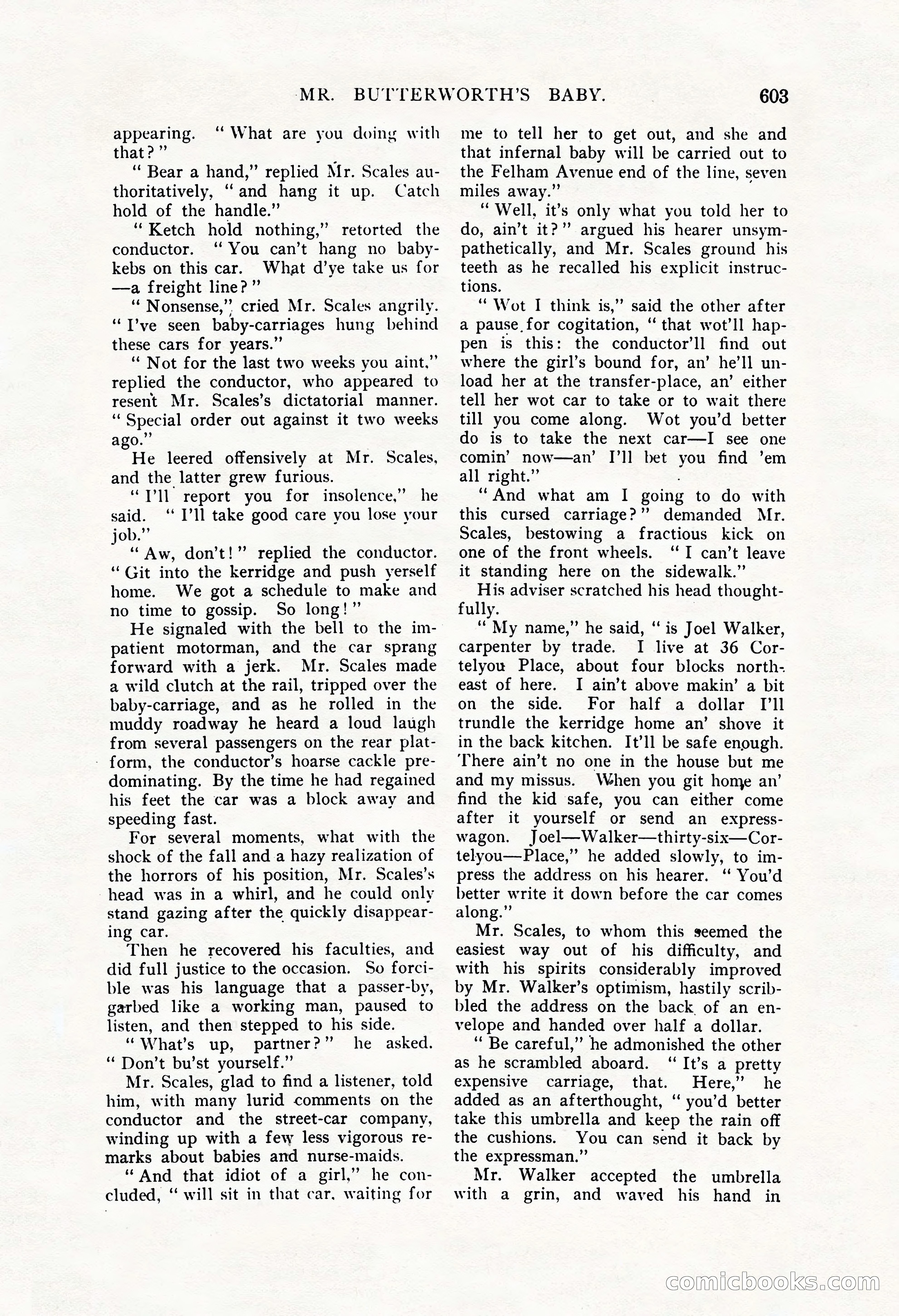
A restored page from Pulp Fiction, 1909. Page through the whole issue in the reader above.
📄 Transcribed text from this page (OCR, searchable)
Machine-transcribed from the original scan — historical spelling and the odd misread are preserved.
MR. BUTTERWORTH’S BABY. 603 appearing. “‘ What are you doing with that?” ; ‘* Bear a hand,” replied Mr. Scales au- thoritatively, ‘‘and hang it up. Catch hold of the handle.” ‘Ketch hold nothing,” retorted the conductor. ‘ You can’t hang no baby- kebs on this car. What d’ye take us for —a freight line?” ‘‘ Nonsense,’’ cried Mr. Scales angrily. ‘“T’ve seen baby-carriages hung behind these cars for years.” “Not for the last two weeks you aint,”’ replied the conductor, who appeared to resent Mr. Scales’s dictatorial manner. ‘‘ Special order out against it two weeks ago.” He leered offensively at Mr. Scales, and the latter grew furious. “T’ll report you for insolence,” he said. ‘ I’ll take good care you lose your job.” ‘“ Aw, don’t!” replied the conductor. ‘Git into the kerridge and push yerself home. We got a schedule to make and no time to gossip. So long!”’ He signaled with the bell to the im- patient motorman, and the car sprang forward with a jerk. Mr. Scales made a wild clutch at the rail, tripped over the baby-carriage, and as he rolled in the muddy roadway he heard a loud laugh from several passengers on the rear plat- - form, the conductor’s hoarse cackle pre- dominating. By the time he had regained his feet the car was a block away and speeding fast. For several moments, what with the shock of the fall and a hazy realization of the horrors of his position, Mr. Scales’s head was in a whirl, and he could only stand gazing after the quickly disappear- ing car. Then he recovered his faculties, and did full justice to the occasion. So forci- ble was his language that a passer-by, garbed like a working man, paused to listen, and then stepped to his side. ‘“What’s up, partner?” he asked. ‘Don’t bu’st yourself.” Mr. Scales, glad to find a listener, told him, with many lurid comments on the conductor and the street-car company, winding up with a few less vigorous re- marks about babies and nurse-maids. ‘“ And that idiot of a girl,” he con- cluded, “ will sit in that car, waiting for me to tell her to get out, and she and that infernal baby will be carried out to the Felham Avenue end of the line, seven miles away.” “Well, it’s only what you told her to do, ain’t it?”’ argued his hearer unsym- pathetically, and Mr. Scales ground his teeth as he recalled his explicit instruc- tions. “Wot I think is,’ said the other after a pause for cogitation, “ that wot’ll hap- pen is this: the conductor’ll find out where the girl’s bound for, an’ he’ll un- load her at the transfer-place, an’ either tell her wot car to take or to wait there till you come along. Wot you'd better do is to take the next car—I see one comin’ now—an’ I’]] bet you find ’em all right.” “And what am I going to do with this cursed carriage?” demanded Mr. Scales, bestowing a fractious kick on one of the front wheels. ‘I can’t leave it standing here on the sidewalk.” His adviser scratched his head thought- fully. 3 ‘My name,” he said, “ is Joel Walker, carpenter by trade. I live at 36 Cor- telyou Place, about four blocks north- east of here. I ain’t above makin’ a bit on the side. For half a dollar I'll trundle the kerridge home an’ shove it in the back kitchen. It'll be safe enough. There ain’t no one in the house but me and my missus. When you git home an’ find the kid safe, you can either come after it yourself or send an _ express- wagon. Joel—Walker—thirty-six—Cor- telyou—Place,”” he added slowly, to im- press the address on his hearer. ‘‘ You’d better write it down before the car comes along.” Mr. Scales, to whom this seemed the easiest way out of his difficulty, and with his spirits considerably improved by Mr. Walker’s optimism, hastily scrib- bled the address on the back of an en- velope and handed over half a dollar. ‘‘ Be careful,’ he admonished the other as he scrambled aboard. ‘It’s a pretty expensive carriage, that. Here,” he added as an afterthought, “ you’d better take this umbrella and keep the rain off the cushions. You can send it back by the expressman.” Mr. Walker accepted the umbrella with a grin, and waved his hand in COMIC OO® (©