
Pulp Fiction, 1909 · page 36 of 266
The Argosy, Vol. 61, No. 4 — page 36: what you’re looking at
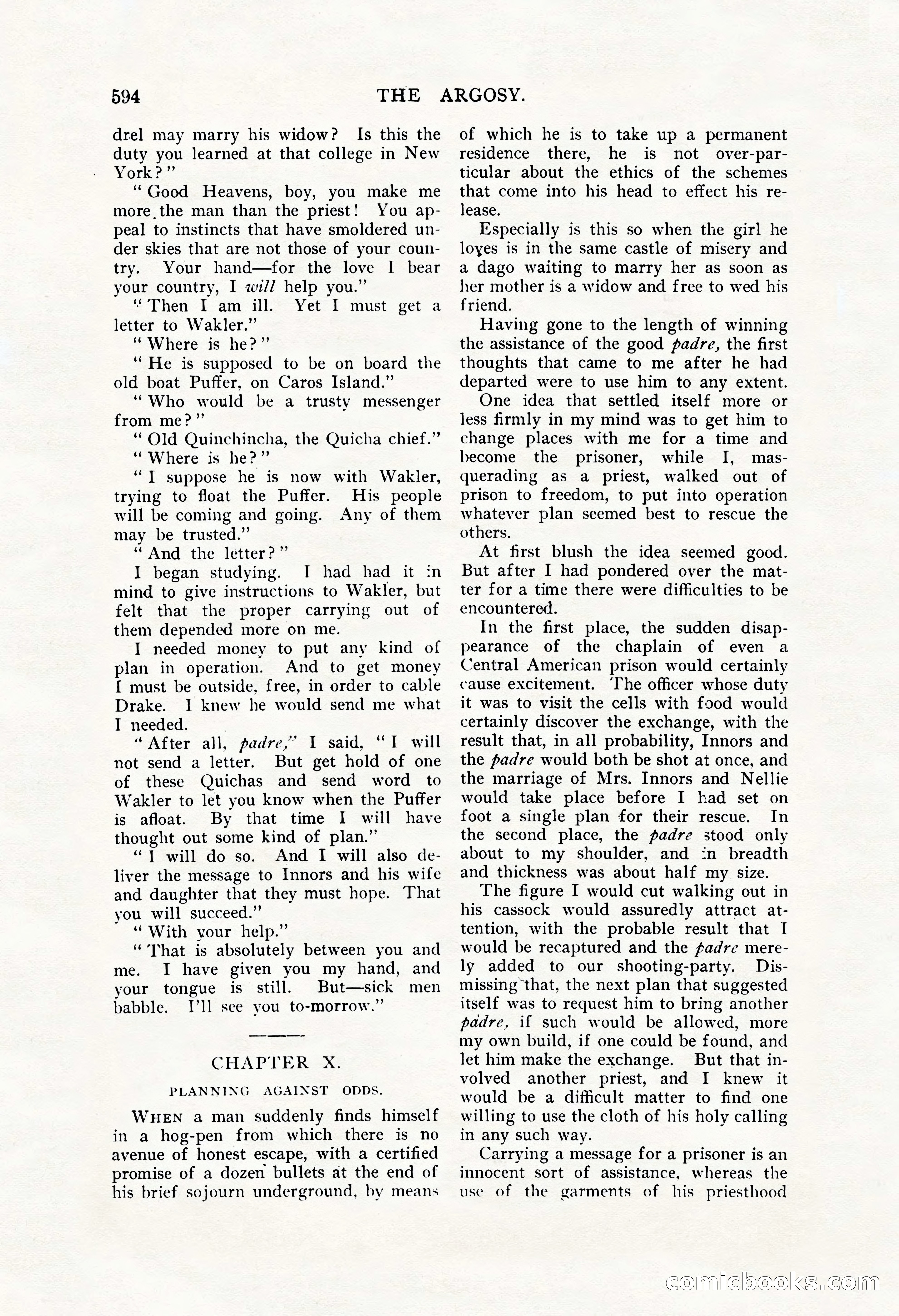
A restored page from Pulp Fiction, 1909. Page through the whole issue in the reader above.
📄 Transcribed text from this page (OCR, searchable)
Machine-transcribed from the original scan — historical spelling and the odd misread are preserved.
594 drel may marry his widow? Is this the duty you learned at that college in New York?” ‘“Good Heavens, boy, you make me more the man than the priest! You ap- peal to instincts that have smoldered un- der skies that are not those of your coun- try. Your hand—for the love I bear your country, I w// help you.” “Then I am ill. Yet I must get a letter to Wakler.”’ ‘Where is he?” ‘“He is supposed to be on board the old boat Puffer, on Caros Island.” ‘Who would be a trusty messenger from me?” “ Old Quinchincha, the Quicha chief.” “Where is he?” ‘“T suppose he is now with Wakler, trying to float the Puffer. His people will be coming and going. Any of them may be trusted.” ‘“And the letter?”’ I began studying. I had had it :n mind to give instructions to Wakler, but felt that the proper carrying out of them depended more on me. I needed money to put any kind of plan in operation. And to get money I must be outside, free, in order to cable Drake. I knew he would send me what I needed. “After all, padre,” I said, “IT will not send a letter. But get hold of one of these Quichas and send word to Wakler to let you know when the Puffer is afloat. By that time I will have thought out some kind of plan.” “T will do so. And I will also de- liver the message to Innors and his wife and daughter that they must hope. That you will succeed.” “With your help.” “That is absolutely between you and me. I have given you my hand, and your tongue is still. But—sick men babble. I’ll see you to-morrow.” CHAPTER X. PLANNING AGAINST ODDS. WHEN a man suddenly finds himself in a hog-pen from which there is no avenue of honest escape, with a certified promise of a dozen bullets at the end of his brief sojourn underground, by means THE ARGOSY. of which he is to take up a permanent residence there, he is not over-par- ticular about the ethics of the schemes that come into his head to effect his re- lease. Especially is this so when the girl he loyes is in the same castle of misery and a dago waiting to marry her as soon as her mother is a widow and free to wed his friend. Having gone to the length of winning the assistance of the good padre, the first thoughts that came to me after he had departed were to use him to any extent. One idea that settled itself more or less firmly in my mind was to get him to change places with me for a time and become the prisoner, while I, mas- querading as a priest, walked out of prison to freedom, to put into operation whatever plan seemed best to rescue the others. At first blush the idea seemed good. But after I had pondered over the mat- ter for a time there were difficulties to be encountered. In the first place, the sudden disap- pearance of the chaplain of even a Central American prison would certainly cause excitement. The officer whose duty it was to visit the cells with food would certainly discover the exchange, with the result that, in all probability, Innors and the padre would both be shot at once, and the marriage of Mrs. Innors and Nellie would take place before I had set on foot a single plan for their rescue. In the second place, the padre stood only about to my shoulder, and :n breadth and thickness was about half my size. The figure I would cut walking out in his cassock would assuredly attract at- tention, with the probable result that I would be recaptured and the fadre mere- ly added to our shooting-party. Dis- missing that, the next plan that suggested itself was to request him to bring another padre, if such would be allewed, more my own build, if one could be found, and let him make the exchange. But that in- volved another priest, and I knew it would be a difficult matter to find one willing to use the cloth of his holy calling in any such way. Carrying a message for a prisoner is an innocent sort of assistance. whereas the use of the garments of his priesthood EO OO (©