
Pulp Fiction, 1909 · page 27 of 266
The Argosy, Vol. 61, No. 4 — page 27: what you’re looking at
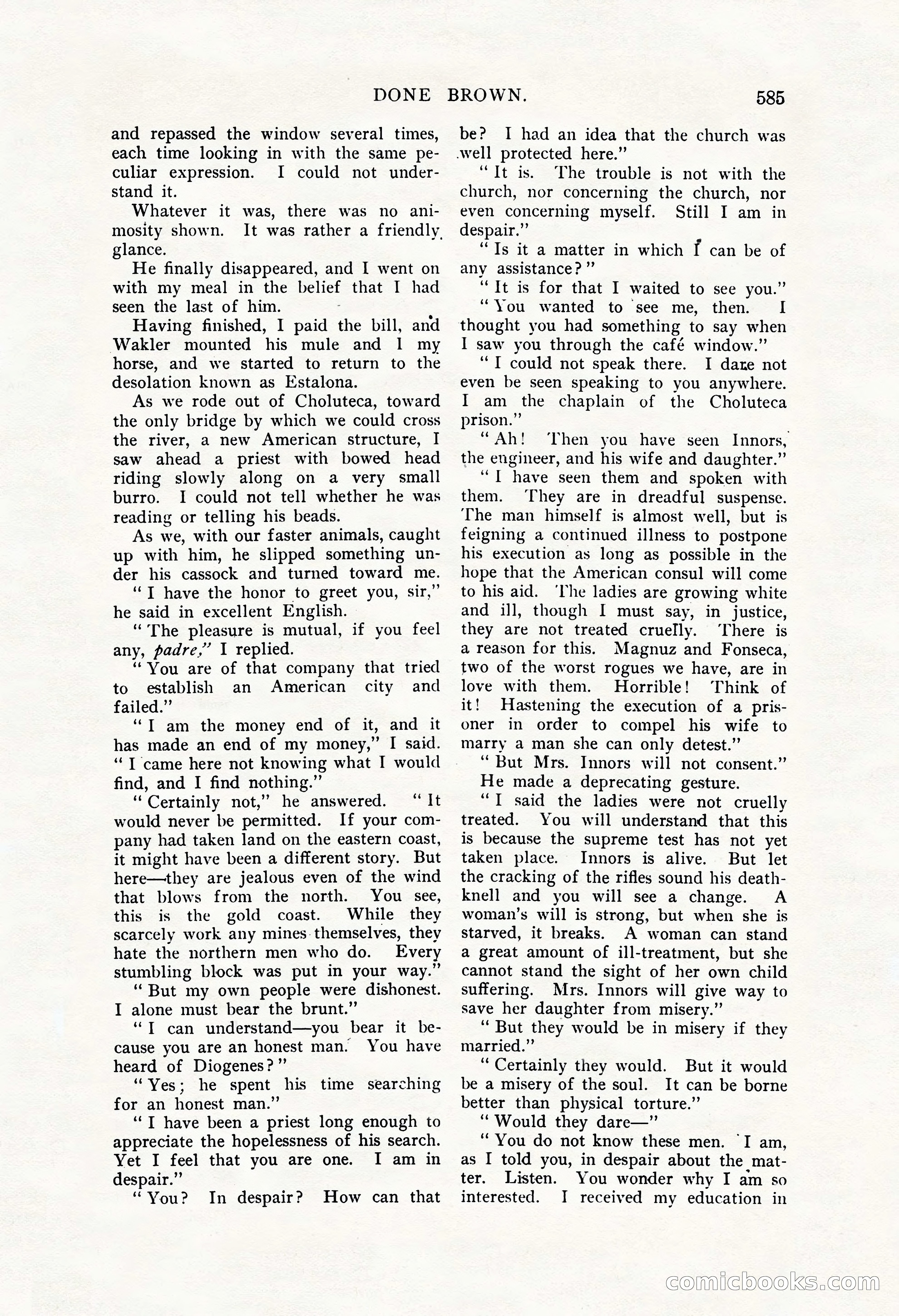
A restored page from Pulp Fiction, 1909. Page through the whole issue in the reader above.
📄 Transcribed text from this page (OCR, searchable)
Machine-transcribed from the original scan — historical spelling and the odd misread are preserved.
DONE BROWN. and repassed the window several times, each time looking in with the same pe- culiar expression. I could not under- stand it. Whatever it was, there was no ani- mosity shown. glance. He finally disappeared, and I went on with my meal in the Bees that I had seen the last of him. Having finished, I paid the bill, and Wakler mounted his mule and 1 my horse, and we started to return to the desolation known as Estalona. As we rode out of Choluteca, toward the only bridge by which we could cross the river, a new American structure, I saw ahead a priest with bowed head riding slowly along on a very small burro. I could not tell whether he was reading or telling his beads. As we, with our faster animals, caught up with him, he slipped something un- der his cassock and turned toward me. ‘“T have the honor to greet you, sir,” he said in excellent English. “The pleasure is mutual, if you feel any, padre,” I replied. “Vou are of that company that tried to establish an American city and failed.” “Tam the money end of it, and it has made an end of my money,” I said. ‘‘T came here not knowing what I would find, and I find nothing.” “Certainly not,” he answered. “It would never be permitted. If your com- pany had taken land on the eastern coast, it might have been a different story. But here—they are jealous even of the wind that blows from the north. You see, this is the gold coast. While they scarcely work any mines-themselves, they hate the northern men who do. Every stumbling block was put in your way.” ‘But my own people were dishonest. I alone must bear the brunt.” ““T can understand—you bear it be- cause you are an honest man. You have heard of Diogenes?” “Yes; he spent his time searching for an honest man.” ‘‘T have been a priest long enough to appreciate the hopelessness of his search. Yet I feel that you are one. I am in despair.” “You? In despair? How can that It was rather a friendly. 585 be? I had an idea that the church was well protected here.” “It is. The trouble is not with the church, nor concerning the church, nor even concerning myself. Still I am in despair.”’ “Ts it a matter in which [ can be of any assistance?” “It is for that I waited to see you.” “You wanted to see me, then. I thought you had something to say when I saw you through the café window.” “IT could not speak there. I dare not even be seen speaking to you anywhere. I am the chaplain of the Choluteca prison.” “ Ah! the engineer, and his wife and daughter.” ‘I have seen them and spoken with them. ‘They are in dreadful suspense. The man himself is almost well, but is feigning a continued illness to postpone his execution as long as possible in the hope that the American consul will come to his aid. ‘lhe ladies are growing white and ill, though I must say, in justice, they are not treated cruelly. ‘There is a reason for this. Magnuz and Fonseca, two of the worst rogues we have, are in love with them. Horrible! Think of it! Hastening the execution of a pris- oner in order to compel his wife to marry a man she can only detest.” ‘But Mrs. Innors will not consent.” He made a deprecating gesture. “I said the ladies were not cruelly treated. You will understand that this is because the supreme test has not yet taken place. Innors is alive. But let the cracking of the rifles sound his death- knell and you will see a change. A woman’s will is strong, but when she is starved, it breaks. A woman can stand a great amount of ill-treatment, but she cannot stand the sight of her own child suffering. Mrs. Innors will give way to save her daughter from misery.” ‘ But they would be in misery if they married.” “Certainly they would. But it would be a misery of the soul. It can be borne better than physical torture.” ‘Would they dare—”’ ‘You do not know these men. ‘I am, as I told you, in despair about the mat- ter. Listen. You wonder why I am so interested. I received my education in EO VOO Then you have seen Innors, (©