
Pulp Fiction, 1909 · page 25 of 266
The Argosy, Vol. 61, No. 4 — page 25: what you’re looking at
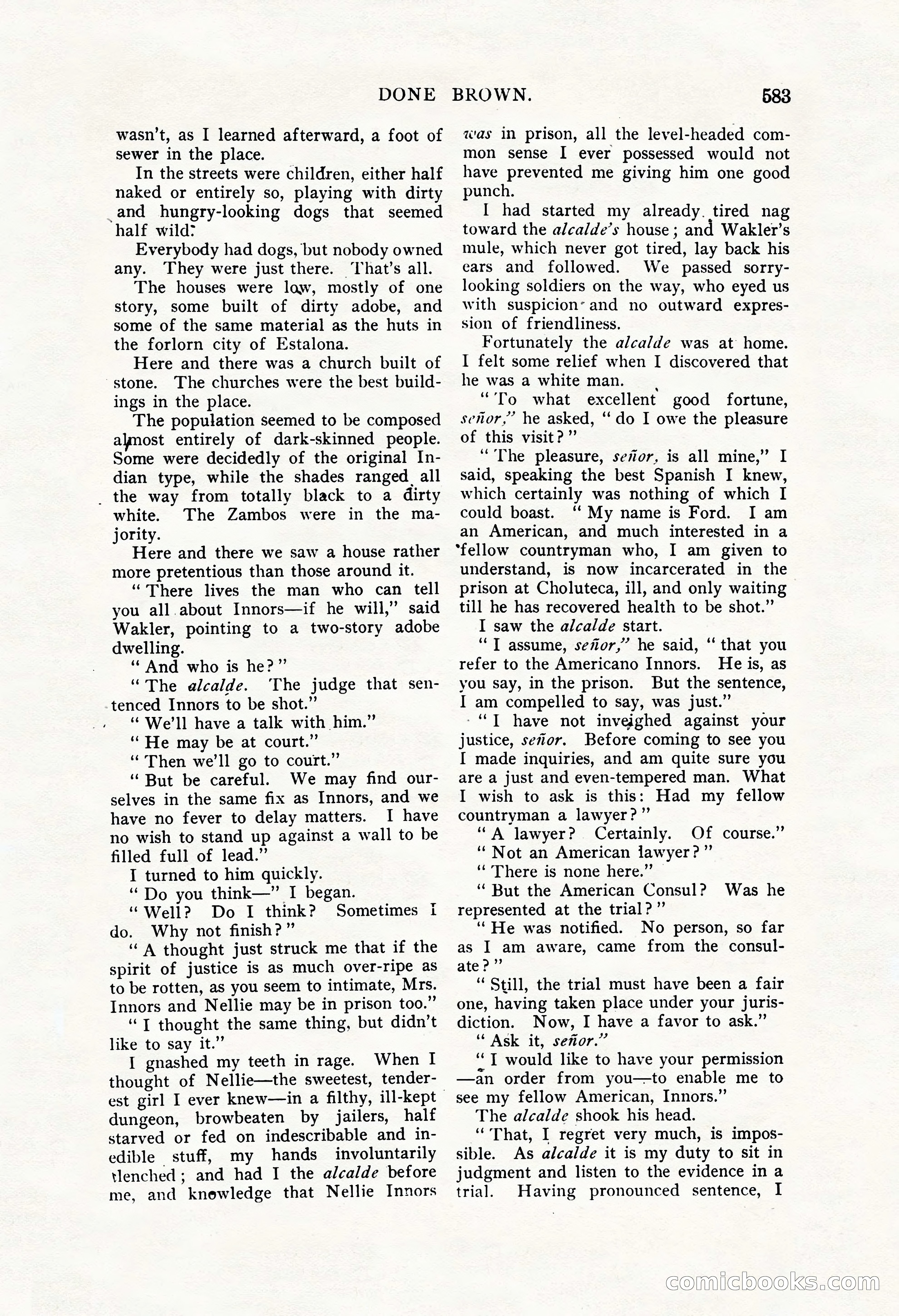
A restored page from Pulp Fiction, 1909. Page through the whole issue in the reader above.
📄 Transcribed text from this page (OCR, searchable)
Machine-transcribed from the original scan — historical spelling and the odd misread are preserved.
DONE BROWN. wasn't, as I learned afterward, a foot of sewer in the place. In the streets were children, either half naked or entirely so, playing with dirty and hungry-looking dogs that seemed half wild? Everybody had dogs, but nobody owned any. They were just there. ‘That’s all. The houses were law, mostly of one story, some built of dirty adobe, and some of the same material as the huts in the forlorn city of Estalona. Here and there was a church built of -stone. The churches were the best build- ings in the place. The population seemed to be composed almost entirely of dark-skinned people. Some were decidedly of the original In- dian type, while the shades ranged _ all _ the way from totally black to a dirty white. The Zambos were in the ma- jority. Here and there we saw a house rather more pretentious than those around it. “There lives the man who can tell you all.about Innors—if he will,” said Wakler, pointing to a two-story adobe dwelling. ‘And who is he?” “The alcalde. ‘The judge that sen- tenced Innors to be shot.” “We'll have a talk with him.” ‘“He may be at court.” ‘Then we’ll go to court.” “But be careful. We may find our- selves in the same fix as Innors, and we have no fever to delay matters. I have no wish to stand up against a wall to be filled full of lead.” I turned to him quickly. “Do you think—” I began. “Well? Do I think? Sometimes f do. Why not finish?” “A thought just struck me that if the spirit of justice is as much over-ripe as to be rotten, as you seem to intimate, Mrs. Innors and Nellie may be in prison too.” “T thought the same thing, but didn’t like to say it.” I gnashed my teeth in rage. When I thought of Nellie—the sweetest, tender- est girl I ever knew—in a filthy, ill-kept dungeon, browbeaten by jailers, half starved or fed on indescribable and in- edible stuff, my hands involuntarily tlenched ; and had I the alcalde before me, and knewledge that Nellie Innors 583 was in prison, all the level-headed com- mon sense I ever possessed would not have prevented me giving him one good punch. I had started my already. tired nag toward the alcalde’s house ; and Wakler’s mule, which never got tired, lay back his ears and followed. We passed sorry- looking soldiers on the way, who eyed us with suspicion’ and no outward expres- sion of friendliness. Fortunately the alcalde was at home. I felt some relief when I discovered that he was a white man. “To what excellent good fortune, senor,” he asked, “‘ do I owe the pleasure of this visit?” “The pleasure, sevior, is all mine,” I said, speaking the best Spanish I knew, which certainly was nothing of which I could boast. ‘‘ My name is Ford. I am an American, and much interested in a ‘fellow countryman who, I am given to understand, is now incarcerated in the prison at Choluteca, ill, and only waiting till he has recovered health to be shot.” I saw the alcalde start. ‘““T assume, sevor,”’ he said, “ that you refer to the Americano Innors. He is, as you say, in the prison. But the sentence, I am compelled to say, was just.” -“T have not inveighed against your justice, sevior. Before coming to see you I made inquiries, and am quite sure you are a just and even-tempered man. What I wish to ask is this: Had my fellow countryman a lawyer?” ‘““A lawyer? Certainly. Of course.” ‘“ Not an American lawyer?” ‘‘ There is none here.” ‘But the American Consul? Was he represented at the trial?” ‘‘He was notified. No person, so far as I am aware, came from the consul- ate?” “ Still, the trial must have been a fair one, having taken place under your juris- diction. Now, I have a favor to ask.” “ Ask it, senor.” ‘TI would like to have your permission —an order from you—to enable me to see my fellow American, Innors.” The alcalde shook his head. “That, I regret very much, is impos- sible. As alcalde it is my duty to sit in judgment and listen to the evidence in a trial. Having pronounced sentence, I (C OO (©