
Pulp Fiction, 1909 · page 23 of 266
The Argosy, Vol. 61, No. 4 — page 23: what you’re looking at
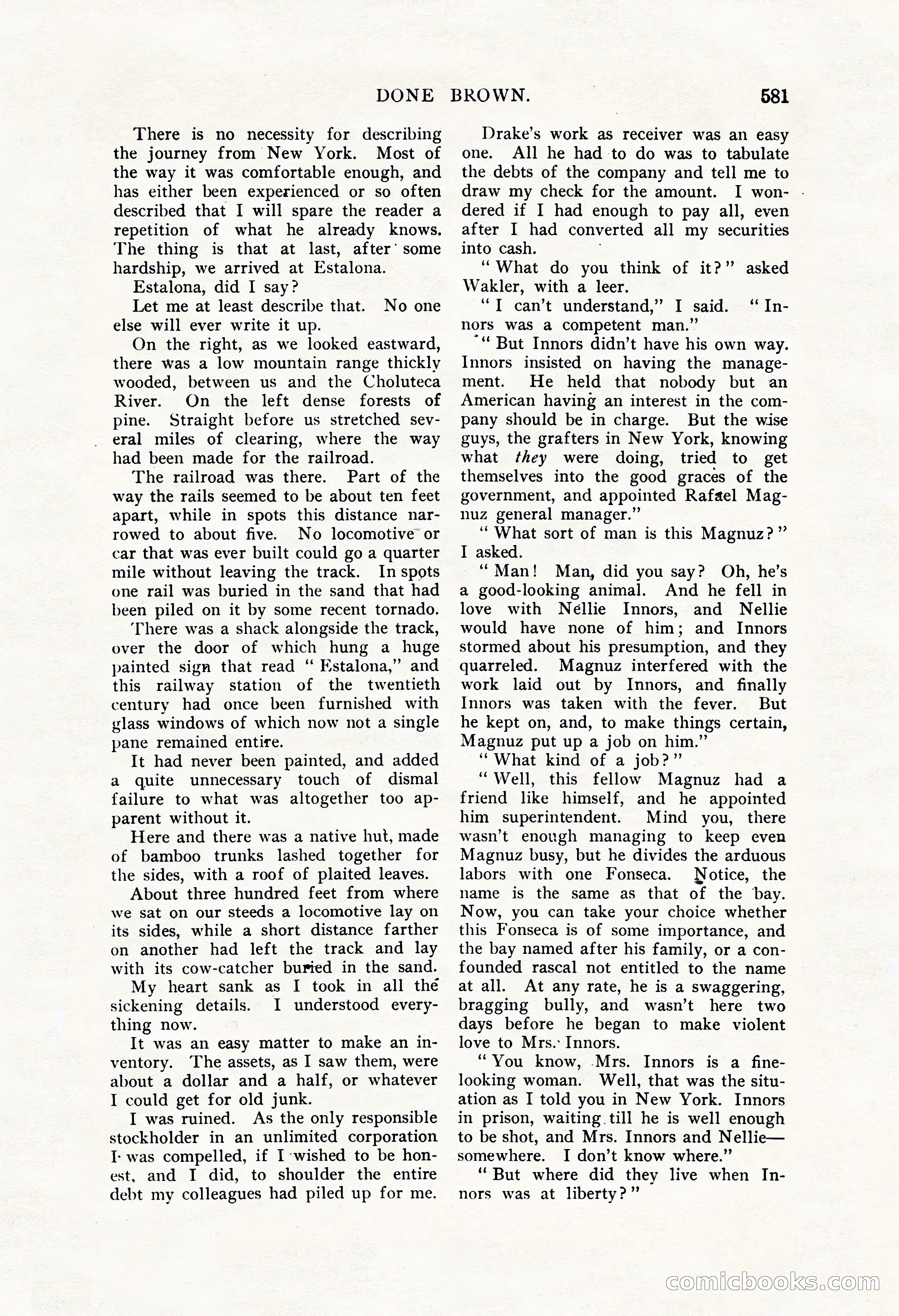
A restored page from Pulp Fiction, 1909. Page through the whole issue in the reader above.
📄 Transcribed text from this page (OCR, searchable)
Machine-transcribed from the original scan — historical spelling and the odd misread are preserved.
DONE BROWN. There is no necessity for describing the journey from New York. Most of the way it was comfortable enough, and has either been experienced or so often described that I will spare the reader a repetition of what he already knows. The thing is that at last, after’ some hardship, we arrived at Estalona. Estalona, did I say? Let me at least describe that. else will ever write it up. On the right, as we looked eastward, there was a low mountain range thickly wooded, between us and the Choluteca River. On the left dense forests of pine. Straight before us stretched sev- eral miles of clearing, where the way had been made for the railroad. The railroad was there. Part of the way the rails seemed to be about ten feet apart, while in spots this distance nar- rowed to about five. No locomotive or car that was ever built could go a quarter mile without leaving the track. In spots one rail was buried in the sand that had been piled on it by some recent tornado. There was a shack alongside the track, over the door of which hung a huge painted sign that read ‘‘ Estalona,” and this railway station of the twentieth century had once been furnished with glass windows of which now not a single pane remained entire. It had never been painted, and added a quite unnecessary touch of dismal failure to what was altogether too ap- parent without it. Here and there was a native hut, made of bamboo trunks lashed together for the sides, with a roof of plaited leaves. About three hundred feet from where we sat on our steeds a locomotive lay on its sides, while a short distance farther on another had left the track and lay with its cow-catcher buried in the sand. My heart sank as I took in all the sickening details. I understood every- thing now. It was an easy matter to make an in- ventory. The assets, as I saw them, were about a dollar and a half, or whatever I could get for old junk. I was ruined. As the only responsible stockholder in an unlimited corporation I- was compelled, if I wished to be hon- est, and I did, to shoulder the entire debt my colleagues had piled up for me. No one 581 Drake’s work as receiver was an easy one. All he had to do was to tabulate the debts of the company and tell me to draw my check for the amount. dered if I had enough to pay all, even after I had converted all my securities into cash. “What do you think of it?” asked Wakler, with a leer. ‘“T can’t understand,” I said. nors was a competent man.” ““ But Innors didn’t have his own way. Innors insisted on having the manage- ment. He held that nobody but an American having an interest in the com- pany should be in charge. But the wise guys, the grafters in New York, knowing what they were doing, tried to get themselves into the good graces of the government, and appointed Rafael Mag- nuz general manager.”’ ‘What sort of man is this Magnuz?” I asked. “Man! Man, did you say? Oh, he’s a good-looking animal. And he fell in love with Neéllie Innors, and Nellie would have none of him; and Innors stormed about his presumption, and they quarreled. Magnuz interfered with the work laid out by Innors, and finally Innors was taken with the fever. But he kept on, and, to make things certain, Magnuz put up a job on him.” ‘What kind of a job?” “Well, this fellow Magnuz had a friend like himself, and he appointed him superintendent. Mind you, there wasn’t enough managing to keep even Magnuz busy, but he divides the arduous labors with one Fonseca. Notice, the name is the same as that of the bay. Now, you can take your choice whether this Fonseca is of some importance, and the bay named after his family, or a con- founded rascal not entitled to the name at all. At any rate, he is a swaggering, bragging bully, and wasn’t here two days before he began to make violent love to Mrs.: Innors. “You know, -Mrs. Innors is a fine- looking woman. Well, that was the situ- ation as I told you in New York. Innors in prison, waiting till he is well enough to be shot, and Mrs. Innors and Nellie— somewhere. I don’t know where.” ‘““But where did they live when In- nors was at liberty?” 66 In- COMICLAOO I won- . (©