
Pulp Fiction, 1909 · page 113 of 266
The Argosy, Vol. 61, No. 4 — page 113: what you’re looking at
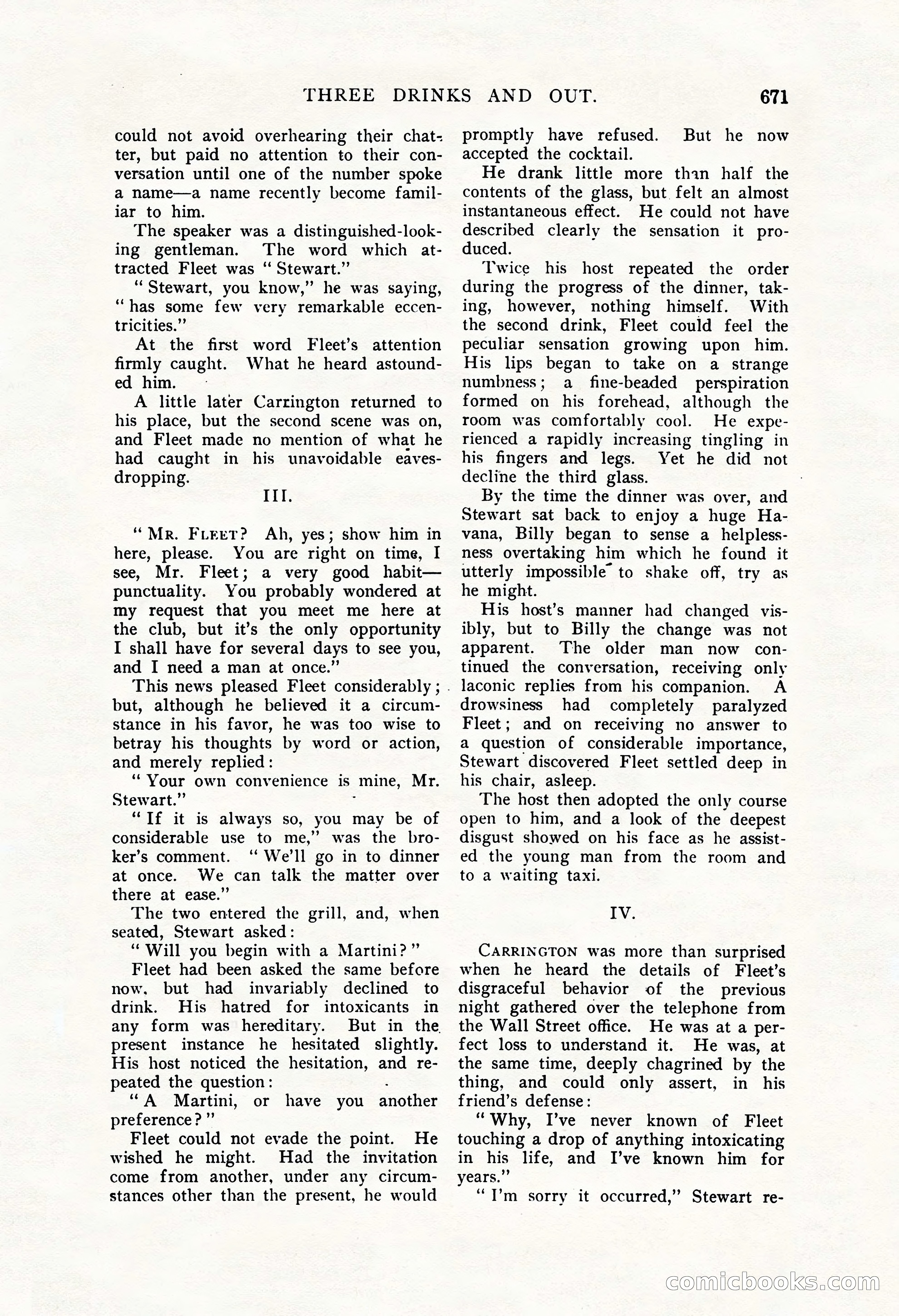
A restored page from Pulp Fiction, 1909. Page through the whole issue in the reader above.
📄 Transcribed text from this page (OCR, searchable)
Machine-transcribed from the original scan — historical spelling and the odd misread are preserved.
THREE DRINKS AND OUT. could not avoid overhearing their chat- ter, but paid no attention to their con- versation until one of the number spoke a name—a name recently become famil- lar to him. The speaker was a distinguished-look- ing gentleman. The word which at- tracted Fleet was ‘ Stewart.” “Stewart, you know,” he was saying, ‘has some few very remarkable eccen- tricities.”’ At the first word Fleet’s attention firmly caught. What he heard astound- ed him. - A little later Carrington returned to his place, but the second scene was on, and Fleet made no mention of what he had caught in his unavoidable eaves- dropping. IIT. ‘Mr. Fieet? Ah, yes; show him in here, please. You are right on time, I see, Mr. Fleet; a very good habit— punctuality. You probably wondered at my request that you meet me here at the club, but it’s the only opportunity I shall have for several days to see you, and I need a man at once.” This news pleased Fleet considerably ; . but, although he believed it a circum- stance in his favor, he was too wise to betray his thoughts by word or action, and merely replied: ‘“ ‘Your own convenience is mine, Mr. Stewart.” : “If it is always so, you may be of considerable use to me,” was the bro- ker’s comment. ‘‘ We’ll go in to dinner at once. We can talk the matter over there at ease.” The two entered the grill, and, when seated, Stewart asked: Will you begin with a Martini? ”’ Fleet had been asked the same before now. but had invariably declined to drink. His hatred for intoxicants in any form was hereditary. present instance he hesitated slightly. His host noticed the hesitation, and re- peated the question: ‘“A Martini, or have you another preference? ”’ Fleet could not evade the point. He wished he might. Had the invitation come from another, under any circum- stances other than the present, he would But in the 671 promptly have refused. But he now accepted the cocktail. He drank little more than half the contents of the glass, but felt an almost instantaneous effect. He could not have described clearly the sensation it pro- duced. Twice his host repeated the order during the progress of the dinner, tak- ing, however, nothing himself. With the second drink, Fleet could feel the peculiar sensation growing upon him. His lips began to take on a strange numbness; a _ fine-beaded perspiration formed on his forehead, although the room was comfortably cool. He expe- rienced a rapidly increasing tingling in his fingers and legs. Yet he did not decline the third glass. By the time the dinner was over, and Stewart sat back to enjoy a huge Ha- vana, Billy began to sense a _helpless- ness overtaking him which he found it utterly impossible to shake off, try as he might. His host’s manner had changed vis- ibly, but to Billy the change was not apparent. The older man now con- tinued the conversation, receiving only laconic replies from his companion. <A drowsiness had completely paralyzed Fleet; and on receiving no answer to a question of considerable importance, Stewart discovered Fleet settled deep in his chair, asleep. The host then adopted the only course open to him, and a look of the deepest disgust showed on his face as he assist- ed the young man from the room and to a waiting taxi. IV. CARRINGTON was more than surprised when he heard the details of Fleet’s disgraceful behavior of the previous night gathered over the telephone from the Wall Street office. He was at a per- fect loss to understand it. He was, at the same time, deeply chagrined by the thing, and could only assert, in his friend’s defense: “Why, I’ve never known of Fleet touching a drop of anything intoxicating in his life, and I’ve known him for years.” “I’m sorry it occurred,” Stewart re- EO OO C©