
Pulp Fiction, 1909 · page 111 of 266
The Argosy, Vol. 61, No. 4 — page 111: what you’re looking at
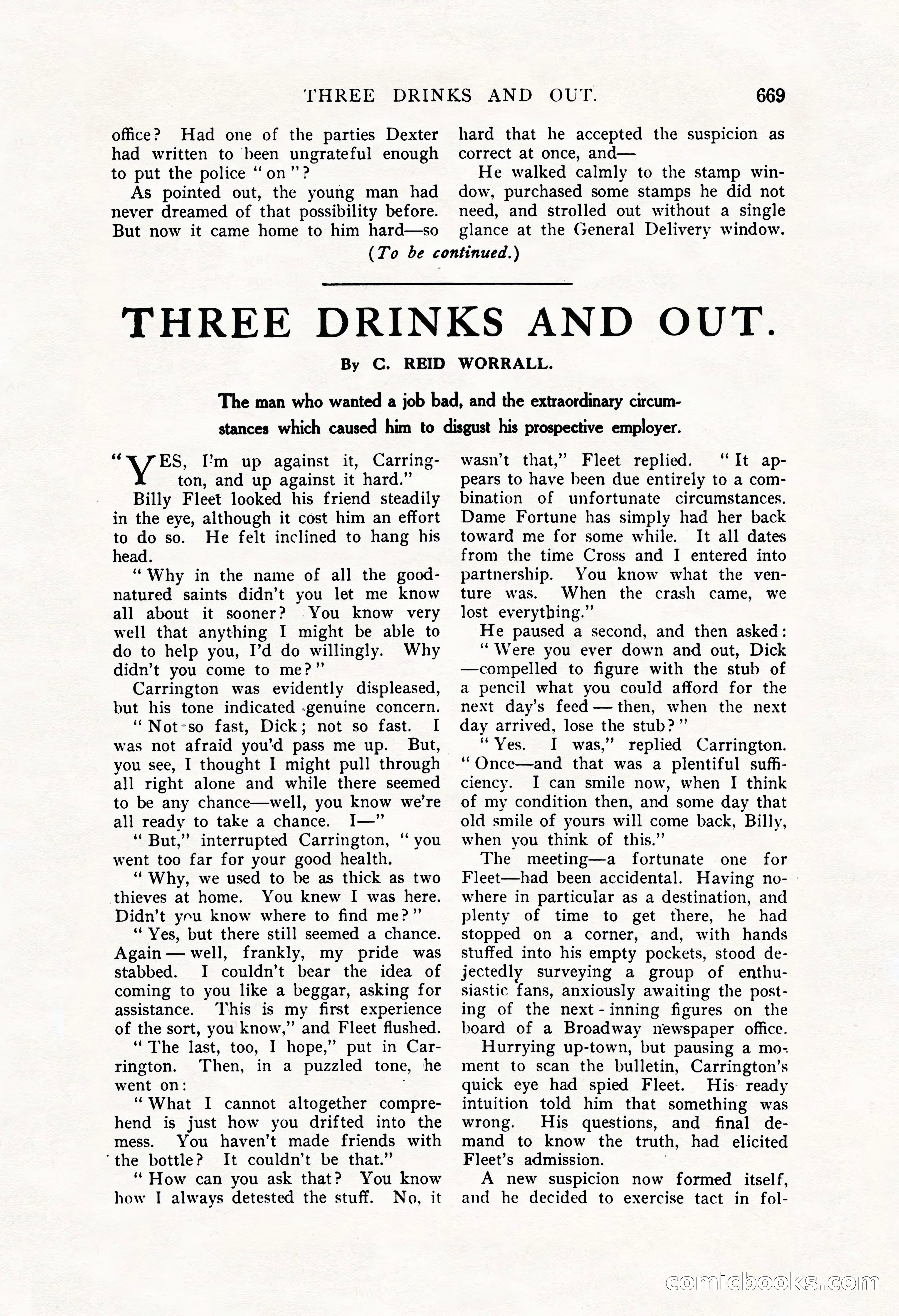
A restored page from Pulp Fiction, 1909. Page through the whole issue in the reader above.
📄 Transcribed text from this page (OCR, searchable)
Machine-transcribed from the original scan — historical spelling and the odd misread are preserved.
THREE DRINKS AND OUT. office? Had one of the parties Dexter had written to been ungrateful enough to put the police ‘‘on’’? As pointed out, the young man had never dreamed of that possibility before. But now it came home to him hard—so 669 hard that he accepted the suspicion as correct at once, and— He walked calmly to the stamp win- dow, purchased some stamps he did not need, and strolled out without a single glance at the General Delivery window. (To be continued.) THREE DRINKS AND OUT. By C. REID WORRALL. The man who wanted a job bad, and the extraordinary circum- stances which caused him to disgust his prospective employer. ES, [’m up against it, Carring- ton, and up against it hard.” Billy Fleet looked his friend steadily in the eye, although it cost him an effort to do so. He felt inclined to hang his head. ‘““Why in the name of all the good- natured saints didn’t you let me know all about it sooner? .-You know very well that anything I might be able to do to help you, I’d do willingly. Why didn’t you come to me?” Carrington was evidently displeased, but his tone indicated -genuine concern. ‘““Not-so fast, Dick; not so fast. I was not afraid you’d pass me up. But, you see, I thought I might pull through all right alone and while there seemed to be any chance—well, you know we're all ready to take a chance. I—” “ But,” interrupted Carrington, went too far for your good health. ‘“Why, we used to be as thick as two thieves at home. You knew I was here. Didn’t yeu know where to find me?”’ ‘Yes, but there still seemed a chance. Again — well, frankly, my pride was stabbed. I couldn’t bear the idea of coming to you like a beggar, asking for assistance. This is my first experience of the sort, you know,” and Fleet flushed. “The last, too, I hope,” put in Car- rington. Then, in a puzzled tone, he went on: ‘What I cannot altogether compre- hend is just how you drifted into the mess. You haven’t made friends with ‘the bottle? It couldn’t be that.” “How can you ask that? You know how I always detested the stuff. No, it wasn’t that,’ Fleet replied. ‘It ap- pears to have been due entirely to a com- bination of unfortunate circumstances. Dame Fortune has simply had her back toward me for some while. It all dates from the time Cross and I entered into partnership. You know what the ven- ture was. When the crash came, we lost everything.” He paused a second, and then asked: ‘Were you ever down and out, Dick —compelled to figure with the stub of a pencil what you could afford for the next day’s feed—then, when the next day arrived, lose the stub? ”’ “Yes. I was,” replied Carrington. ““Once—and that was a plentiful suff- ciency. I can smile now, when I think of my condition then, and some day that old smile of yours will come back, Billy, when you think of this.” The meeting—a fortunate one for Fleet—had been accidental. Having no- - where in particular as a destination, and plenty of time to get there, he had stopped on a corner, and, with hands stuffed into his empty pockets, stood de- jectedly surveying a group of enthu- siastic fans, anxiously awaiting the post- ing of the next-inning figures on the board of a Broadway newspaper office. Hurrying up-town, but pausing a mo- ment to scan the bulletin, Carrington’s quick eye had spied Fleet. His ready intuition told him that something was wrong. His questions, and final de- mand to know the truth, had elicited Fleet’s admission. A new suspicion now formed itself, and he decided to exercise tact in fol- OO (C ©