
Pulp Fiction, 1909 · page 102 of 266
The Argosy, Vol. 61, No. 4 — page 102: what you’re looking at
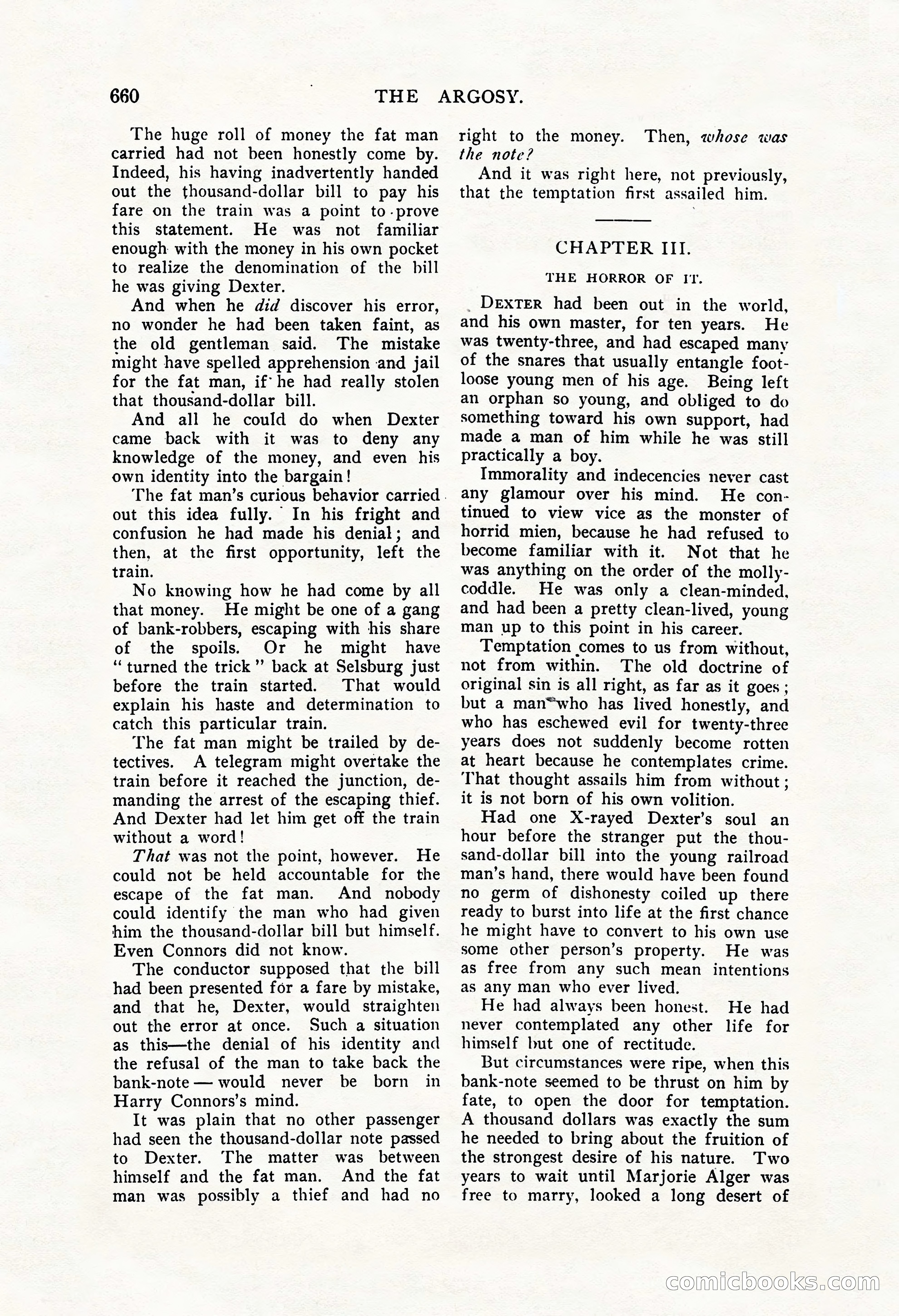
A restored page from Pulp Fiction, 1909. Page through the whole issue in the reader above.
📄 Transcribed text from this page (OCR, searchable)
Machine-transcribed from the original scan — historical spelling and the odd misread are preserved.
660 The huge roll of money the fat man carried had not been honestly come by. Indeed, his having inadvertently handed out the thousand-dollar bill to pay his fare on the train was a point to-prove this statement. He was not familiar enough with the money in his own pocket to realize the denomination of the bill he was giving Dexter. And when he did discover his error, no wonder he had been taken faint, as the old gentleman said. The mistake might have spelled apprehension and jail for the fat man, if’ he had really stolen that thousand-dollar bill. And all he could do when Dexter came back with it was to deny any knowledge of the money, and even his own identity into the bargain! The fat man’s curious behavior carried . out this idea fully. In his fright and confusion he had made his denial; and then, at the first opportunity, left the train. No knowing how he had come by all that money. He might be one of a gang of bank-robbers, escaping with his share of the spoils. Or he might have ‘turned the trick’ back at Selsburg just before the train started. That would explain his haste and determination to catch this particular train. The fat man might be trailed by de- tectives. A telegram might overtake the train before it reached the junction, de- manding the arrest of the escaping thief. And Dexter had let him get off the train without a word! That was not the point, however. He could not be held accountable for the escape of the fat man. And nobody could identify the man who had given him the thousand-dollar bill but himself. Even Connors did not know. The conductor supposed that the bill had been presented for a fare by mistake, and that he, Dexter, would straighten out the error at once. Such a situation as this—the denial of his identity and the refusal of the man to take back the bank-note — would never be born in Harry Connors’s mind. It was plain that no other passenger had seen the thousand-dollar note passed to Dexter. The matter was between himself and the fat man. And the fat man was possibly a thief and had no THE ARGOSY. right to the money. Then, whose was the note? And it was right here, not previously, that the temptation first assailed him. CHAPTER III. THE HORROR OF IT. _ DEXTER had been out in the world, and his own master, for ten years. He was twenty-three, and had escaped many of the snares that usually entangle foot- loose young men of his age. Being left an orphan so young, and obliged to do something toward his own support, had made a man of him while he was still practically a boy. Immorality and indecencies never cast any glamour over his mind. He con- tinued to view vice as the monster of horrid mien, because he had refused to become familiar with it. Not that he was anything on the order of the molly- coddle. He was only a clean-minded, and had been a pretty clean-lived, young man up to this point in his career. Temptation comes to us from without, not from within. The old doctrine of original sin is all right, as far as it goes; but a man“who has lived honestly, and who has eschewed evil for twenty-three years does not suddenly become rotten at heart because he contemplates crime. That thought assails him from without ; it is not born of his own volition. Had one X-rayed Dexter’s soul an hour before the stranger put the thou- sand-dollar bill into the young railroad man’s hand, there would have been found no germ of dishonesty coiled up there ready to burst into life at the first chance he might have to convert to his own use some other person’s property. He was as free from any such mean intentions as any man who ever lived. He had always been honest. He had never contemplated any other life for himself but one of rectitude. But circumstances were ripe, when this bank-note seemed to be thrust on him by fate, to open the door for temptation. A thousand dollars was exactly the sum he needed to bring about the fruition of the strongest desire of his nature. Two years to wait until Marjorie Alger was free to marry, looked a long desert of EO OO Cc (©