
Pulp Fiction, 1909 · page 100 of 266
The Argosy, Vol. 61, No. 4 — page 100: what you’re looking at
A restored page from Pulp Fiction, 1909. Page through the whole issue in the reader above.
📄 Transcribed text from this page (OCR, searchable)
Machine-transcribed from the original scan — historical spelling and the odd misread are preserved.
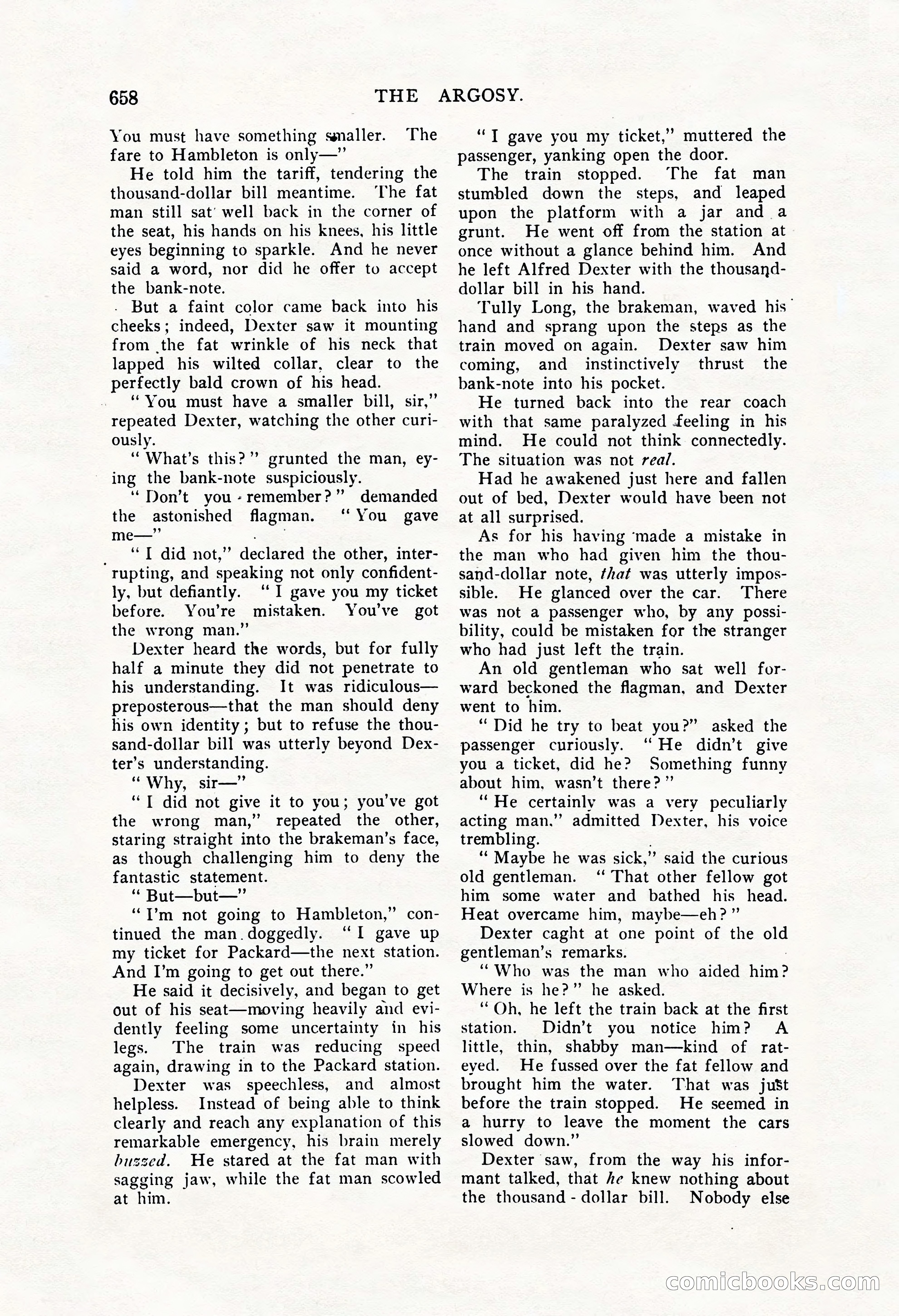
658 You must have something ssnaller. The fare to Hambleton is only—” He told him the tariff, tendering the thousand-dollar bill meantime. ‘The fat man still sat’ well back in the corner of the seat, his hands on his knees, his little eyes beginning to sparkle. And he never said a word, nor did he offer to accept the bank-note. But a faint color came back into his cheeks; indeed, Dexter saw it mounting from the fat wrinkle of his neck that lapped his wilted collar, clear to the perfectly bald crown of his head. ‘You must have a smaller bill, sir,” repeated Dexter, watching the other curi- ously. ‘What's this?’’ grunted the man, ey- ing the bank-note suspiciously. ‘“Don’t you -remember?” demanded the astonished flagman. “You gave me—”’ ==, —.1-did not,” declared the other, inter- rupting, and speaking not only confident- ly, but defiantly. “I gave you my ticket before. You’re mistaken. You've got the wrong man.” Dexter heard the words, but for fully half a minute they did not penetrate to his understanding. It was ridiculous— preposterous—that the man should deny his own identity; but to refuse the thou- sand-dollar bill was utterly beyond Dex- ter’s understanding. “Why, sir—” ‘“T did not give it to you; you've got the wrong man,” repeated the other, staring straight into the brakeman’s face, as though challenging him to deny the fantastic statement. ‘“ But—but—” “T’m not going to Hambleton,” con- tinued the man.doggedly. “I gave up my ticket for Packard—the next station. And I’m going to get out there.” He said it decisively, and began to get out of his seat—moving heavily and evi- dently feeling some uncertainty in his legs. The train was reducing speed again, drawing in to the Packard station. Dexter was speechless, and almost helpless. Instead of being able to think clearly and reach any explanation of this remarkable emergency, his brain merely bussed. He stared at the fat man with sagging jaw, while the fat man scowled at him. THE ARGOSY. ‘““T gave you my ticket,’ muttered the passenger, yanking open the door. The train stopped. The fat man stumbled down the steps, and leaped upon the platform with a jar anda grunt. He went off from the station at once without a glance behind him. And he left Alfred Dexter with the thousand- dollar bill in his hand. Tully Long, the brakeman, waved his- hand and sprang upon the steps as the train moved on again. Dexter saw him coming, and instinctively thrust the bank-note into his pocket. He turned back into the rear coach with that same paralyzed feeling in his mind. He could not think connectedly. The situation was not real. Had he awakened just here and fallen out of bed, Dexter would have been not at all surprised. As for his having ‘made a mistake in the man who had given him the thou- sand-dollar note, ‘hat was utterly impos- sible. He glanced over the car. There was not a passenger who, by any possi- bility, could be mistaken for the stranger who had just left the train. An old gentleman who sat well for- ward beckoned the flagman, and Dexter went to him. “Did he try to beat you?” asked the passenger curiously. ‘“ He didn’t give you a ticket, did he? Something funny about him, wasn’t there?” “He certainly was a very peculiarly acting man.”’ admitted Dexter, his voice trembling. ““ Maybe he was sick, ” said the curious old gentleman. ‘“ That other fellow got him some water and bathed his_ head. Heat overcame him, maybe—eh?”’ Dexter caght at one point of the old gentleman’s remarks. “Who was the man who aided ene Where is he?” he asked. “Oh, he left the train back at the first station. Didn’t you notice him? A little, thin, shabby man—kind of rat- eved. He fussed over the fat fellow and brought him the water. That was juSt before the train stopped. He seemed in a hurry to leave the moment the cars slowed down.” Dexter saw, from the way his infor- mant talked, that he knew nothing about the thousand - dollar bill. Nobody else ECO OO (Cc (©