
Pulp Fiction, 1909 · page 14 of 236
The Argosy for February — page 14: what you’re looking at
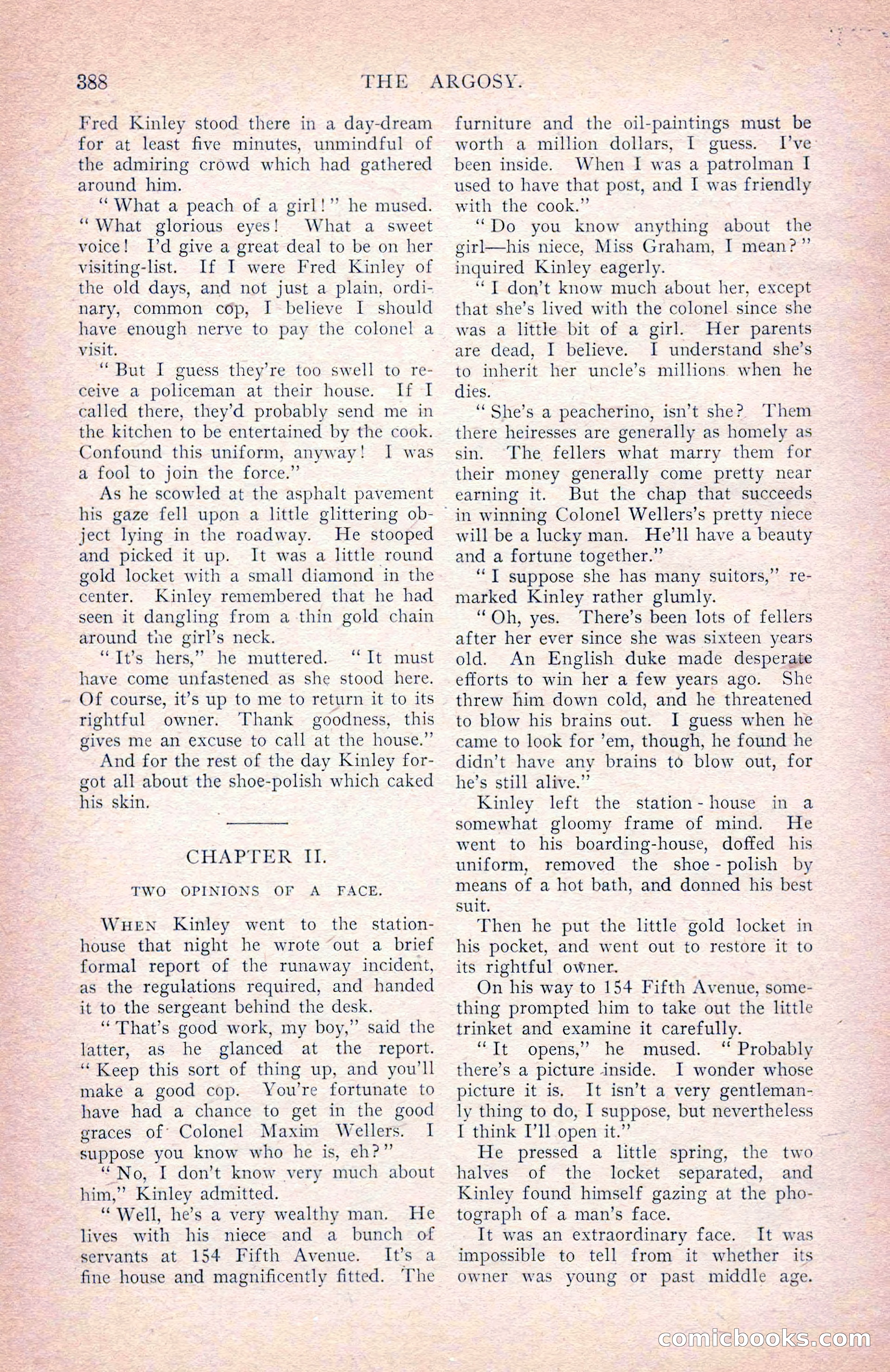
A restored page from Pulp Fiction, 1909. Page through the whole issue in the reader above.
📄 Transcribed text from this page (OCR, searchable)
Machine-transcribed from the original scan — historical spelling and the odd misread are preserved.
388 Fred Kinley stood there in a day-dream for at least five minutes, unmindful of the admiring crowd which had gathered around him. ‘What a peach of a girl!” he mused. “What glorious eyes! What a sweet voice! I’d give a great deal to be on her visiting-list. If I were Fred Kinley of the old days, and not just a plain, ordi- nary, common cop, I believe I should have enough nerve to pay the colonel a visit. “ But I guess they’re too swell to re- ceive a policeman at their house. If I called there, they’d probably send me in the kitchen to be entertained by the cook. Confound this uniform, anyway! I was a fool to join the force.” As he scowled at the asphalt pavement his gaze fell upon a little glittering ob- ject lying in the roadway. He stooped and picked it up. It was a little round gold locket with a small diamond in the center. Kinley remembered that he had seen it dangling from a thin gold chain around tne girl’s neck. “It’s hers,” he muttered. “It must have come unfastened as she stood here. - Of course, it’s up to me to return it to its rightful owner. Thank goodness, this gives me an excuse to call at the house.” And for the rest of the day Kinley for- got all about the shoe-polish which caked his skin. CHAPTER II. TWO OPINIONS OF A _ FACE, WHEN Kinley went to the station- house that night he wrote out a brief formal report of the runaway incident, as the regulations required, and handed it to the sergeant behind the desk. “'That’s good work, my boy,” said the latter, as he glanced at the report. ‘Keep this sort of thing up, and you'll make a good cop. You're fortunate to have had a chance to get in the good graces of Colonel Maxim Wellers. I suppose you know who he is, eh?” “No, I don’t know very much about him,” Kinley admitted. “Well, he’s a very wealthy man. He lives with his niece and a bunch of servants at 154 Fifth Avenue. It’s a fine house and magnificently fitted. The "FHE ~~ ARGOSY: furniture and the oil-paintings must be worth a million dollars, [ guess. been inside. When I was a patrolman I used to have that post, and [I was friendly with the cook.” “Do you know anything about the girl—his niece, Miss Graham, I mean?” inquired Kinley eagerly. ‘“T don’t know much about her, except that she’s lived with the colonel since she was a little bit of a girl. Her parents are dead, I believe. I understand she’s to inherit her uncle’s millions when he dies. ‘“She’s a peacherino, isn’t she? Them there heiresses are generally as homely as sin. The fellers what marry them for their money generally come pretty near earning it. But the chap that succeeds -in winning Colonel Wellers’s pretty niece will be a lucky man. He’ll have a beauty and a fortune together.” ‘“T suppose she has many suitors,” re- marked Kinley rather glumly. ‘“Oh, yes. There’s been lots of fellers after her ever since she was sixteen years old. An English duke made desperate efforts to win her a few years ago. She threw him down cold, and he threatened to blow his brains out. I guess when he came to look for ’em, though, he found he didn’t have any brains to blow out, for he’s still alive.” Kinley left the station- house in a somewhat gloomy frame of mind. He went to his boarding-house, doffed his uniform, removed the shoe - polish by means of a hot bath, and donned his best suit. Then he put the little gold locket in his pocket, and went out to restore it to its rightful owner. On his way to 154 Fifth Avenue, some- thing prompted him to take out the little trinket and examine it carefully. “It opens,’ he mused. “ Probably there’s a picture inside. I wonder whose picture it is. It isn’t a very gentleman- ly thing to do, I suppose, but nevertheless I think [’l1l open it.” He pressed a little spring, the two halves of the locket separated, and Kinley found himself gazing at the pho- tograph of a man’s face. It was an extraordinary face. It was impossible to tell from it whether its owner was young or past middle age. Gomichboo SH I’ve: (C@)