
Pulp Fiction, 1907 · page 70 of 220
The Argosy, January 1907 — page 70: what you’re looking at
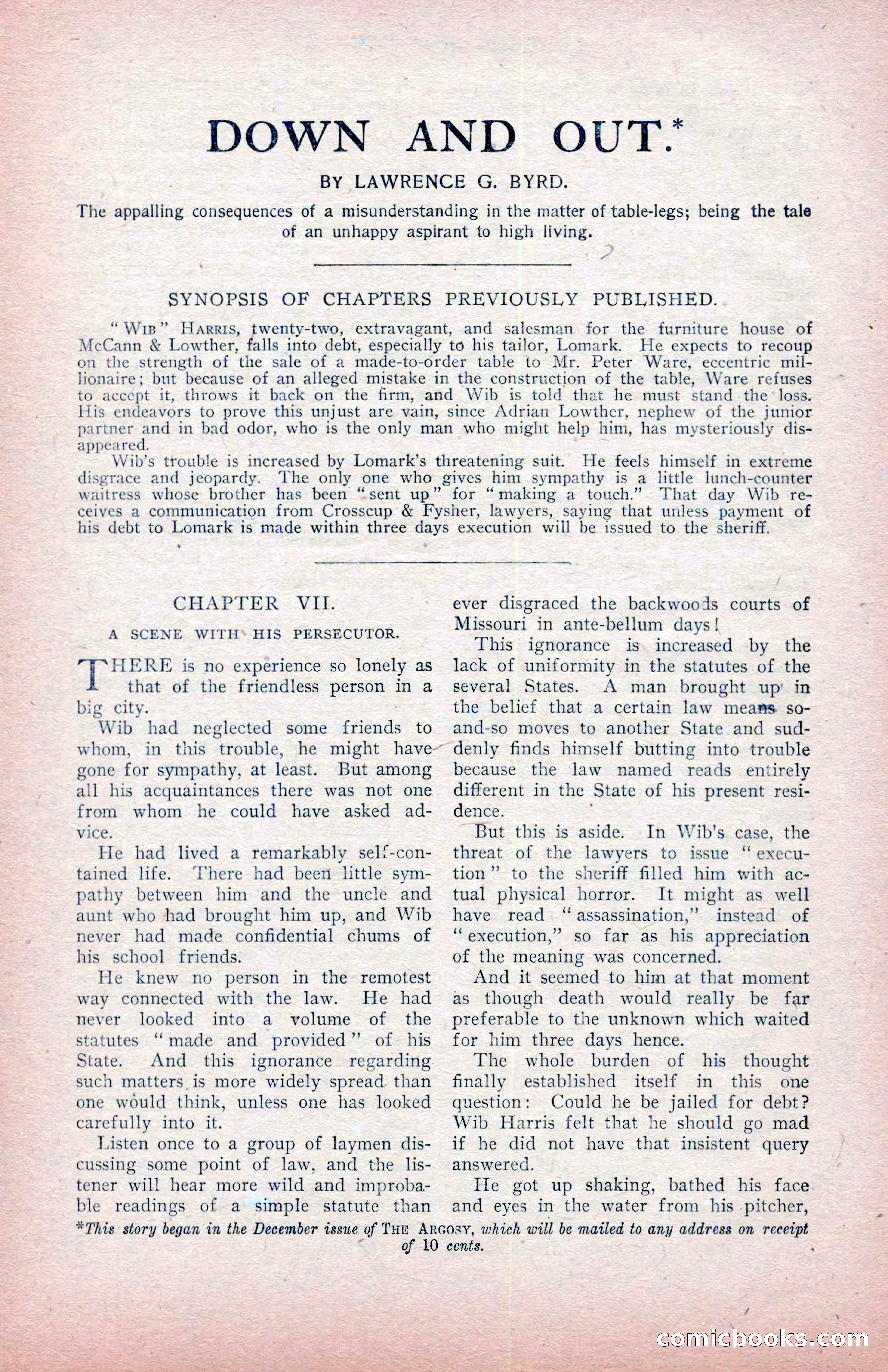
A restored page from Pulp Fiction, 1907. Page through the whole issue in the reader above.
📄 Transcribed text from this page (OCR, searchable)
Machine-transcribed from the original scan — historical spelling and the odd misread are preserved.
DOWN AND OUT. BY LAWRENCE G. BYRD. The appalling consequences of a misunderstanding in the matter of table-legs; being the tale of an unhappy aspirant to high living. SYNOPSIS OF CHAPTERS PREVIOUSLY PUBLISHED. “Wie” Harris, twenty-two, extravagant, and salesman for the furniture house of McCann & Lowther, falls into debt, especially to his tailor, Lomark. He expects to recoup on the strength of the sale of a made-to-order table to Mr. Peter Ware, eccentric mil- lionaire; but because of an alleged mistake in the construction of the table, Ware refuses to accept it, throws it back on the firm, and Wihib is told that he must stand the loss. His endeavors to prove this unjust are vain, since Adrian Lowther, nephew of the junior peninet aid in bad odor, who is the only man who might help him, has mysteriously dis- appeared. Wib’s trouble is increased by Lomark’s threatening suit. He feels himself in extreme disgrace and jeopardy. The only one who gives him sympathy is a little lunch-counter waitress whose brother has been “sent up” for “making a touch.” That day Wib re- ceives a communication from Crosscup & Fysher, lawyers, saying that unless payment of his debt to Lomark is made within three days execution will be issued to the sheriff. * CHAPTER VII. A SCENE WITH* HIS PERSECUTOR. HERE is no experience so lonely as that of the friendless person in a big city. Wib had neglected some friends to whom, in this trouble, he might have~ gone for sympathy, at least. But among all his acquaintances there was not one from whom he could have asked ad- vice. He had lived a remarkably self-con- tained life. ‘There had been little sym- pathy between him and the uncle and aunt who had brought him up, and Wib never had made confidential chums of his school friends. He knew no person in the remotest way connected with the law. He had never looked into a volume of the statutes “made and provided” of his State. such matters is more widely spread. than one would think, unless one has looked carefully into it. Listen once to a group of laymen dis- cussing some point of law, and the lis- tener will hear more wild and improba- ble readings of a simple statute than And this ignorance regarding. ever disgraced the backwoods courts of Missouri in ante-bellum days! This ignorance is. increased by the lack of uniformity in the statutes of the several States. A man brought up’ in the belief that a certain law means so- and-so moves to another State and sud- denly finds himself butting into trouble because the law named reads entirely different in the State of his present resi- dence. But this is aside. In Wib’s case, the threat of the lawyers to issue ‘“‘ execu- tion” to the sheriff filled him with ac- tual physical horror. It might as well have read “assassination,” instead of “execution,” so far as his appreciation of the meaning was concerned. And it seemed to him at that moment as though death would really be far preferable to the unknown which waited for him three days hence. The whole burden of his thought finally established itself in this one question: Could he be jailed for debt? Wib Harris felt that he should go mad if he did not have that insistent query answered. He got up shaking, bathed his face and eyes in the water from his pitcher, *This story began in the December issue of TH ARGOSY, which will be mailed to any address on receipt of 10 cents. / (E©) choo