
Pulp Fiction, 1907 · page 66 of 220
The Argosy, January 1907 — page 66: what you’re looking at
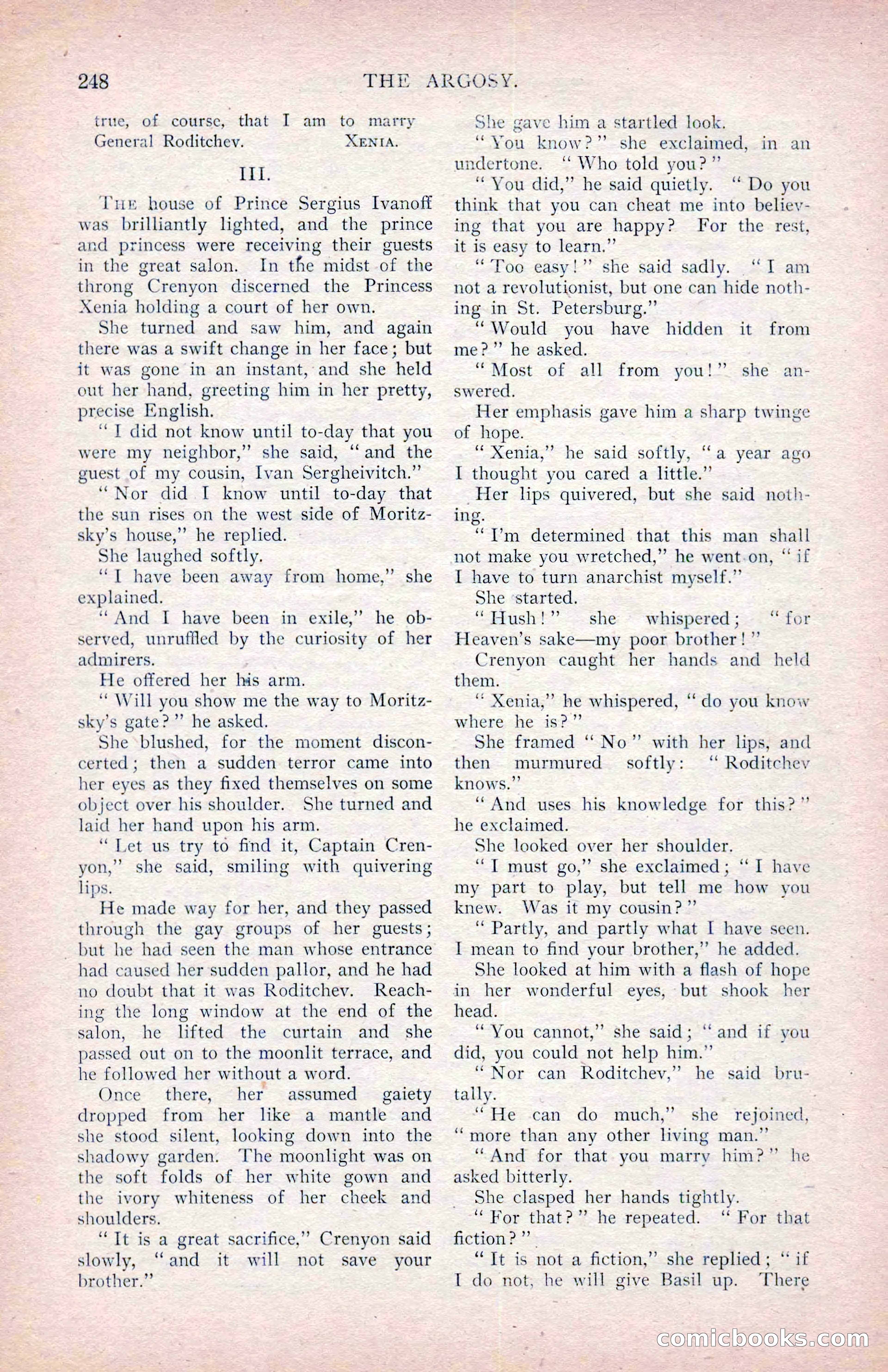
A restored page from Pulp Fiction, 1907. Page through the whole issue in the reader above.
📄 Transcribed text from this page (OCR, searchable)
Machine-transcribed from the original scan — historical spelling and the odd misread are preserved.
248 THE true, of course, that I am to marry General Roditchev. XENIA. IIT. Tue house of Prince Sergius Ivanoft was brilliantly lighted, and the prince and princess were receiving their guests in the great salon. In the midst of the throng Crenyon discerned the Princess Xenia holding a court of her own. She turned and saw him, and again there was a swift change in her face; but it was gone in an instant, and she held out her hand, greeting him in her pretty, precise English, “IT did not know until to-day that you were my neighbor,” she said, “and the guest of my cousin, Ivan Sergheivitch.”’ ‘Nor did [I know until to-day that the sun rises on the west side of Moritz- sky’s house,” he replied. She laughed softly. “[T have been away from home,” she explained. ‘“And I have been in exile,’ he ob- served, unruffled by the curiosity of her admirers. He offered her his arm. ‘“ Will you show me the way to Moritz- sky’s gate?”’ he asked. She blushed, for the moment discon- certed; then a sudden terror came into her eyes as they fixed themselves on some object over his shoulder. She turned and laid her hand upon his arm. “Let us try to find it, Captain Cren- yon,’ she said, smiling with quivering lips. He made way for her, and they passed through the gay groups of her guests; but he had seen the man whose entrance had caused her sudden pallor, and he had no doubt that it was Roditchev. Reach- ing the long window at the end of the salon, he lifted the curtain and she passed out on to the moonlit terrace, and he followed her without a word. Once there, her assumed — gaiety dropped from her like a mantle and she stood silent, looking down into the shadowy garden. ‘The moonlight was on the soft folds of her white gown and the ivory whiteness of her cheek and shoulders. ‘Tt is a great sacrifice,” Crenyon said slowly, ‘and it will not save your brother.” ARGOSY. She gave him a startled look. “You know?” she exclaimed, in an undertone. ‘ Who told you?” “You did,” he said quietly. “ Do you think that you can cheat me into beliey- ing that you are happy? For the rest, it is easy to learn.”’ “Too easy!” she said sadly. “I am not a revolutionist, but one can hide noth- ing in St. Petersburg.” “Would you have hidden it from me?” he asked. “Most of all from you!” she. an- swered. Her emphasis gave him a sharp twinge of hope. “ Xenia,” he said softly, “a year ago I thought you cared a little.” Her lips quivered, but she said noth- ing. ‘“[’m determined that this man shall not make you wretched,” he went.on, “ if { have to turn anarchist myself.” She ‘started. “Hush!” she whispered ; Heaven’s sake—my poor brother! ”’ Crenyon caught her hands and held them. ‘“ Xenia,” he whispered, “do you know where he is?” She framed ‘ No” with her lips, and then murmured softly: “ Roditchey knows.” ‘And uses his knowledge for this?” he exclaimed. She looked over her shoulder. “I must go,” she exclaimed; “I have my part to play, but tell me how you knew. Was it my cousin?” ‘Partly, and partly what I have seen. I mean to find your brother,” he added. She looked at him with a flash of hope in her wonderful eyes, but shook her head. “You cannot,” she said; “and if you did, you could not help him.” “Nor can Roditchev,” he said bru- tally. “He can do much,” she rejoined, “more than any other living man.” ‘“And for that you marry him?” he asked bitterly. She clasped her hands tightly. “For that?” he repeated. ‘“‘ For that fiction?” “Tt is not a fiction,” she replied; “ if I do not, he will give Basil up. There te for ) EOPMICLOOW S (©)