
Pulp Fiction, 1907 · page 22 of 220
The Argosy, January 1907 — page 22: what you’re looking at
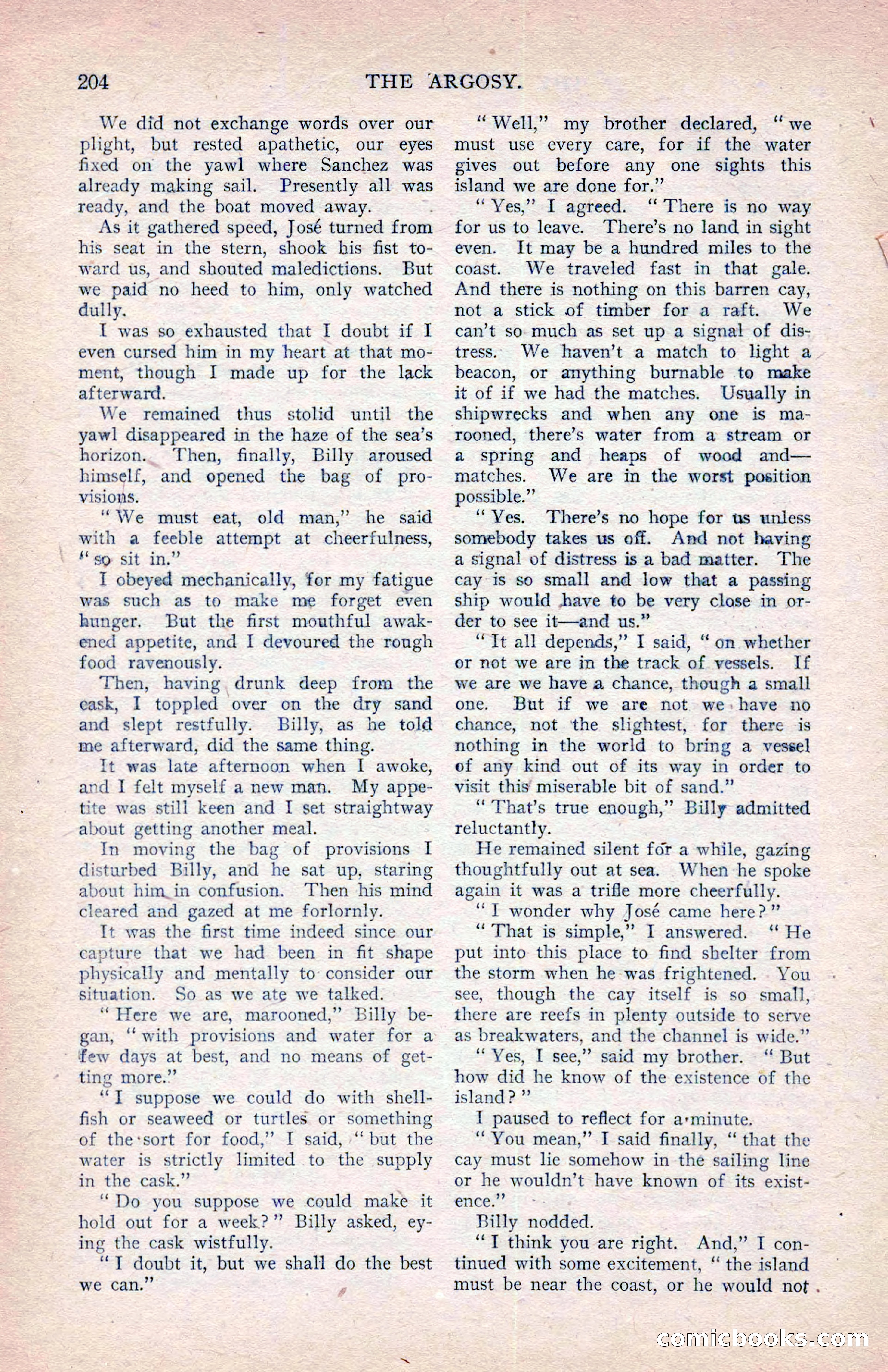
A restored page from Pulp Fiction, 1907. Page through the whole issue in the reader above.
📄 Transcribed text from this page (OCR, searchable)
Machine-transcribed from the original scan — historical spelling and the odd misread are preserved.
204 We did not exchange words over our plight, but rested apathetic, our eyes fixed on the yawl where Sanchez was already making sail. Presently all was ready, and the boat moved away. As it gathered speed, José turned from his seat in the stern, shook his fist to- ward us, and shouted maledictions. But we paid no heed to him, only watched dully. I was so exhausted that I doubt if I even cursed him in my heart at that mo- ment, though I made up for the lack afterward. We remained thus stolid until the yawl disappeared in the haze of the sea’s horizon... Then, finally, Billy aroused himself, and opened the bag of pro- visions. “We must eat, old man,” he said with a feeble attempt at cheerfulness, so sit in.” I obeyed mechanically, for my fatigue was such as to make me forget even hunger. But the first mouthful awak- ened appetite, and I devoured the rough food ravenously. Then, having. drunk deep from the eask, I toppled over on the dry sand and slept restfully. Billy, as he told me afterward, did the same thing. It was late afternoon when I awoke, and I felt myself a new man. My appe- tite was still keen and I set straightway about getting another meal. In moving the bag of provisions I disturbed Billy, and he sat up, staring about him_in confusion. Then his mind cleared and gazed at me forlornly. It was the first time indeed since our capture that we had been in fit shape physically and mentally to: consider our situation. So as we ate we talked. ‘Here we are, marooned,” Billy be- gan, ‘with provisions and water for a - few days at best, and no means of get- ting more.” “JT suppose we could do with shell- fish or seaweed or turtles or something of the:sort for food,’ I said, “‘ but the water is strictly lmited to the supply in the cask.” “Do you suppose we could make it hold out for a week?” Billy asked, ey- ing the cask wistfully. ““T doubt it, but we shall do the best we can.” > = THE ARGOSY. “Well,” my brother declared, ‘ we must use every care, for if the water gives out before any one sights this island we are done for.” “Yes,” I agreed. “ There is no way for us to leave. ‘There’s no land in sight even. It may be a hundred miles to the coast. We traveled fast in that gale. And there is nothing on this barren cay, not a stick of timber for a raft. We can’t so much as set up a signal of dis- tress. We haven’t a match to light a beacon, or anything burnable to make it of if we had the matches. Usually in shipwrecks and when any one is ma- rooned, there’s water from a stream or a spring and heaps of wood and— matches. We are in the worst position possible.” “Yes. There’s no hope for us unless somebody takes us off. And not having a signal of distress is a bad matter. The cay is so small and low that a passing ship would have to be very close in or- der to see it—and us.’ “Tt all depends,” I said, “ on whether or not we are in the track of vessels. If we are we have a chance, though a small one. But if we are not we.have no chance, not the slightest, for there is nothing in the world to bring a vessel of any kind out of its way in order to visit this miserable bit of sand.” “ That’s true enough,” Billy admitted reluctantly. He remained silent for a while, gazing thoughtfully out at sea. When he spoke again it was a trifle more cheerfully. ‘“T wonder why José came here?” “That is simple,” I answered. ‘ He put into this place to find shelter from the storm when he was frightened. . You see, though the cay itself is so small, there are reefs in plenty outside to serve as breakwaters, and the channel is wide.” ‘Yes, I see,” said my brother. “ But how did he know of the existence of the island?” I paused to reflect for arminute. “You mean,’ I said finally, ‘“ that the cay must lie somehow in the sailing line or he wouldn’t have known of its exist- ence.” Billy nodded. ““T think you are right. And,” I con- tinued with some excitement, “ the island must be near the coast, or he would not . COPMICLOOC <S) (E@