
Pulp Fiction, 1906 · page 201 of 248
The Argosy, October 1906 — page 201: what you’re looking at
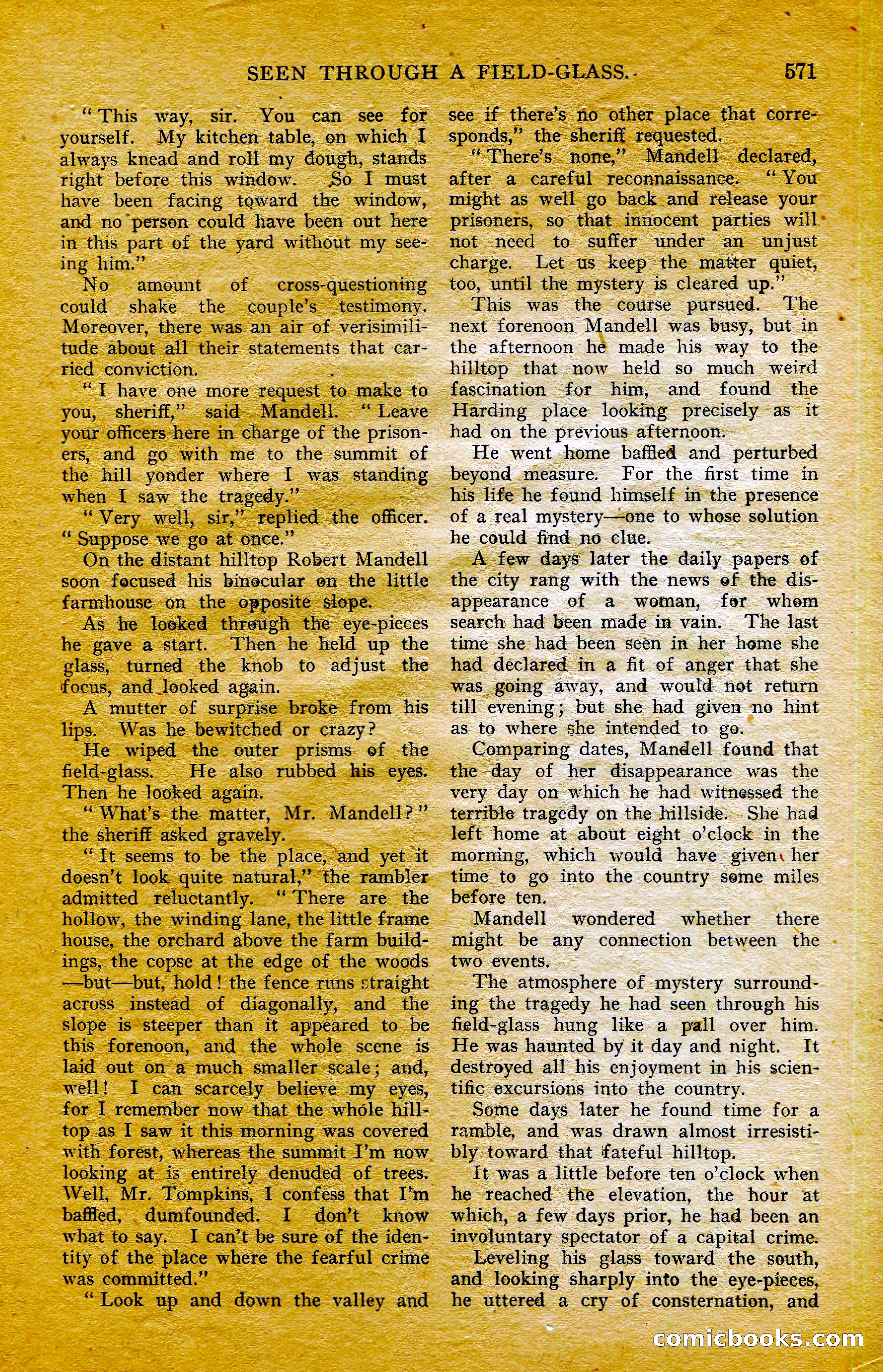
A restored page from Pulp Fiction, 1906. Page through the whole issue in the reader above.
📄 Transcribed text from this page (OCR, searchable)
Machine-transcribed from the original scan — historical spelling and the odd misread are preserved.
. £ SEEN THROUGH A FIELD- GLASS... "This way, sir. yourself. always knead and roll my dough, stands right before this window. So I must have been facing toward the window, and no person could have been out here in this part of the yard without my see= ing him.” No -amount — of cross-questioning could shake the —couple’s — testimony. Moreover, there was an air ‘of verisimili- tude about all their statements that -car- ried conviction. “T have one more. request. to make to you, sheriff,” said Mandell. “‘ Leave your officers here i in charge of the prison- ers, and go with me to the summit of the hill yonder where I was ee eneng when I saw the tragedy.” = Very well, sir,” “replied “he iicer. “ Suppose we go at once.’ | On the distant hilltop Robert Mandell soon fecused his binecular en the little farmhouse on the opposite slope. - As he looked threugh the -eye-pieces he gave a start. [hen he held up the glass, turned the knob to 28) JOE the focus, and looked again. : A mutter of surprise broke from as lips. -Was he bewitched or crazy? He wiped the outer prisms. ef the field-glass. Then he Jooked again. ““What’s the matter, Mr. Mandell?’ ws the sheriff asked gravely. “Tt seems to be the place, and ee = doesn’t look quite natural,” the rambler admitted reluctantly. “ There are the hollow, the winding lane, the little frame house, the orchard above the farm build- ings, the copse at the edge of the woods —but—but, hold! the fence runs straight across instead of diagonally, and the slope is*steeper than it appeared to be this forenoon, and the whole scene is- laid out on a much_ smaller. scale: and, well! I can scarcely believe ‘my eyes, for I remember. now that the whole hill- top as I saw it this morning was covered with forest, whereas the summit I’m now looking at i3- entirely denuded of trees. Well, Mr. Tompkins, I cenfess that I’m baffled, . dumfounded. I don’t know what to say. I can’t be sure of the iden- tity of the place wher ere the fearful crime was committed. Wee = eet up and down the valley ou ES can see te My kitchen table, on which I He_also rubbed his eyes. 571 see BS there's 'S Tho “other place that corre=- sponds,” the. sheriff requested. _ There's. none,” Mande. ‘declared, after a careful -reconnaissance. — ‘“ You might as well go back and release your prisoners, so that innocent. parties will not need to suffer under an unjust charge. Let-us keep the matter quiet, too, until the mystery is cleared up.’ This was the course pursued. The next forenoon Mandell was busy, but in the afternoon hé made his way to the hilltop that now held so much weird ‘fascination for him, and found the Harding place looking precisely as it had on the previous afternoon. He went home baffled and perturbed beyond measure. For the first time in his life he found himself in‘the presence of a real mystery—one to whese solution he could find no clue. } A few days later the daily papers of the city rang with the news ef the dis- appearance “of a-weman, fer whem search had been made in vain. The last time she had been seen in her heme she had declared in a fit of anger that. she was going away, and would not return til evening; but she had given no hint as to where she intended to go. Comparing dates, Mandell found that the day of her disappearance was the very day on which he had witnessed the terrible tragedy on the hillside. She had left home at about eight o’cleck in the morning, which would have given, her time to go into the country seme miles before ten. Mandell wondered whether’ there might be any connection between the two events. The atmosphere of mystery surround- ing the tragedy he had seen through his field-glass hung like a pall over him. He was haunted by it day and night. It destroyed all -his enjoyment in his scien- tific excursiens into the country. Some days later he found time for a ramble, and was drawn almost irresisti- bly toward that fateful hilltop. It was a little before ten o’cleck when he reached the elevation, the hour at which, a few days prior, he had been an inveluntary spectator of a capital crime. Leveling his glass toward the south, and looking sharply into the eye-pieces, he uttered a cry -of consternation, and “Comicbooks.co