
Pulp Fiction, 1906 · page 129 of 248
The Argosy, October 1906 — page 129: what you’re looking at
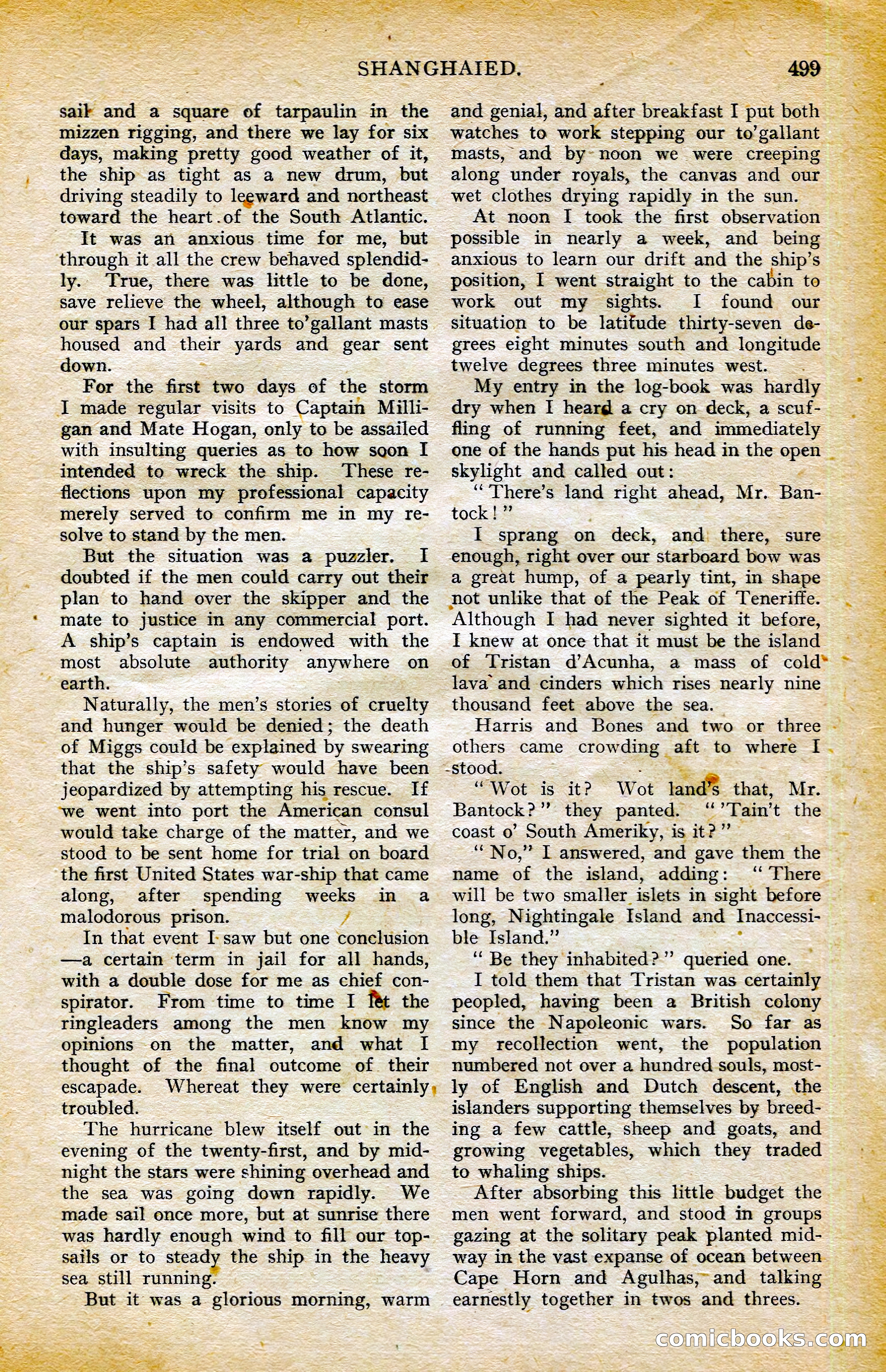
A restored page from Pulp Fiction, 1906. Page through the whole issue in the reader above.
📄 Transcribed text from this page (OCR, searchable)
Machine-transcribed from the original scan — historical spelling and the odd misread are preserved.
saik 5 a ——— of tarpaulin im the mizzen rigging, and there we lay for six days, making pretty good weather of it, the ship as tight as a new drum, but driving steadily to leeward and northeast toward the heart .of the South Atlantic. Jt was an anxious time for me, but through it all the crew behaved splendid- ly. True, there was little to be done, save relieve the wheel, although to ease our spars f had all three to’gallant masts housed and their yards and gear sent down. > For the first two days of the storm I made regular visits to Captain Milli- gan and Mate Hogan, only to be assailed with insulting queries as to how sqon I intended to wreck the ship. These re- flections upon my professional capacity merely served to confirm me in my re- solve to stand by the men. But the situation was a puzzler. I doubted if the men could carry out their plan to hand over the skipper and the mate to justice Mm any commercial port. A ship’s captain is endowed with the most absolute authority ange nore on ~~ earth. Naturally, the men’s stories of cruelty and hunger would be denied; the death of Miggs could be explained by swearing that the ship’s safety would have been jeopardized by attempting his rescue. If ‘we went into port the American consul would take charge of the matter, and we stood to be sent home for trial on board the first United States war-ship that came along, after spending weeks in a malodorous prison. ? : In that event I-saw but one conelusion —a certain term in jail for all hands, with a double dose for me as chief con- spirator. From time to time I ft the ringleaders among the men know my opinions on the matter, and what I thought of the final outcome of. their escapade. Whereat they were certainly, troubled. s : The hurricane blew itself out in the evening of the twenty-first, and by mid- night the stars were shining overhead and the sea was going down rapidly. We made sail once more, but at sunrise there was hardly enough wind to fill our top- sails or to stead y the ship in the heavy sea still running. But it was a glorious morning, warm se _ SHANGHAIED. Se work out my _ sights. stood. eal Set and after breakfast I put tenho watches to work stepping our to’ gallant masts, and by- noon we were creeping along under royals, the canvas and our wet clothes drying rapidly in the sun. At noon I took the first observation © possible in nearly a week, and being anxious to learn our drift and the ship’s position, 1 went straight to the cabin to I found our situation to be latitude thirty-seven de- grees eight minutes south and longitude — twelve degrees three minutes west. .. My entry in the log-book was hardly dry when I hear@ a cry on deck, a scuf-_ fling of running feet, and immediately one of the hands put his head in the apes skylight and called out: “There’s land right ahead, Mr. Ban tock!” I sprang on deck, and: there, | sure enough, right over our ‘starboard bow was a great hump, of a pearly tint, in shape not unlike that of the Peak of Teneriffe. Although I had never sighted it before, I knew at once that it must be the island of Tristan d’Acunha, a mass of cold* ~ lava and cinders which rises nearly nine thousand feet above the sea. Harris and Bones and two or ace - others came crowding _ aft to where [I . “Wot is it? Bantock?’ they panted. coast 0’ South Ameriky, is it?” “No,” I answered, and gave them the name of the island, adding: ble Island.” “ Be they inhabited?” queried one. I told them that Tristan was certainly peopled, having been a British colony since the Napoleonic wars. So far as my recollection went, numbered not over a hundred souls, most- ly of English and Dutch descent, the islanders supporting themselves by breed- ing a few cattle, sheep and goats, and growing vegetables, which they traded to whaling ships. After absorbing this little budget the . men went forward, and stood in groups gazing at the solitary peak planted mid- way in the vast expanse of ocean between. Cape Horn and Agulhas,-and talking earnestly together in twos and threes. oO Wot ad that, Mr. — “>Tain’t the ‘ There. will be two smaller islets in sight before — long, Nightingale Island and Inaccessi- | the population — PR eM aU Me i A Eomicbhooks.com. ber ese. t uth pF 1" /