
Pulp Fiction, 1906 · page 115 of 248
The Argosy, October 1906 — page 115: what you’re looking at
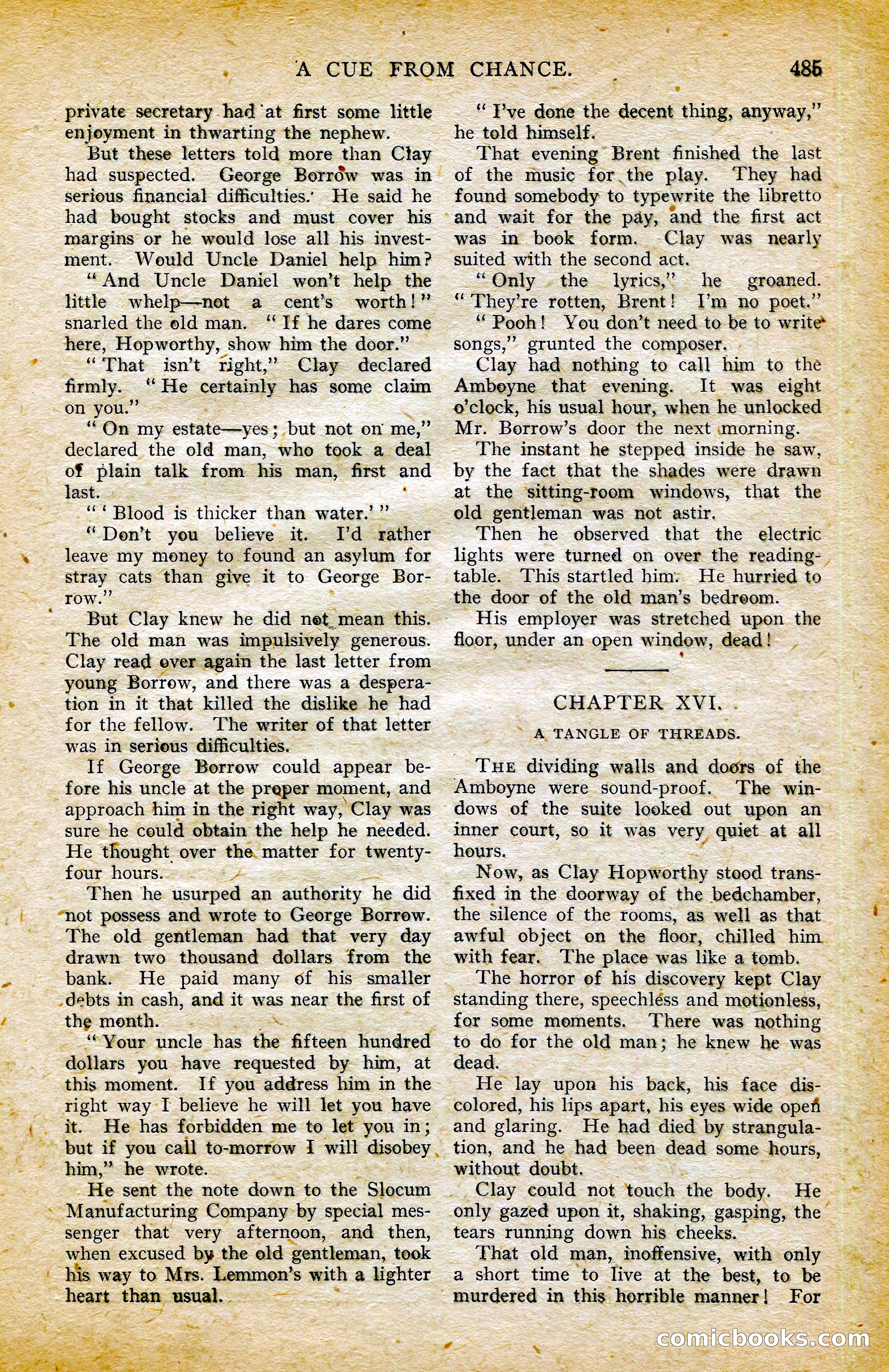
A restored page from Pulp Fiction, 1906. Page through the whole issue in the reader above.
📄 Transcribed text from this page (OCR, searchable)
Machine-transcribed from the original scan — historical spelling and the odd misread are preserved.
CUE FROM ‘CHANCE. _ private secretary had’ at first some little - enjoyment in thwarting the nephew. _ But these letters told more than Clay had suspected. George Borrdw was in- serious financial difficulties.. He said he had bought stocks and must cover his margins or he would lose all his invest- ment. Would Uncle Daniel help him? ““And Uncle Daniel won’t help the little whelp—not a _cent’s worth!” snarled the old man. “ If he dares come here, Hopworthy, show him the door.” — “That isn't right,’ Clay declared firmly. “ He certainly has some claim ~on you.” “On my ee -but not on me,’ declared the old man, who took me of plain talk from his man, first and last. . ; -.“* Blood is thicker than water.’”’ “Den’t you believe it. I’d rather leave my money to. found an asylum for stray cats than give it to George Bor- row.’ But Clay knew he did net_mean this. The old man was impulsively generous. Clay read ever again the last letter from young Borrow, and there was a despera- tion in it that killed the dishke he had for the fellow. The writer of that letter was in serious difficulties. If George Borrow could appear be- fore his uncle at the preper moment, and approach him in the right way, Clay was sure he could obtain the help he needed. He thought over the. matter for twenty- four hours.. Then he isuepeil an autherity he did “not possess and wrote to George Borrow. The old gentleman had that very day drawn two thousand dollars from the bank. He paid many of his smaller -debts in cash, and it was near the first of the month. - cee “Your uncle has the fifteen hundred ; dollars » you have requested by him, at this moment. If you address him in the. right way I believe he will let you have it. He has forbidden me to let you in; ~ but if you call to-morrow 4 will disobey him,” he wrote. os sent the note pee to ‘he Siac > Manufacturing Company by special mes- senger that very afternoon, and then, when excused by the old ‘gentleman, took his way to Mrs. Lemmon’s with a lighter see Fame, natal. —_ 6s _ ~ murdered in this horrible manner ! se ve done the ecent thing, anyway,” | a he told himself. eo, That evening "Brent finished the laste of the music for the play. They had = _ found somebody to typewrite the libretto ‘and wait for the pay, and the first act oa. was in book form. -Clay was nearly _ = suited with the second act. oes “Only . the lyrics,” he groaned. & They’ re rotten, Brent! I’m no poet.” “Pooh! You don’t need tobe to writ® songs,”’ grunted the composer. - Se Clay had nothing to call him to the Amboeyne that evening. It was eight o'clock, his usual hour, when he unlocked . Mr. Borrow’s door the next morning. <2 The instant he stepped inside he saw, by the fact that the shades were drawn at the ‘sitting-room windows, that the = old gentleman was not astir. = Then he observed that the electric” : lights were turned on over the reading-_ = table. This startled him: He hurried to = the door of the old man’s bedreom. = His employer was stretched upon the = floor, under an open window, dead! _ = CHAPTER XVI. . = _* A TANGLE OF THREADS. | = THE dividing walls and doors of the : Amboyne were sound-proof. The wine — ~dows of the suite looked out upon an inner court, so it was very quiet at all 2 hours. ge Now, as Clay Hop Worthy stood trans- = fixed in the doorway of the bedchamber, a the silence of the rooms, as well as that i awful object on the floor, chilled him — with fear. The place was likeatomb. = The horror of his discovery kept Clay — =: standing there, speechléss and motionless, ee for some moments. There was nothing a to do for the old man; he knew he was” dead. aS He lay upon his back, his face dis- a colored, his lips apart, his eyes wide opefi it bh _. and glaring. He had died by strangula- 2 tion, and he had been dead some hours, i without doubt. aS Clay could not touch the body. He_ 2S only gazed upon it, shaking, gasping, the tears running down his cheeks. 2G That old man, inoffensive, with only a a short time to live at the best, to be es For’: =o nicbooks com o = . = ins ae a x. _ &4 < — POS he at Comicboo —- =—_on