
Pulp Fiction, 1906 · page 109 of 248
The Argosy, October 1906 — page 109: what you’re looking at
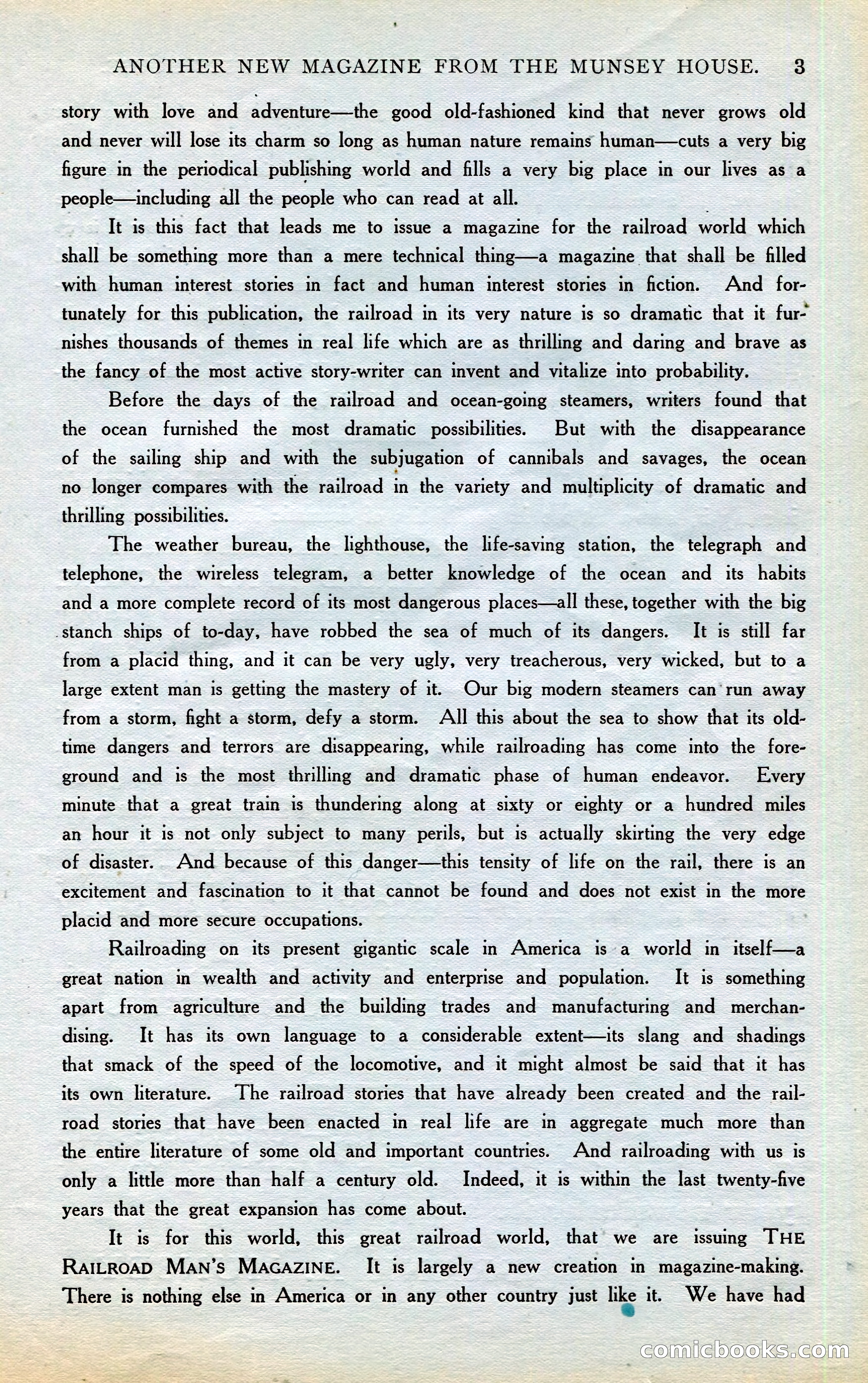
A restored page from Pulp Fiction, 1906. Page through the whole issue in the reader above.
📄 Transcribed text from this page (OCR, searchable)
Machine-transcribed from the original scan — historical spelling and the odd misread are preserved.
ANOTHER NEW MAGAZINE FROM THE MUNSEY HOUSE. 3 story with love and adventure—the good old-fashioned kind that never grows old and never will lose its charm so long as human nature remains human—cuts a very big figure in the periodical publishing world and fills a very big place in our lives as a people—including all the people who can read at all. It is this fact that leads me to issue a magazine for the railroad world which shall be something more than a mere technical thing—a magazine that shall be filled with human interest stories in fact and human interest stories in fiction. And for- tunately for this publication, the railroad in its very nature is so dramatic that it fur- nishes thousands of themes in real life which are as thrilling and daring and brave as the fancy of the most active story-writer can invent and vitalize into probability. Before the days of the railroad and ocean-going steamers, writers found that the ocean furnished the most dramatic possibilities. But with the disappearance of the sailing ship and with the subjugation of cannibals and savages, the ocean no longer compares with the railroad in the variety and multiplicity of dramatic and thrilling possibilities. The weather bureau, the lighthouse, the life-saving station, the telegraph and telephone, the wireless telegram, a better knowledge of the ocean and its habits and a more complete record of its most dangerous places—all these, together with the big -stanch ships of to-day, have robbed the sea of much of its dangers. It is still far from a placid thing, and it can be very ugly, very treacherous, very wicked, but to a large extent man is getting the mastery of it. Our big modern steamers can'run away from a storm, fight a storm, defy a storm. All this about the sea to show that its old- time dangers and terrors are disappearing, while railroading has come into the fore- ground and is the most thrilling and dramatic phase of human endeavor. Every minute that a great train 1s thundering along at sixty or eighty or a hundred miles an hour it is not only subject to many perils, but is actually skirting the very edge of disaster. And because of this danger—this tensity of life on the rail, there is an excitement and fascination to it that cannot be found and does not exist in the more placid and more secure occupations. Railroading on its present gigantic scale in America is a world in itself—a great nation in wealth and activity and enterprise and population. It is something apart from agriculture and the building trades and manufacturing and merchan- dising. It has its own language to a considerable extent—its slang and shadings that smack of the speed of the locomotive, and it might almost be said that it has its own literature. The railroad stories that have already been created and the rail- road stories that have been enacted in real life are in aggregate much more than the entire literature of some old and important countries. And railroading with us is only a little more than half a century old. Indeed, it is within the last twenty-five years that the great expansion has come about. It is for this world, this great railroad world, that we are issuing THE RAILROAD MAN’s MAGAZINE. It is largely a new creation in magazine-making. There is nothing else in America or in any other country just like it. We have had oO GOmMmIchooks.co